
Atmospheric Moisture Practice Test
$69.00
- Buy to unlock unlimited access to all Quiz questions and Answers in this Quiz.
- After purchase you can print a PDF of the whole quiz at any point. The PDF will contain the questions and the correct answers.
About this Exam
Welcome to your study guide for the Atmospheric Moisture Practice Test! Atmospheric moisture is a critical component of meteorology and environmental science, influencing everything from daily weather patterns to global climate. Mastering this subject is essential for anyone pursuing careers in weather forecasting, aviation, agriculture, climate science, and resource management. This practice exam is designed to help you gauge your understanding of fundamental concepts such as humidity, dew point, cloud formation, and precipitation, ensuring you are prepared for advanced studies or relevant certifications in these fields.
Ready to test your knowledge?
Buy Now to Access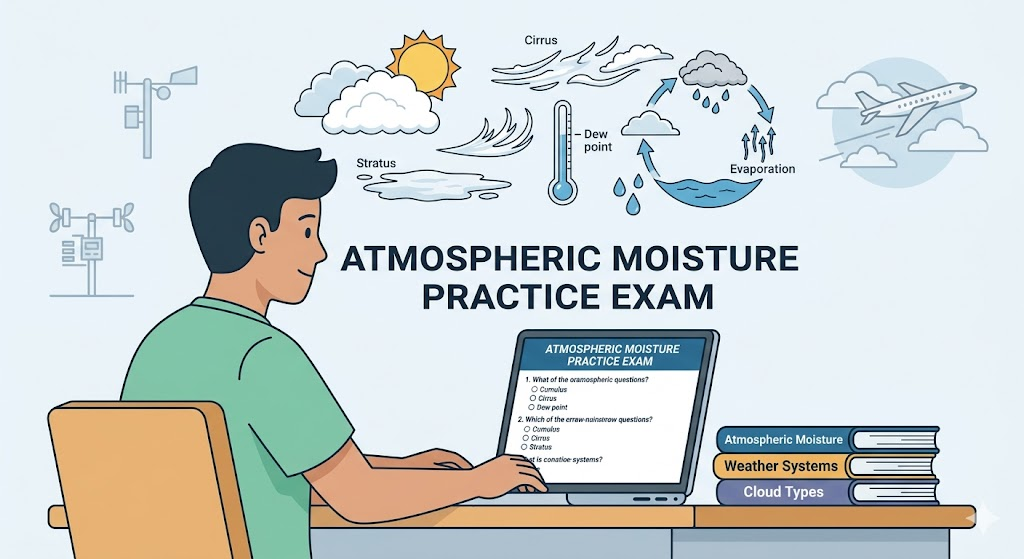
Additional Information
What the Course Entails and Exam Details
The material covered in preparation for the Atmospheric Moisture Practice Test typically involves a deep dive into the properties of water vapor in the atmosphere and its effects on weather. Core topics include:
Humidity Fundamentals: Definitions and calculations for relative humidity, absolute humidity, and specific humidity. Understanding the relationship between temperature and water vapor capacity.
Dew Point: The concept of dew point temperature, its practical significance in forecasting, and how it is measured.
States of Water: Understanding the physical processes and energy transfers (latent heat) involved in evaporation, condensation, freezing, melting, sublimation, and deposition.
Atmospheric Stability: How moisture affects air parcels, stable and unstable air, and the environmental lapse rate.
Adiabatic Processes: Understanding dry and moist adiabatic lapse rates and their role in air mass movement and cloud development.
Cloud Formation: Identifying various cloud types (cirrus, cumulus, stratus, etc.), the conditions required for their development, and the classification systems used.
Precipitation Types and Processes: Explaining how precipitation forms, including the Bergeron process and the collision-coalescence process. Distinguishing between rain, snow, sleet, and hail.
Measurement and Instruments: How to use and interpret data from devices like psychrometers, hygrometers, and rain gauges.
Global Water Cycle: The continuous movement of water on, above, and below the Earth's surface and the role of the atmosphere within this cycle.
What to Expect in the Final Exam
While this guide focuses on a practice test, understanding the format of typical comprehensive exams in this subject area is beneficial. You can expect a structure similar to the following:
Exam Format: Most exams are predominantly multiple-choice questions, with some true/false questions or matching exercises. Practical questions that require you to interpret weather maps, satellite imagery, or perform calculations related to humidity and adiabatic processes may also be included.
Time Limit: Expect a timed test, often ranging from 60 to 120 minutes, depending on the number of questions and the institution providing the assessment.
Passing Score: The passing score is often set between 70% and 80%, although this can vary significantly between different courses or institutions.
Rules: Depending on the platform, exams may be proctored online or require you to take them in a supervised testing environment. The use of calculators for humidity equations might be permitted.
How to Study and Exam Centers
Effectively preparing for your Atmospheric Moisture Practice Test, and ultimately the comprehensive exam, requires a strategic approach. Here are actionable study strategies:
Leverage Practice Tests: Taking multiple practice tests, like the Atmospheric Moisture Practice Test, is one of the best ways to build stamina and identify your strengths and weaknesses. Aim to understand why the correct answers are correct and why the distractors are wrong.
Master the Terms and Concepts: Create flashcards for key terms, definitions, and equations. Ensure you can confidently explain the difference between relative humidity and absolute humidity, and understand the practical implications of dew point.
Visualize the Processes: Use diagrams and videos to help you understand cloud formation, the types of precipitation, and the global water cycle. Draw your own diagrams of the different types of lapse rates.
Work Through Calculations: Practice problems involving humidity calculations and adiabatic lapse rates until the formulas and methods feel natural.
Form a Study Group: Collaborating with others can help you understand challenging concepts from different perspectives.
Regarding Exam Centers:
The Atmospheric Moisture Practice Test is typically available through online educational portals, learning management systems, or as part of a meteorology or Earth science textbook's resources. These are designed for self-assessment and can be accessed from any device with an internet connection.
For larger, formal exams, procedures will vary. Many are administered through university testing centers or specialized online platforms that may use remote proctoring. Always confirm the specific testing details with your course provider.
Job Opportunities from the Course
Gaining mastery over atmospheric moisture concepts opens up numerous career paths across various sectors. The knowledge you build for this test is essential for roles such as:
Weather Observer: Collecting and interpreting data on current weather conditions, including humidity and cloud cover.
Meteorological Technician: Supporting research and forecasting efforts by maintaining instruments and analyzing atmospheric data.
Aviation Support Staff: Assisting pilots and air traffic controllers by providing crucial weather information relevant to safe flight operations.
Hydrology Technician: Monitoring water resources and analyzing the atmospheric factors that influence rainfall and runoff.
Agriculture and Forest Management: Using knowledge of weather and moisture to optimize farming practices, manage irrigation, and assess wildfire risk.
Environmental Consultant: Analyzing atmospheric data for environmental impact studies and climate change assessments.
Air Quality Monitor: Understanding how humidity and other atmospheric conditions affect air pollution dispersion.
Natural Resource Manager: Incorporating weather and climate data into the sustainable management of forests, water bodies, and other resources.
Good luck with your studies and your Atmospheric Moisture Practice Test! With dedication and focused preparation, you can confidently build the knowledge and skills necessary to succeed in this dynamic field.
Frequently Asked Questions
Reviews
5.0
Based on 0 reviews
Leave a Review
No reviews yet. Be the first to review!