
Atomic Theory Chem (DH) Practice Test
$69.00
- Buy to unlock unlimited access to all Quiz questions and Answers in this Quiz.
- After purchase you can print a PDF of the whole quiz at any point. The PDF will contain the questions and the correct answers.
About this Exam
The Atomic Theory Chem (DH) Practice Exam is a comprehensive study resource designed for students preparing for a challenging high school or early college-level chemistry exam on atomic theory. Whether you are aiming to solidify your understanding of fundamental atomic concepts or are looking for a rigorous practice tool, this test is tailored for individuals seeking mastery in this core area of chemistry.
It provides a focused assessment of the key principles and calculations that underpin our understanding of matter. This practice exam is an essential step for students who want to excel in their coursework and perform with confidence on their final evaluation. It is structured to help you identify your strengths and weaknesses in atomic theory, ensuring you are thoroughly prepared.
Ready to test your knowledge?
Buy Now to Access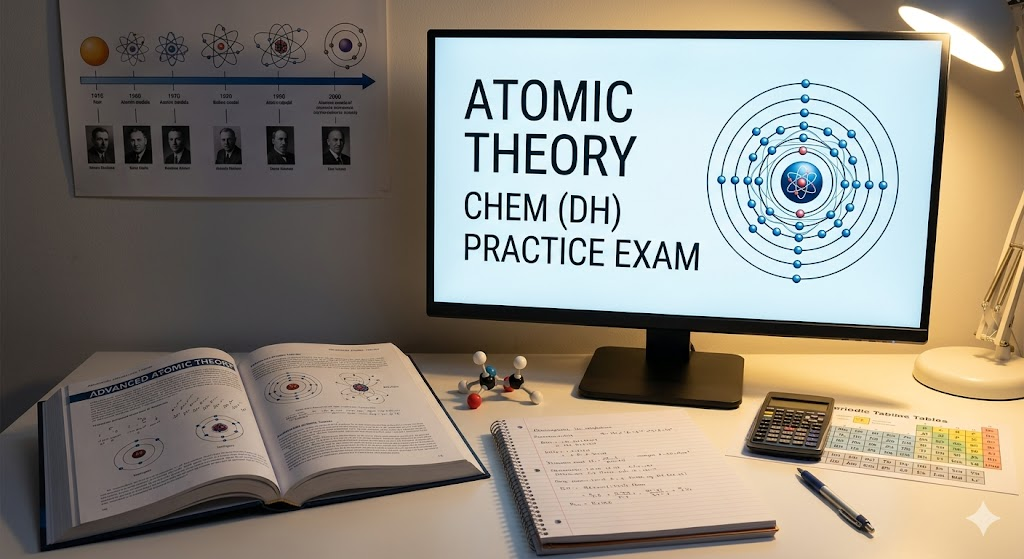
Additional Information
What the Course Entails and Exam Details
This course typically covers the foundational concepts of the structure of the atom and the behavior of subatomic particles. Students must dive deep into topics such as the development of atomic theory from ancient philosophy to modern quantum mechanics. Key areas include identifying different isotope notation, calculating average atomic mass, and understanding the concept of ions.
The syllabus covers:
Atomic Structure: The nature and properties of protons, neutrons, and electrons. Understanding atomic number, mass number, and the organization of particles in the atom.
Isotopes and Atomic Mass: Defining isotopes, understanding isotopic abundant data, and calculating the weighted average atomic mass of an element.
Early Atomic Models: From Dalton’s postulates to Thomson’s 'plum pudding' model and Rutherford’s nuclear model, students trace the experiments that shaped our early understanding of the atom.
The Bohr Model and Modern Quantum Mechanics: Understanding the limitations of the Bohr model and exploring the fundamentals of the quantum mechanical model, including orbitals, energy levels, and electron configurations.
Quantum Numbers and Electron Configurations: Learning to assign quantum numbers, write electron configurations, and draw orbital diagrams according to the Pauli exclusion principle, Aufbau principle, and Hund’s rule.
Periodic Table Trends: Examining trends such as atomic radius, ionization energy, and electronegativity, and explaining them based on atomic structure and effective nuclear charge.
What to Expect in the Final Exam
While the format of the actual final exam for a course like this varies, this practice exam is designed to mirror typical assessment styles. Students can expect to encounter:
A balanced mix of multiple-choice questions. These questions test a wide range of knowledge, from fundamental definitions to complex problem-solving.
Calculations. Expect questions requiring calculations of average atomic mass, identifying numbers of subatomic particles, determining charges of ions, and converting between different units if applicable to atomic theory problems.
Conceptual Understanding. The exam will assess your ability to explain concepts, compare different atomic models, and predict trends in the periodic table.
Time Limit. The actual exam is likely to have a specified time limit, often around 60 to 90 minutes. Practice managing your time effectively.
Passing Score. While the exact passing score is determined by your institution, a common threshold is 70% or higher. Utilize this practice test to gauge your readiness.
Instructions and Materials. Always carefully read the final exam instructions. Be prepared for any restrictions on the use of calculators, periodic tables, and formula sheets.
How to Study and Exam Centers
Preparation for this exam requires consistent and focused study. Follow these strategies:
Review Class Materials Thoroughly. Revisit your textbook chapters, class notes, and handouts focused on atomic theory. Pay close attention to definitions, formulas, and diagrams.
Practice with Multiple Resources. Do not rely solely on one source. Use multiple-choice questions from textbooks, online resources, and past class assignments to diversify your practice.
Utilize This Practice Exam. Work through this practice test under timed conditions to simulate the real exam environment. Analyze your mistakes and review the relevant concepts for any questions you answer incorrectly.
Focus on Key Calculations. Practice atomic mass calculations, identifying subatomic particles in atoms and ions, and writing electron configurations until you can complete them accurately and efficiently.
Understand the 'Why' Behind the Concepts. Don't just memorize information; understand the underlying principles of atomic theory. This will help you answer conceptual and application-based questions.
Study Groups. Form a study group to discuss challenging concepts and solve problems together. Teaching a concept to someone else is a powerful way to reinforce your own understanding.
Seek Help Early. If you are struggling with a particular concept, do not wait. Ask your teacher, a tutor, or a classmate for assistance as soon as possible.
Exam Locations. Where and how you take the final exam will depend on your specific course. For school-based courses, exams are typically held in the designated classroom or school testing center. Check with your instructor for the exact date, time, and location. For online courses or those requiring standardized testing, the final exam may be administered through authorized physical testing centers (like Pearson VUE) or proctored online portals.
Job Opportunities from the Course
A strong foundation in atomic theory is essential for many rewarding careers in science and technology. Completing coursework in this area opens doors to:
Chemical Technician: Assisting chemists and chemical engineers in research and development, quality control, or production.
Laboratory Assistant: Performing varied laboratory tasks to support research and analytical procedures in academic, industrial, or clinical settings.
Quality Control Analyst: Testing products and materials in industries like pharmaceuticals, food and beverage, or manufacturing to ensure they meet quality and safety standards.
Research Assistant (Chem-related fields): Contributing to scientific research projects in disciplines such as materials science, biochemistry, or environmental chemistry.
Science Teacher (High School): Educating the next generation of scientists (requires additional teaching certification).
Advanced Studies: Foundation for degrees and careers in medicine, pharmacy, chemical engineering, materials science, biochemistry, and many other STEM fields. A solid grasp of chemistry at this level is crucial for success in these competitive programs.
Frequently Asked Questions
Reviews
5.0
Based on 0 reviews
Leave a Review
No reviews yet. Be the first to review!