
Atrial Fibrillation Practice Test
$69.00
- Buy to unlock unlimited access to all Quiz questions and Answers in this Quiz.
- After purchase you can print a PDF of the whole quiz at any point. The PDF will contain the questions and the correct answers.
About this Exam
The Atrial Fibrillation Practice Test is an essential preparatory tool designed for medical professionals and students seeking to solidify their knowledge of one of the most common cardiac arrhythmias. Atrial Fibrillation (AFib) is a leading cause of stroke and heart failure, making its accurate diagnosis and effective management critical across various clinical settings. This practice exam is expertly crafted to simulate the experience of a final comprehensive exam, providing high-quality questions that mirror the structure and content of certifications such as ACLS, PCCN, CCRN, or specific rhythm analysis exams. It is primarily designed for registered nurses, paramedics, emergency medical technicians (EMTs), cardiovascular technicians, medical assistants, and nursing or medical students who must demonstrate cardiac competency. By completing this practice test, candidates can build the necessary confidence to excel in their official certifications and, ultimately, in real-world patient care.
Ready to test your knowledge?
Buy Now to Access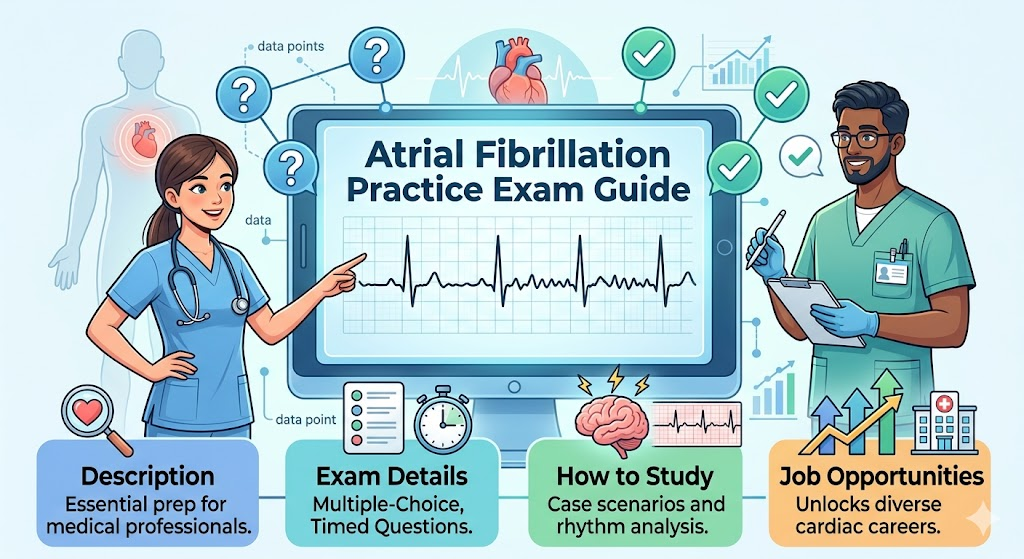
Additional Information
What the Course Entails and Exam Details
This practice guide is structured to help you master the key domains of Atrial Fibrillation care. It ensures you have a thorough understanding of the pathophysiology, identification, and evidence-based treatment strategies.
Pathophysiology of Atrial Fibrillation: Understanding the underlying mechanical and electrical issues, distinguishing it from atrial flutter and sinus rhythm.
Risk Factors and Causes: Knowing the modifiable and non-modifiable factors that increase AFib risk, including hypertension, age, and existing heart disease.
Classification: Differentiating between paroxysmal, persistent, and permanent (chronic) Atrial Fibrillation.
Clinical Presentation and Complications: Recognizing standard symptoms (palpitations, fatigue, shortness of breath) and understanding the catastrophic risks, most notably ischemic stroke and heart failure.
Diagnostic Methods: Reviewing 12-lead ECG/EKG criteria (specifically the absence of P-waves and an irregularly irregular R-R interval) and understanding when to use telemetry or Holter monitoring.
Management Strategies (The "Three Pillars"):
Rate Control: Mastering medications and protocols used to control ventricular rate (e.g., beta-blockers, calcium channel blockers).
Rhythm Control: Understanding electrical cardioversion, chemical cardioversion, and catheter ablation.
Anticoagulation: Applying stroke risk assessment tools like the CHA₂DS₂-VASc score and identifying common anticoagulants (e.g., Warfarin, DOACs).
What to Expect in the Final Exam
While this is a practice test, it is designed to prepare you for the rigor of an official certification final exam. When taking a standard final certification, you can generally expect the following format:
Exam Format: The majority of comprehensive AFib-related questions are presented in a Multiple-Choice Question (MCQ) format. This requires you to identify the single best answer among several plausible distractors. You may also encounter select-all-that-apply questions or scenarios that ask you to prioritize actions.
Time Limit: Official certification exams are always timed. You must develop both accuracy and efficiency. A typical session might allow roughly 60-90 seconds per question, emphasizing the need for quick recognition.
Passing Score: Requirements vary by the specific certification (ACLS vs. a specialized rhythm exam), but a passing score often ranges between 70% and 80%.
Rules and Proctors: Final exams are usually "closed book" and proctored, whether taken online (with remote monitoring) or in-person.
This practice test mirrors these challenges by timing your session and providing a mix of easy, moderate, and difficult questions to test your depth of knowledge and clinical judgment.
How to Study and Exam Centers
Preparation is the key to success. Your study plan should be comprehensive and use a variety of active learning methods.
Rhythm Strip Practice: Dedicate significant time to reviewing ECG strips. You must be able to spot Atrial Fibrillation and differentiate it from similar arrhythmias (like Multifocal Atrial Tachycardia or Atrial Flutter with variable block) instantly.
Active Recall with Case Studies: Use clinical scenarios to practice applying protocols. For example, "A patient presents with new-onset AFib and a CHA₂DS₂-VASc score of 4. What is the priority intervention?"
Algorithm Review: Memorize current medical guidelines and treatment algorithms for both stable and unstable AFib.
Identify Your Gaps: After taking this practice test, carefully review every question you answered incorrectly. Understand why the correct answer is correct and why your initial choice was wrong. Do not just memorize answers; understand the concept.
Taking the Exam:
Practice Exams: This practice test can be accessed through your provided online learning portal. You may take it multiple times to track your progress and improve your speed.
Official Final Certification: The formal final exam is usually administered through recognized testing providers. Depending on the exact certification (ACLS, PCCN, etc.), you may take it at:
Authorized third-party testing centers, such as Pearson VUE, which have locations nationwide.
Authorized training centers, hospitals, or nursing schools that are approved to administer specific clinical certifications.
In many cases, online proctored options are now available, allowing you to take the exam from a quiet, secure room at your home or office.
Job Opportunities from the Course
A strong mastery of Atrial Fibrillation knowledge, as demonstrated by passing this practice test and earning a related certification, is a prerequisite or significant advantage for numerous healthcare roles. This skill set is required across multiple departments.
Specific career paths and job titles include:
Registered Nurse (RN) – Critical Care/ICU/CCU
Registered Nurse (RN) – Telemetry/Progressive Care
Registered Nurse (RN) – Emergency Department (ED)
Telemetry Technician / Monitor Technician
Cardiovascular Technician / EKG Technician
Cardiac Cath Lab Nurse/Technician
Paramedic / Advanced EMT
Clinical Nurse Specialist (CNS) or Nurse Practitioner (NP)
This knowledge is a foundation for advancement in any cardiac-focused healthcare environment.
Frequently Asked Questions
Reviews
5.0
Based on 0 reviews
Leave a Review
No reviews yet. Be the first to review!