
Australia CASA Instrument Proficiency Practice Exam
$69.00
- Buy to unlock unlimited access to all Quiz questions and Answers in this Quiz.
- After purchase you can print a PDF of the whole quiz at any point. The PDF will contain the questions and the correct answers.
About this Exam
The Instrument Proficiency Check (IPC) is a mandatory requirement for Australian pilots who hold an Instrument Rating (IR) and wish to continue flying in Instrument Meteorological Conditions (IMC). This check is not an initial rating but a recurrent assessment designed to ensure a pilot maintains the high level of competency required to safely operate aircraft purely by reference to instruments. It validates that your knowledge and flying skills are current and compliant with Australian Civil Aviation Safety Authority (CASA) regulations. The IPC is designed for all pilots, from commercial aviators to serious private pilots, who require the operational flexibility provided by an Instrument Rating.
Ready to test your knowledge?
Buy Now to Access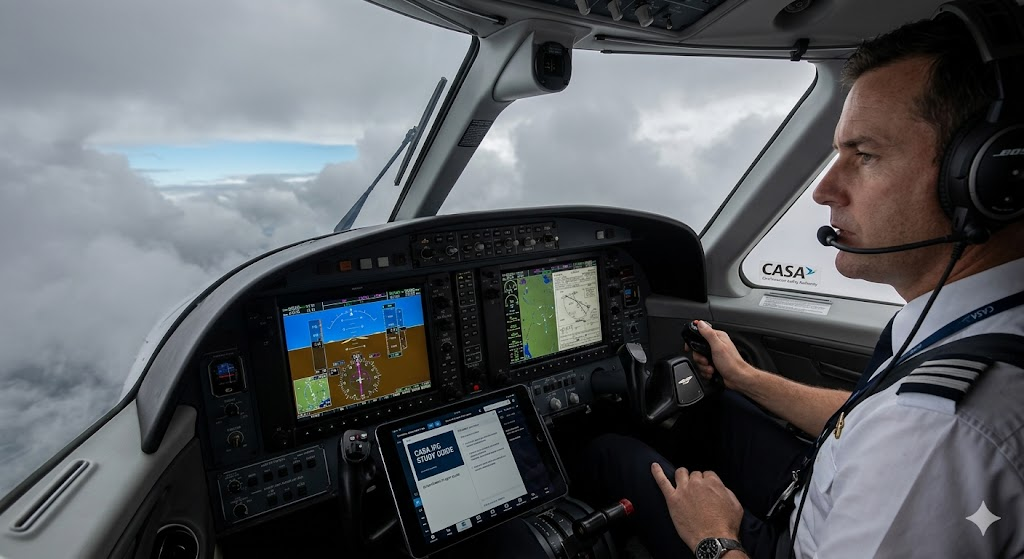
Additional Information
What the Course Entails and Exam Details
To prepare for the Instrument Proficiency Check, a pilot must revise a comprehensive set of theoretical knowledge and practical skills. The preparation course entails a thorough review of Instrument Flight Rules (IFR), including deep knowledge of the Aeronautical Information Publication (AIP) and Civil Aviation Safety Regulations (CASR). Pilots must review the operational procedures for all phases of instrument flight, from departure to arrival and holding patterns. A critical component involves demonstrating knowledge of navigational aids (such as VOR, NDB, and GNSS) and assessing proficiency in handling abnormal and emergency situations while operating under IFR. The syllabus requires a detailed understanding of meteorology, specifically concerning icing, thunderstorms, and low-visibility operations. Mastering the preparation materials ensures you possess the required knowledge retention to meet the proficiency standard during the final assessment.
What to Expect in the Final Exam
While "practice exams" focus on preparing you theoretically, the actual CASA Instrument Proficiency Check is not a standardized written test taken in an exam hall. Instead, the final "exam" is a comprehensive practical flight assessment conducted either in an aircraft or a CASA-approved high-fidelity flight simulator. Before the flight begins, there is a substantial ground briefing and oral examination. A CASA-authorized Flight Examiner will question you extensively on IFR regulations, flight planning, weather interpretation, and aircraft systems. To "pass," you must demonstrate competency in all mandatory flight sequences throughout the entire flight check. There is no percentage passing score; rather, you are graded as either "proficient" or "not proficient." The flight examiner assesses your ability to maintain flight tolerances and make sound operational decisions throughout the check. Failure on any critical safety item results in a non-proficient outcome.
How to Study and Exam Centers
Effective study involves combining theoretical review with practical application. Utilize high-quality CASA Instrument Proficiency Practice Exams online to test your regulatory and procedural knowledge. These mock exams are an excellent way to identify gaps in your understanding before the actual check. Dedicate significant time to reviewing the AIP, relevant CAO/CASR parts, and your aircraft's specific Avionics Flight Manual Supplement. Mentally visualize approaches ("chair flying") and, if possible, practice sequences in a simulator environment. To take the final IPC, you do not book a session at a standardized testing center like Pearson VUE. Instead, the IPC is arranged directly through an approved Part 141 or 142 flight training organization or by contacting a CASA-authorized Flight Examiner directly. They will conduct the assessment using their facilities or aircraft, validating your proficiency within the actual operational environment.
Job Opportunities from the Course
Maintaining your Instrument Proficiency is essential for nearly every professional piloting role in Australia. Keeping this qualification current unlocks numerous critical career paths, including:
Airline Pilot (Domestic and International)
Charter Pilot (Corporate and Business Aviation)
Aerial Work Pilot (e.g., Aerial Surveying or Firefighting)
Flight Instructor (with Instrument Rating Instructor endorsement)
Air Ambulance/Medical Retrieval Pilot
Cargo and Logistics Pilot
Military Pilot (transitioning to civil operations)
Maintaining an active Instrument Rating through regular proficiency checks is not just a regulatory hurdle; it is the cornerstone of professional currency and operational safety for any IFR pilot.
Frequently Asked Questions
Reviews
5.0
Based on 0 reviews
Leave a Review
No reviews yet. Be the first to review!