
Australia Geography Practice Test
$69.00
- Buy to unlock unlimited access to all Quiz questions and Answers in this Quiz.
- After purchase you can print a PDF of the whole quiz at any point. The PDF will contain the questions and the correct answers.
About this Exam
Welcome to the definitive study resource for the Australia Geography Practice Exam! This comprehensive practice assessment is expertly designed for students, educators, and anyone seeking to validate their deep understanding of the diverse physical and human landscapes of the Australian continent. Whether you are preparing for a high school geography final, a university-level entrance requirement, or simply want to test your knowledge of this unique land, this practice exam offers a perfect benchmark.
It is tailored for individuals who need an engaging, accurate way to identify their strengths and weaknesses in key geographical domains. By taking this test, you are not just memorizing facts; you are developing a holistic view of Australia’s environmental challenges, urban planning, and demographic shifts.
Ready to test your knowledge?
Buy Now to Access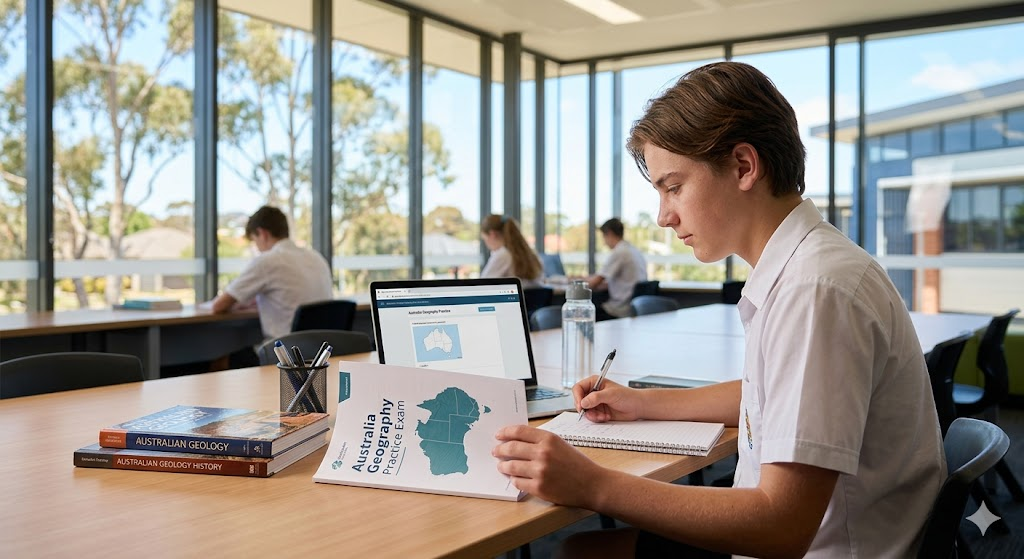
Additional Information
What the Course Entails and Exam Details
This practice exam is a reflection of a robust curriculum covering essential Australian geographical principles. Candidates preparing for the test must master diverse topics including:
Physical Geography: Mastery of major landforms like the Great Dividing Range, the Outback, and the Great Barrier Reef; detailed knowledge of climatic zones and weather patterns, including the impacts of El Niño; understanding Australia’s unique flora, fauna, and environmental ecosystems.
Human Geography: Deep insights into Australia's population distribution, urban development patterns, and demographics; understanding the relationship between the built environment and natural spaces.
Cultural and Indigenous Geography: Understanding the deep connection of Aboriginal and Torres Strait Islander peoples to the land (Country), including traditional land management and native title concepts.
Economic and Resource Geography: Analyzing Australia's key industries, including mining, agriculture, and tourism, and how they utilize natural resources; investigating current environmental sustainability challenges.
What to Expect in the Final Exam
The actual exam is often structured to test both breadth and depth. When you arrive at the testing center, or log into the official online portal, you should expect:
Exam Format: The test primary consists of a significant number of multiple-choice questions, supplemented by several short-answer questions. Some sections may require map identification, diagram analysis, or interpretation of geographical data sets.
Passing Score Requirements: A minimum score of 70% is typically required to pass the formal certification exam. It is vital to use this practice test to consistently exceed that mark.
Time Limits: Candidates are generally given 120 minutes (2 hours) to complete the exam, demanding strong time-management skills during the assessment.
Specific Rules: This is typically a closed-book exam. No external materials, notes, or digital devices (other than those required to take the test) are allowed during the session. Map booklets are sometimes provided.
How to Study and Exam Centers
Effective preparation requires a combination of structured study and active practice. We recommend implementing the following actionable strategies:
Use High-Quality Study Guides: Utilize this article and official curriculum guides to focus your efforts. Supplement these with high school or university geography textbooks.
Take Multiple Practice Exams: This practice test is an invaluable tool. Take it under timed conditions to simulate the real environment. Analyze your mistakes to focus your subsequent study sessions on your weakest areas.
Master Map Skills: Regularly review physical, political, and thematic maps of Australia. Practice identifying every state, capital city, major river, and prominent natural feature quickly and accurately.
Create Visual Aids: Use flashcards for key terms, climatic zones, and historical geographical data. Draw and label your own maps of ecosystems or resource distribution.
Where to Take the Exam
The actual exam is administered through several channels, depending on your location and the certifying body:
Authorized Schools and Universities: Most students take the exam directly through their educational institution as part of their enrolled curriculum.
Online Portals: Many certifications use secure online testing platforms, requiring a reliable internet connection and a webcam for proctoring.
Professional Testing Centers: Specialized centers, similar to Pearson VUE or Prometric facilities, may be used for certain independent geographic certifications. Always check your specific registration information for exact location details.
Job Opportunities from the Course
Mastery of Australian geography opens several distinct career paths, especially when combined with relevant degrees or experience:
Urban and Regional Planner: Designing sustainable and efficient urban areas.
Environmental Consultant: Assessing ecological impact and managing natural resources.
Secondary Geography Teacher: Educating the next generation on Australian and global geography.
GIS Analyst: Using Geographic Information Systems to map and analyze data for logistics, mining, or government.
Conservation Officer: Managing and protecting national parks and wildlife.
Tourism Manager: developing geography-based tourism products and experiences.
Climatologist: Researching weather patterns and long-term climate change effects.
Frequently Asked Questions
Reviews
5.0
Based on 0 reviews
Leave a Review
No reviews yet. Be the first to review!