
Australian Year 10 Biology Practice Test
$69.00
- Buy to unlock unlimited access to all Quiz questions and Answers in this Quiz.
- After purchase you can print a PDF of the whole quiz at any point. The PDF will contain the questions and the correct answers.
About this Exam
The Australian Year 10 Biology course serves as a critical bridge between junior science and senior specialized biology studies. It provides foundational knowledge required for success in Years 11 and 12 biology or environmental science programs across Australian states.
This comprehensive study guide and the associated practice test are designed specifically for Australian Year 10 students. It is ideal for learners aiming to consolidate their knowledge before a final internal school exam or preparing for subject selection in their senior years. Whether you need a refresher or a primary study tool, this resource ensures you are ready for the test.
Ready to test your knowledge?
Buy Now to Access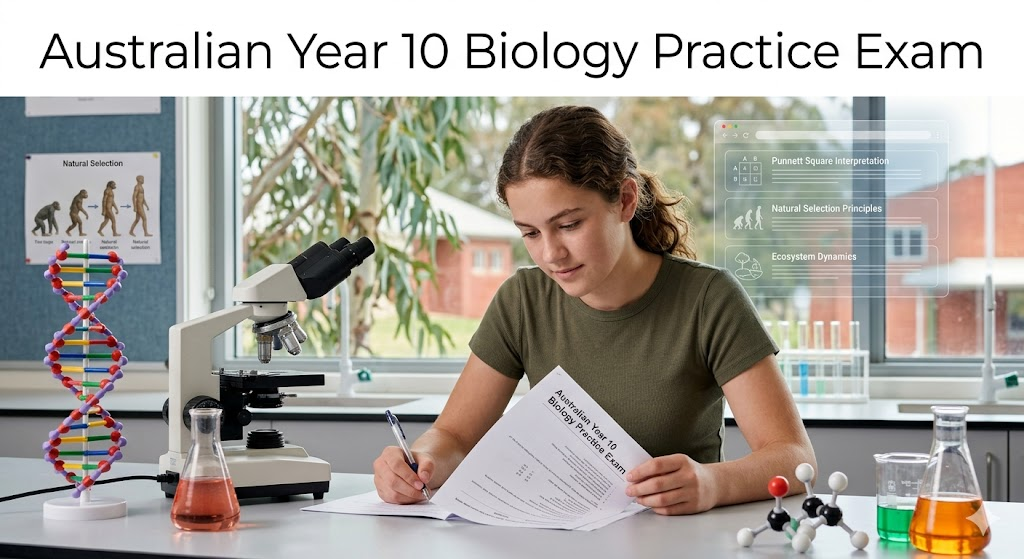
Additional Information
What the Course Entails and Exam Details
Year 10 Biology in Australia, largely guided by the Australian Curriculum (ACARA), focuses on understanding the patterns, structures, and systems of living things and how they evolve. The core syllabus and therefore the practice exam typically cover four primary domains:
Genetics and Inheritance: Understanding DNA, genes, chromosomes, and inheritance patterns (like dominant/recessive traits) using Punnett squares.
Evolution: Exploring the theory of evolution by natural selection and the evidence supporting it (like the fossil record).
Ecology: Investigating ecosystems, biotic and abiotic factors, the flow of energy and matter, and the impact of human activity on ecosystems.
Cell Biology (Systems): While often introduced earlier, Year 10 may reinforce cell structures or focus on how organisms maintain a stable internal environment (homeostasis).
A standard practice exam will include a variety of questions testing both factual recall and the application of biological concepts.
What to Expect in the Final Exam
Since Year 10 is generally administered internally by schools, the exact format can vary slightly between institutions. However, a standard Australian Year 10 final biology exam, and our accompanying practice test, usually adheres to a recognizable structure.
Exam Format: The test will commonly consist of a mixture of multiple-choice questions, which assess quick recall, and short-answer questions requiring explanations of biological concepts, diagram labelling, or data analysis.
Data and Diagrams: You should expect to interpret diagrams (such as food webs, cell structures, or pedigrees) or analyze simple data sets.
Time Limits: A typical school exam might run from 60 to 90 minutes.
Passing Score: While schools may have different internal benchmarks, a score of 50% is generally required to pass. A higher score is usually recommended for students looking to enroll in VCE, HSC, SACE, or QCE Senior Biology courses.
How to Study and Exam Centers
Effectively preparing for this test requires active study techniques rather than passive reading. We recommend creating summary notes or flashcards for key biological terms, such as "natural selection," "genotype," "allele," and "ecosystem."
Practice creating and interpreting Punnett squares and pedigrees until they become routine. Additionally, drawing and labelling key biological diagrams, like the structure of DNA or a simple ecosystem pyramid, helps solidify knowledge.
Since this assessment is school-based, the final "exam center" is your own high school classroom, managed by your science teacher according to the school's specific exam timetable. However, students looking to prepare online can access various portals or tutoring sites that offer practice tests, simulation questions, and interactive learning modules.
Our [Australian Year 10 Biology Practice Test] is one such comprehensive online resource designed to test your knowledge in a timed environment similar to the actual exam.
Job Opportunities from the Course
Achieving success in Year 10 Biology does not provide immediate job certification. However, it is a foundational prerequisite for senior biology courses, which are essential stepping stones to a wide array of prestigious and fulfilling careers in Australia.
Excelling in this course puts you on a pathway to the following job opportunities and career fields:
Doctor or Surgeon
Registered Nurse
Veterinarian
Marine Biologist
Ecologist or Environmental Scientist
Pharmacist
Forensic Scientist
Biomedical Engineer
Lab Technician
Zoo Keeper or Wildlife Conservationist
Agricultural Scientist
Frequently Asked Questions
Reviews
5.0
Based on 0 reviews
Leave a Review
No reviews yet. Be the first to review!