
Authorities (EJPME‑US002‑23) Practice Test
$69.00
- Buy to unlock unlimited access to all Quiz questions and Answers in this Quiz.
- After purchase you can print a PDF of the whole quiz at any point. The PDF will contain the questions and the correct answers.
About this Exam
The Authorities (EJPME-US002-23) module is a vital educational component within the broader Enlisted Joint Professional Military Education program. This certification is specifically designed to prepare intermediate and senior Non-Commissioned Officers and Petty Officers (E6 through E9) to operate effectively in a Joint environment. It bridges Service-specific doctrinal knowledge with the complex operational and legal frameworks necessary for success within Combatant Commands and Joint Task Forces. The primary goal of this course is to develop enlisted leaders who are not only technically proficient but also possess a deep understanding of the organizational relationships and authorities that govern the U.S. military.
Ready to test your knowledge?
Buy Now to Access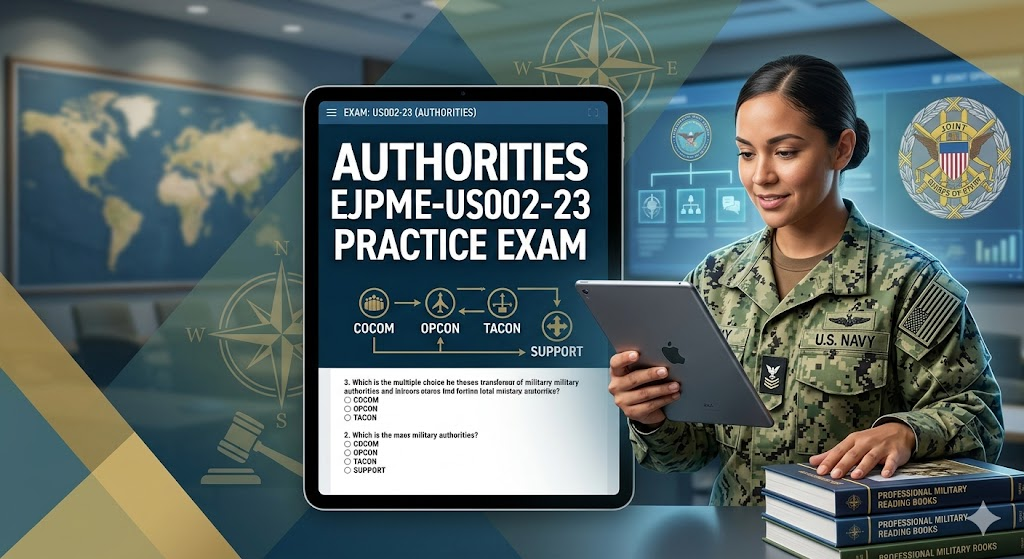
Additional Information
What the Course Entails and Exam Details
The core curriculum of this module focuses intensely on the legal foundations and organizational structures of the Department of Defense. Students will engage with a syllabus that covers the hierarchy of command, starting with the U.S. Constitution and statutory authorities like Title 10 of the U.S. Code. A significant portion of the course is dedicated to defining and distinguishing critical operational command relationships. You will deep-dive into the specific nuances and limitations of Combatant Command (COCOM), Operational Control (OPCON), Tactical Control (TACON), and Support relationships. The exam demands that candidates demonstrate an understanding of how these authorities are delegated down through the chain of command during both peace and war.
What to Expect in the Final Exam
Candidates should prepare for a thorough, computer-based assessment consisting primarily of multiple-choice questions. The final exam is designed to test scenario-based application rather than simple memorization of definitions. You will be expected to read a situational operational scenario and determine which command relationship or specific authority applies to the Service Members involved. Students typically must achieve a minimum passing score of 80% to receive credit for the module. It is generally a timed test, often allowing 60 minutes for completion. Candidates must adhere strictly to all academic integrity rules enforced by the Joint Knowledge Online portal, as this exam is closed-book.
How to Study and Exam Centers
The most actionable study strategy is to balance the review of core curriculum slides with simulation. We highly recommend utilizing reputable Authorities (EJPME-US002-23) Practice Tests repeatedly before attempting the final exam. Practice tests help you internalize the specific phrasing and logical traps used in the scenario-based questions. Additionally, create flashcards for the legal definitions and limitations of OPCON versus TACON. Because this is a Department of Defense-sponsored professional development course, you do not take the exam at a physical center like Pearson VUE. This exam is hosted entirely on the Joint Knowledge Online (JKO) learning management system. Candidates must have an active JKO account and require Common Access Card (CAC) authentication to access the material and take the final assessment.
Job Opportunities from the Course
Successfully completing this certification signals to leadership that you are ready for advanced joint responsibilities. This module is essential for career progression and competitive assignment to joint billets. It prepares enlisted leaders for critical roles such as Joint Operations Center (JOC) Non-Commissioned Officer in Charge (NCOIC), or assignment as a Senior Enlisted Advisor (SEA) within a specific J-Directorate (e.g., J-3 Operations or J-5 Plans). The knowledge gained is also paramount for Service Members slated to serve in Joint Task Forces, Combatant Commands, or as Liaisons to multinational commands and interagency partners, where understanding legal operating authorities is necessary for mission success.
Frequently Asked Questions
Reviews
5.0
Based on 0 reviews
Leave a Review
No reviews yet. Be the first to review!