
Auto Body Practice Test
$69.00
- Buy to unlock unlimited access to all Quiz questions and Answers in this Quiz.
- After purchase you can print a PDF of the whole quiz at any point. The PDF will contain the questions and the correct answers.
About this Exam
The Auto Body Practice Test is a vital resource designed for aspiring and current collision repair professionals aiming to validate their expertise. It is specifically tailored for individuals preparing for official industry certifications, such as the National Institute for Automotive Service Excellence (ASE) Collision Repair and Refinish (B-Series) exams. This comprehensive study guide and its associated practice exams are engineered to help technicians, estimators, and painters prove their knowledge of the critical skills required to diagnose, repair, and refinish vehicles involved in collisions. Whether you are a student entering the trade or a veteran looking to achieve Master Technician status, this guide ensures you are mentally equipped for success.
Ready to test your knowledge?
Buy Now to Access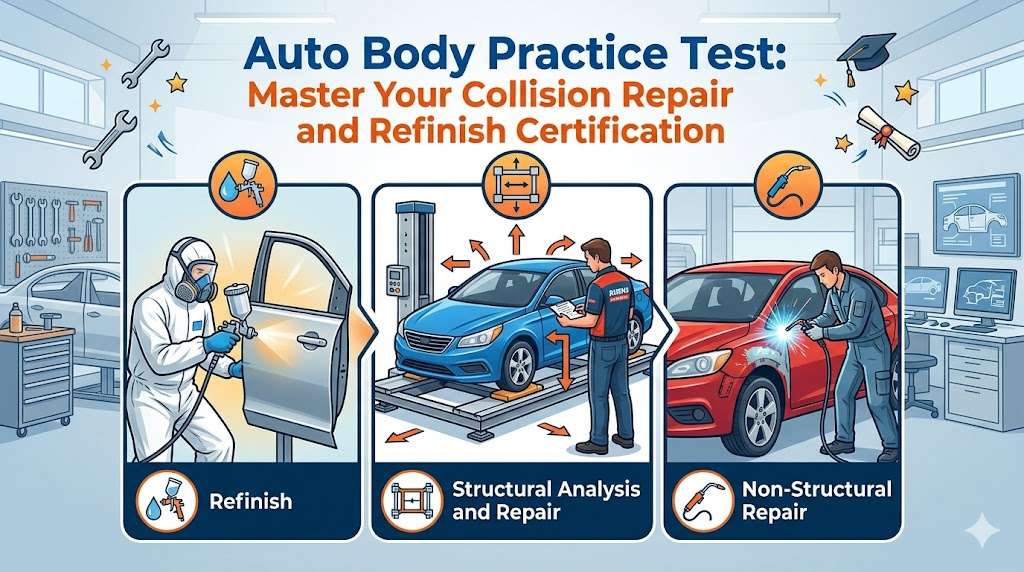
Additional Information
What the Course Entails and Exam Details
To succeed on the full certification, you must demonstrate proficiency across several core disciplines. The study material and practice tests cover the entire spectrum of collision repair. You will delve into structural analysis and damage repair, which includes identifying and correcting unibody and frame damage. The curriculum also encompasses non-structural analysis, focusing on the repair of outer body panels, glass, and welding techniques. For those aiming for the refinishing specialization, the details cover surface preparation, spray gun operation, paint mixing and matching, and identifying finish defects. Furthermore, the practice test addresses essential mechanical and electrical components that are frequently damaged during a collision, ensuring a holistic understanding of vehicle systems.
What to Expect in the Final Exam
The actual certification exams, such as the ASE B-Series, are typically computer-based and administered in a secure, proctored environment. They consist of multiple-choice questions designed to test not just your rote memorization but your ability to apply your knowledge to real-world scenarios. Each specific test (e.g., B2 Painting, B3 Non-Structural) usually contains between 50 and 65 questions, and you are given a strict time limit, ranging from 75 to 90 minutes per test. While specific passing scores are determined by the certifying body and can vary slightly, you should generally aim for a score of 70% or higher to guarantee passage. Some questions may be unscored research items used for future test development.
How to Study and Exam Centers
Effective preparation requires a blend of hands-on experience and targeted academic study. Utilize the official study guides provided by the certifying body to understand the exact task lists and question distributions. We highly recommend taking multiple timed practice exams to familiarize yourself with the question format and manage your time effectively. When you feel prepared, you will need to register through the official portal of the certifying body, such as myASE. The exams are administered at authorized computer testing centers worldwide, including major networks like Prometric. Be sure to arrive early with proper identification, as these centers enforce strict security protocols to maintain exam integrity.
Job Opportunities from the Course
Earning your Auto Body or Collision Repair certification is a powerful way to unlock numerous lucrative career paths. Validating your skills makes you highly competitive in the automotive job market.
Certified Collision Repair Technician
Automotive Refinishing and Paint Specialist
Collision Damage Estimator
Auto Body Shop Foreman or Manager
Structural Repair Specialist
Mobile Auto Body Repair Technician
Insurance Damage Appraiser
Automotive Customization and Restorer
Frequently Asked Questions
Reviews
5.0
Based on 0 reviews
Leave a Review
No reviews yet. Be the first to review!