
Automatic Radar Plotting Aids (ARPA) Practice Test
$69.00
- Buy to unlock unlimited access to all Quiz questions and Answers in this Quiz.
- After purchase you can print a PDF of the whole quiz at any point. The PDF will contain the questions and the correct answers.
About this Exam
The Automatic Radar Plotting Aids (ARPA) certification is a critical qualification for maritime professionals, validating their ability to navigate safely using advanced radar technology.
This exam is designed for deck officers, captains, and maritime students who need to demonstrate proficiency in operating ARPA systems to prevent collisions at sea.
By passing this test, candidates prove they possess the technical skills required by international maritime regulations, specifically the STCW Convention, to maintain a safe navigational watch.
Ready to test your knowledge?
Buy Now to Access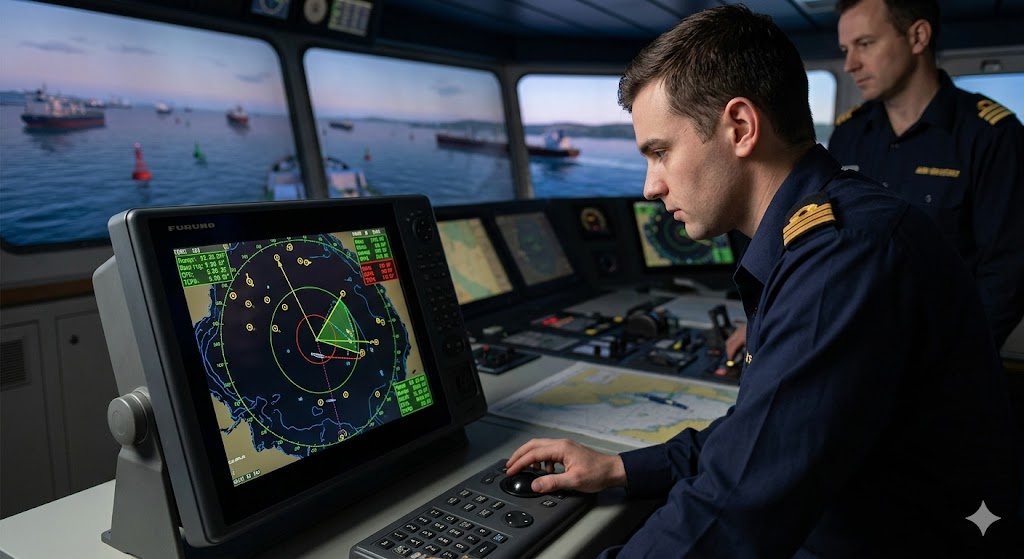
Additional Information
What the Course Entails and Exam Details
The ARPA course and subsequent exam cover a wide spectrum of radar plotting techniques and system functionalities essential for safe vessel operation.
Candidates must master the IMO performance standards for ARPA, including the acquisition and tracking of multiple targets simultaneously.
Key competencies include determining target information such as range, bearing, course, speed, closest point of approach (CPA), and time to closest point of approach (TCPA).
Furthermore, the syllabus includes setting up the ARPA display, analyzing collision risks, and understanding the system's limitations and potential errors.
A significant portion of the course involves practical application, where students practice making collision avoidance decisions in a simulated environment, adhering to the COLREGs (International Regulations for Preventing Collisions at Sea).
What to Expect in the Final Exam
The final ARPA exam typically features a two-part assessment: a written theoretical component and a practical, scenario-based evaluation.
The theoretical part is often composed of multiple-choice questions focusing on IMO regulations, ARPA technical operations, COLREG application, and interpreting radar vector types.
Candidates are tested on their knowledge of relative versus true motion, plotting techniques, and understanding system-generated alarms.
Following the theory, the practical assessment requires candidates to demonstrate their competency in a certified bridge simulator.
In this scenario, you must manage multiple targets, identify collision threats, and execute proper collision avoidance maneuvers, all while correctly operating the ARPA interface.
Passing scores usually require a minimum of 70-80% on the theoretical section and demonstrating flawless proficiency during the simulator scenario.
Failure to identify and avoid a collision risk in the practical part often results in an automatic failure.
How to Study and Exam Centers
Effective preparation for the ARPA practice test involves combining theoretical knowledge with hands-on practice, and utilizing the resources available at authorized schools.
Start by thoroughly reviewing the STCW and IMO ARPA performance standards to understand the foundational requirements.
Utilize practice tests and sample multiple-choice questions to test your theoretical knowledge; focus on collision scenarios and vector analysis.
To master the practical component, maximize your time in the bridge simulator if your maritime training center provides access to it.
If access is limited, leverage online ARPA simulation software to practice target tracking and navigation scenarios at home.
The ARPA certification exam is typically taken at authorized maritime training centers, maritime colleges, or specialized simulation facilities rather than via a standard online portal.
Once you have completed the required training course, the facility will schedule your final assessment, which might be proctored by the maritime administration or an authorized examiner.
Be sure to contact your local maritime school or regulatory body to find an authorized examination center near you.
Job Opportunities from the Course
Earning your ARPA certification is a mandatory step for many seafaring career paths, unlocking diverse job opportunities in the maritime industry.
Deck Officer (All Ranks)
Ship Captain
Marine Pilot
Vessel Traffic Service (VTS) Operator
Marine Surveyor
Maritime Lecturer / Simulator Instructor
Navigational Watchstander
These roles require the precise skill set that this certification proves you possess.
Frequently Asked Questions
Reviews
5.0
Based on 0 reviews
Leave a Review
No reviews yet. Be the first to review!