
Automation Technology SACA Silver Certification Practice Test
$69.00
- Buy to unlock unlimited access to all Quiz questions and Answers in this Quiz.
- After purchase you can print a PDF of the whole quiz at any point. The PDF will contain the questions and the correct answers.
About this Exam
The SACA Silver Automation Technology certification is a premier, industry-recognized credential offered by the Smart Automation Certification Alliance (SACA). It is designed to validate the advanced technical skills required for technicians and engineers working in modern, "Smart" manufacturing and advanced automation environments. While SACA's Gold certifications focus on design and integration, the Silver tier is specifically tailored to demonstrate proficiency in operational, maintenance, troubleshooting, and programming tasks. This certification is ideal for individuals with prior experience or training in basic industrial electricity and mechanics who wish to specialize in connected systems, robotics, and the technologies driving Industry 4.0.
Ready to test your knowledge?
Buy Now to Access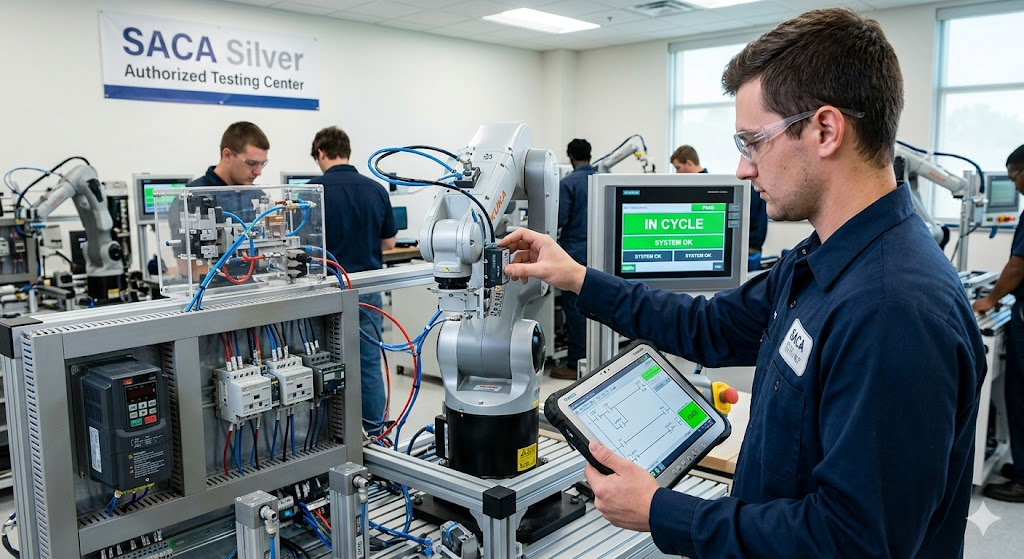
Additional Information
What the Course Entails and Exam Details
To successfully obtain the SACA Silver Automation Technology credential, candidates must master a multi-faceted syllabus that bridges several advanced technical domains. The core knowledge areas assessed include the following:
Programmable Logic Controllers (PLCs): Advanced understanding of PLC hardware architecture, memory mapping, complex troubleshooting of logic, and advanced programming concepts such as function blocks and data manipulation.
Industrial Robotics: Operatorship and foundational programming of robotic arms, including teach pendant operation, coordinate systems, motion types, and safety protocols.
Fluid Power Systems: In-depth knowledge of hydraulic and pneumatic systems, including schematic reading, circuit design, and troubleshooting of directional control valves, actuators, and accumulators.
Electric Motor Drives (VFDs): Application and configuration of Variable Frequency Drives to control AC motors, focusing on parameter setup, commissioning, and diagnostic procedures.
Industrial Networks & IIoT: Understanding of modern connected factory systems, including Ethernet/IP, PROFINET, and the integration of smart sensors and actuators in an Industrial Internet of Things framework.
Mechatronics Systems Integration: The ability to troubleshoot complex, integrated automated systems that combine electrical, mechanical, fluid power, and control components.
What to Expect in the Final Exam
The SACA Silver Automation Technology exam process is rigorous and designed to test both knowledge and applied skill. It is divided into two distinct parts that must both be passed to earn the full certification: a theoretical (written) component and a practical (hands-on) component.
The written exam is a standardized test, often multiple-choice, taken through an online portal. It evaluates comprehensive knowledge of the theoretical principles, terminology, and safety standards across all syllabus topics. There are strict time limits (e.g., 60–90 minutes per module), and the passing score is typically 70% or higher.
The practical exam is the hallmark of SACA's certification. It requires candidates to demonstrate actual proficiency on authorized "Silver-certified" training equipment in a proctored environment. Candidates are given specific operational or troubleshooting tasks—such as programming a robot path, diagnosing a fault in a hydraulic circuit, or configuring a VFD—under the observation of an authorized examiner. This component ensures that a certified individual can perform effectively on a real production floor, not just answer questions.
How to Study and Exam Centers
Preparation for the SACA Silver Automation Technology exam requires a balanced blend of theoretical study and intensive hands-on practice.
Recommended Study Strategies:
Utilize SACA-Authorized Curriculum: The most effective way to prepare is through training programs offered by schools or organizations that use SACA-approved courseware, such as Amatrol’s e-learning and hardware systems.
Review SACA Learning Objectives: SACA provides detailed PDFs outlining the precise skills and knowledge assessed in each micro-credential module. Treat this as your primary study guide.
Create Your Own Practice Scenarios: If you have access to the equipment, create fault scenarios to diagnose or unique programming challenges to solve.
Take Practice Tests: Seek out practice exams tailored to SACA or Amatrol assessments to familiarize yourself with the question style and manage your time.
Exam Centers and How to Register: SACA certifications are administered through an extensive network of Authorized Testing Centers. These are typically localized at technical and community colleges, universities, or private industry training facilities that possess the necessary SACA-approved hardware. To take the exam, you must register through a participating institution, as it requires physical access to mechatronics training stations for the practical component. Candidates cannot take the SACA Silver practical exam purely online.
Job Opportunities from the Course
Earning the SACA Silver Automation Technology certification sends a strong signal to employers that you possess proven, verified skills in the hottest sectors of modern manufacturing. This credential unlocks numerous career paths and provides a substantial advantage in a competitive job market.
Specific job opportunities and career paths unlocked include:
Automation Technician
Mechatronics Technician
Industrial Maintenance Technician (Advanced)
PLC Programmer
Robotics Technician
Control Systems Technician
Field Service Engineer
Maintenance Supervisor (in automated environments)
IIoT Implementation Specialist
Operations Manager (Advanced Manufacturing)
Frequently Asked Questions
Reviews
5.0
Based on 0 reviews
Leave a Review
No reviews yet. Be the first to review!