
Automotive Technician Practice Exam
$69.00
- Buy to unlock unlimited access to all Quiz questions and Answers in this Quiz.
- After purchase you can print a PDF of the whole quiz at any point. The PDF will contain the questions and the correct answers.
About this Exam
Embarking on a career as an automotive service technician is a commitment to mastering complex modern machinery.
An automotive technician certification is the gold standard, proving your competence in diagnosing, repairing, and maintaining a wide range of vehicles.
This certification is designed for aspiring mechanics looking to break into the industry, as well as experienced technicians seeking to validate their skills and increase their earning potential.
Earning this credential demonstrates to employers and customers alike that you possess the rigorous technical knowledge needed to succeed in a fast-paced, high-tech automotive environment.
Ready to test your knowledge?
Buy Now to Access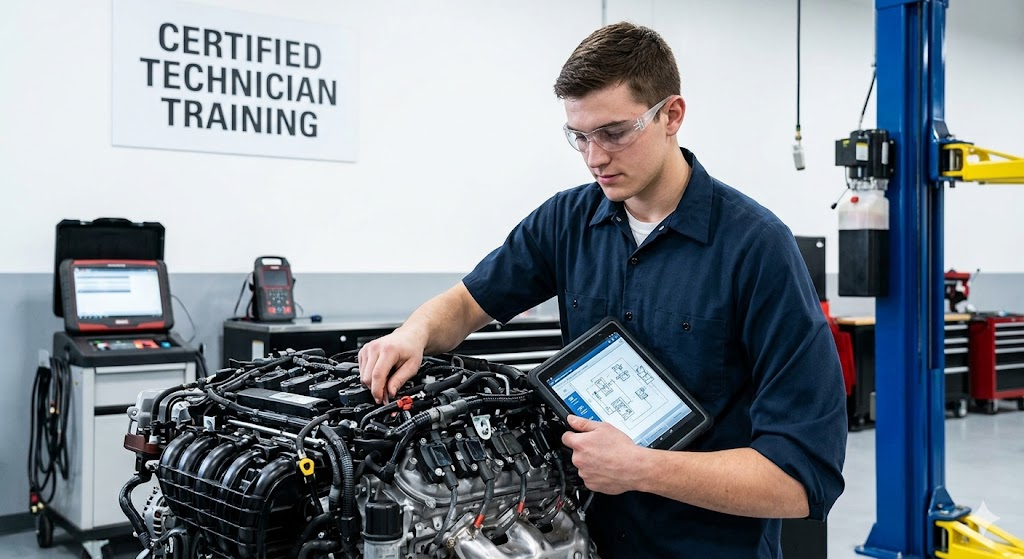
Additional Information
What the Course Entails and Exam Details
Preparing for the final assessment requires a deep understanding of core automotive systems and maintenance procedures.
Comprehensive study guides and preparation courses cover a syllabus that mirrors real-world shop challenges and the latest industry standards.
Key areas of focus include engine repair and performance diagnostics, automatic transmission and transaxle service, manual drive trains, and axles.
You will need to be proficient in suspension and steering systems, braking systems (including ABS), electrical/electronic systems architecture, and heating, ventilation, and air conditioning (HVAC).
Mastery of these subjects ensures you can interpret diagnostic trouble codes, utilize technical service bulletins, and apply fundamental safety protocols in a professional setting.
What to Expect in the Final Exam
While the exact structure may vary slightly depending on the specific certifying body, the final exam is typically a rigorous computerized assessment.
Candidates should expect several dozen multiple-choice questions per test section, often presented as scenario-based problems that require active diagnostic thinking rather than simple recall.
Many exams are segmented into distinct modules, such as Electrical Systems (A6) or Engine Performance (A8), allowing you to tackle one specialization at a time.
You will be given a specific time limit for each section, usually ranging from 60 to 90 minutes.
A passing score is generally around 70 percent, although this threshold can vary, and instant preliminary scoring is often available upon completion of the computer-based test.
How to Study and Exam Centers
Effective preparation is the foundation of exam day success.
We recommend a multi-faceted approach, beginning with a detailed review of standard industry study guides and technical service manuals.
Taking numerous full-length, timed practice exams is critical to familiarize yourself with the question style and manage your time effectively.
You should utilize online learning portals, diagnostic simulators, and flashcards to reinforce your knowledge of complex electrical schematics and diagnostic procedures.
Most recognized automotive technician exams are administered through secure, proctored third-party testing networks, such as Pearson VUE or Prometric, which offer authorized testing centers globally.
Furthermore, many authorized vocational schools and community colleges serve as physical testing hubs for their registered students and local technicians.
Job Opportunities from the Course
Earning an automotive technician certification unlocks diverse and rewarding career paths across the transportation industry.
Becoming a certified technician qualifies you for specialized roles within dealership service departments, independent repair shops, and specialized performance garages.
Many graduates secure positions as specialized diagnostic technicians, focusing specifically on electrical or driveability issues.
Other available job titles include general automotive service technician, brake and suspension specialist, heavy-duty equipment technician, and transmission rebuilding specialist.
With experience, certified professionals often advance to leadership roles such as shop foreman, service advisor, service manager, or specialized fleet maintenance supervisor for major corporations.
Frequently Asked Questions
Reviews
5.0
Based on 0 reviews
Leave a Review
No reviews yet. Be the first to review!