
Aviation Boatswain’s Mate – Handling Test 2 Practice
$69.00
- Buy to unlock unlimited access to all Quiz questions and Answers in this Quiz.
- After purchase you can print a PDF of the whole quiz at any point. The PDF will contain the questions and the correct answers.
About this Exam
The Aviation Boatswain’s Mate – Handling (ABH) certification is a critical qualification for U.S. Navy personnel responsible for the safe and efficient movement of aircraft on flight decks and in hangar bays. This exam is designed for Sailors looking to advance within the ABH rating, validating their knowledge of ground handling, towing, and spotting procedures. It ensures that personnel possess the specialized skills required to operate in high-tempo, high-risk environments aboard aircraft carriers and amphibious assault ships.
Ready to test your knowledge?
Buy Now to Access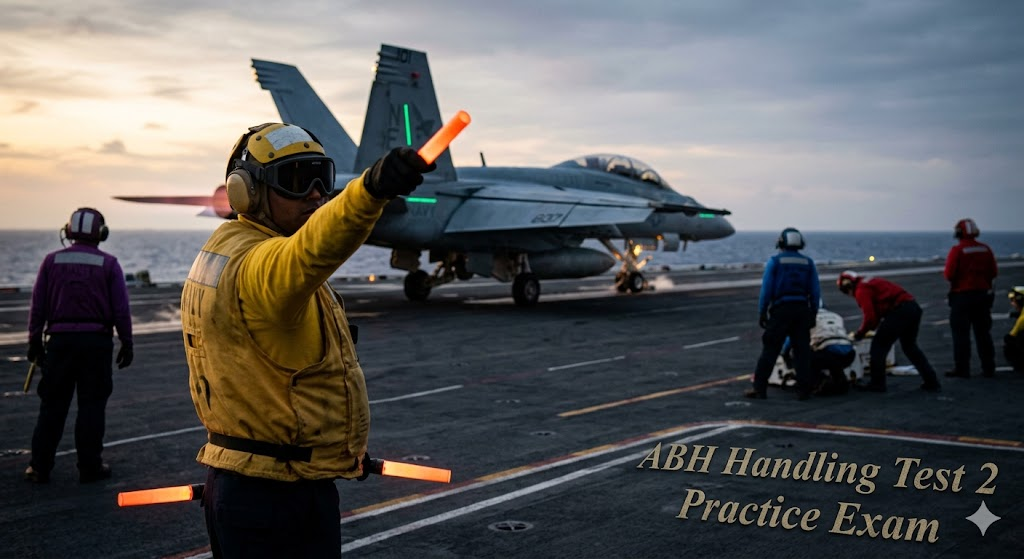
Additional Information
What the Course Entails and Exam Details
The course and subsequent exam cover a comprehensive range of topics essential for aircraft handling operations. Key areas of focus include:
Flight Deck Signaling: Mastering standard hand signals for directing fixed-wing and rotary-wing aircraft during day and night operations.
Aircraft Spotting and Moving: Procedures for towing, pushing, and securing aircraft, including the use of specialized handling equipment.
Hangar Bay Operations: Managing aircraft storage, elevator operations, and safety protocols within the hangar.
Crash and Salvage: Fundamental knowledge of emergency response, firefighting, and rescue procedures specific to flight deck mishaps.
Firefighting Systems: Understanding the operation of flight deck and hangar bay fire suppression systems.
General Safety Procedures: Strict adherence to safety regulations, including Personal Protective Equipment (PPE) requirements and Naval Air Training and Operating Procedures Standardization (NATOPS) guidelines.
What to Expect in the Final Exam
The final exam for the ABH Handling Test 2 is primarily a computerized, multiple-choice assessment designed to test both theoretical knowledge and practical scenario-based problem-solving. While specific details can vary by command and current curriculum, candidates should generally expect:
Format: Multiple-choice questions, potentially including visual aids such as diagrams or photos of hand signals and equipment.
Time Limit: A strictly enforced time limit, typical of standard Navy advancement exams.
Passing Score: Requirements are set according to current Navy advancement standards, often involving a cutoff based on the dynamic Navy-wide standard score.
Rules: Standard military testing protocols apply, meaning no external study materials, unauthorized electronic devices, or collaboration are permitted during the exam.
How to Study and Exam Centers
Preparation is key to succeeding on the ABH Handling Test 2. Effective study strategies include:
Review Official Manuals: The primary sources for all questions are Navy Rate Training Manuals (RTMs), specifically the Aviation Boatswain’s Mate H (Handling) manual, and relevant NATOPS publications.
Practice with Flashcards: Memorizing hand signals, equipment specifications, and safety acronyms is highly effective using flashcards.
Form Study Groups: Collaborating with peers allows you to test each other on complex scenarios and share practical knowledge gained from deckplate experience.
Take Practice Tests: Utilizing practice exams can help you become familiar with the question format and identify areas needing improvement.
The exam is typically administered at official Navy testing centers located on military installations or aboard ship for deployed units. Sailors must coordinate with their command Career Counselor or Educational Services Officer (ESO) to schedule the exam.
Job Opportunities from the Course
Achieving this certification is a significant milestone that opens up various career advancement opportunities within the Navy and provides valuable skills transferable to the civilian sector.
Specific job titles and roles unlocked or enhanced by this qualification include:
Navy Career Paths:
Flight Deck Director (Yellow Shirt)
Tractor Driver (Blue Shirt)
Crash and Salvage Crew Member (Red Shirt)
Hangar Deck Leading Petty Officer
Flight Deck Leading Petty Officer
Civilian Career Paths:
Commercial Airport Ground Handler
Aircraft Towing Specialist
Airport Ramp Supervisor
Industrial Firefighter (Aviation Specialization)
Aviation Safety Inspector
Frequently Asked Questions
Reviews
5.0
Based on 0 reviews
Leave a Review
No reviews yet. Be the first to review!