
Aviation Boatswain’s Mate – Handling Test 1 Practice
$69.00
- Buy to unlock unlimited access to all Quiz questions and Answers in this Quiz.
- After purchase you can print a PDF of the whole quiz at any point. The PDF will contain the questions and the correct answers.
About this Exam
The Aviation Boatswain’s Mate Handling (ABH) Test 1 is a foundational assessment designed for United States Navy sailors entering the ABH rating. This specific practice exam is geared toward individuals enrolled in ABH "A" School who are preparing for their first major written test.
Passing this test is a critical milestone, as it validates that you possess the essential knowledge required to work safely and effectively on one of the most dangerous environments in the world: the flight deck of an aircraft carrier.
This practice guide is structured to mirror the topics covered in the actual exam, ensuring you build the confidence and knowledge needed to advance in your naval career.
Ready to test your knowledge?
Buy Now to Access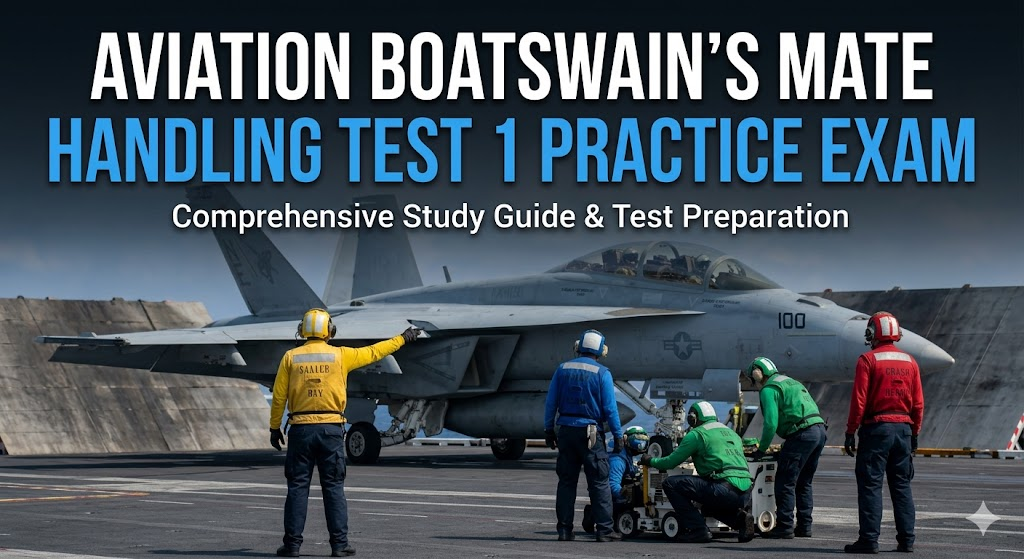
Additional Information
What the Course Entails and Exam Details
The training curriculum preceding this test is intensive and highly focused on safety, efficiency, and standardized operating procedures.
ABH Test 1 covers several core modules essential to ground and flight deck operations. Students will be tested on their comprehensive understanding of visual and auditory hand signals for both rotary and fixed-wing aircraft.
They must demonstrate proficiency in safety protocols, proper use of protective equipment, standard towing and moving procedures, and aircraft securing techniques (tie-downs). Furthermore, students are required to identify different classifications of aircraft and understanding basic hangar deck and flight deck firefighting fundamentals, including the proper identification of firefighting equipment locations.
The exact number of questions may vary slightly between test cycles, but it is uniformly a rigorous, computerized multiple-choice exam focusing on recall and application of these critical procedures.
What to Expect in the Final Exam
When you arrive at the designated testing computer, you can expect a controlled, military testing environment. The final Test 1 will be administered via a secure computer interface, typically presenting 50 to 100 multiple-choice questions depending on the current curriculum update.
You will be given a specific time limit to complete the test, usually ranging from 60 to 90 minutes. This test is designed not just for accuracy but also for speed of recall, as decisions on a flight deck must be made instantly and correctly.
Unlike civilian exams, the Navy maintains a very high standard for passing. While the exact minimum passing score can fluctuate between 75% and 80%, you should strive for mastery.
Remember that strict testing protocols apply; no notes, phones, or outside study materials are permitted, and violating academic integrity policies can have severe consequences for your naval career.
How to Study and Exam Centers
Preparation for this practice exam, and the official test, must be meticulous and repetitive. Your primary resource should be your official "A" School curriculum material and the Naval Air Systems Command (NAVAIR) manuals.
One of the most effective study strategies is the use of visual flashcards. Create or use digital flashcards to memorize dozens of unique hand signals and aircraft identification profiles until they are instantaneous.
Additionally, review procedure manuals repeatedly. Pay close attention to definitions, safety warnings (written in bold or red), and sequential steps for procedures like aircraft movement and towing.
Regarding exam delivery, this practice exam is taken online via recognized military training portals. The official ABH Test 1 itself is not administered at public Pearson VUE centers.
The official final exam must be taken at the Center for Naval Aviation Technical Training (CNATT) "A" School, specifically at authorized testing centers located within Naval Air Station Pensacola or designated fleet training commands.
Job Opportunities from the Course
Successfully navigating the ABH "A" School curriculum and passing Test 1 and subsequent exams opens the door to numerous high-octane careers within the US Navy’s aviation community.
Graduates who complete the full training pipeline are assigned as Aviation Boatswain’s Mates (Handling). This single rating contains several specialized roles.
Job opportunities from this course include:
Aircraft handling team member (working on the flight deck or hangar deck)
Aircraft Tow Tractor Operator
Elevator Operator (moving aircraft between decks)
Flight Deck Aircraft Director (the famous "Yellow Shirts")
Hangar Deck Aircraft Director
Aviation Crash and Rescue Team Member (Firefighter)
Securing Crew Leader
Frequently Asked Questions
Reviews
5.0
Based on 0 reviews
Leave a Review
No reviews yet. Be the first to review!