
Aviation Captains Career Course (AVCCC) Practice Exam
$69.00
- Buy to unlock unlimited access to all Quiz questions and Answers in this Quiz.
- After purchase you can print a PDF of the whole quiz at any point. The PDF will contain the questions and the correct answers.
About this Exam
The Aviation Captains Career Course (AVCCC) is a pivotal professional military education program designed specifically for U.S. Army Aviation Officers who have recently been promoted to or are selected for the rank of Captain. This rigorous course serves as the branch-specific phase of the Captains Career Course (CCC), focusing on equipping company-grade officers with the advanced leadership, tactical, and operational skills required to command at the company, troop, or battery level and serve effectively on battalion and brigade staffs. It bridges the gap between basic officer skills and the complex responsibilities of a senior company-grade leader within the Army Aviation branch.
Ready to test your knowledge?
Buy Now to Access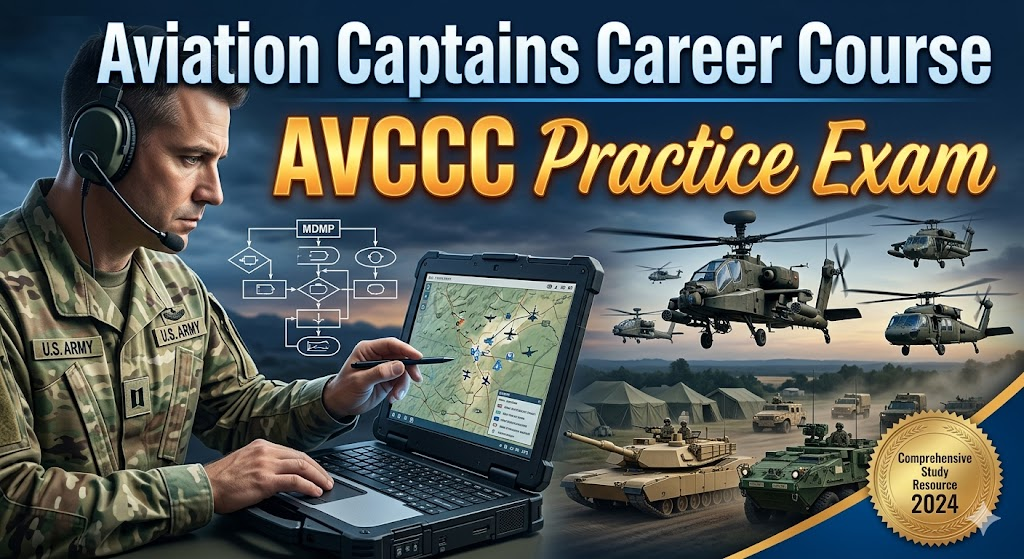
Additional Information
What the Course Entails and Exam Details
The AVCCC is a comprehensive program that blends theoretical knowledge with practical application through classroom instruction, collaborative planning exercises, and simulation-based training. The syllabus is meticulously structured around several core pillars crucial for modern aviation leaders.
Students can expect to delve deeply into the following topics:
Leadership and Ethics: Advanced study of Army leadership doctrine, professional ethics, and command responsibilities.
Military Decision-Making Process (MDMP): A thorough mastery of the seven-step MDMP is central to the course, focusing on how aviation elements are integrated into combined arms operations.
Aviation Operations: Detailed instruction on the employment of various aviation platforms (attack, assault, cargo, and reconnaissance) across the spectrum of conflict.
Tactical Planning: Developing comprehensive Operations Orders (OPORDs) and fragmentary orders (FRAGOs) for aviation missions.
Aviation Sustainment: Understanding the logistics, maintenance management, and personnel support required to keep aviation assets mission-capable.
Air-Ground Operations (AGO): Fostering a synchronized understanding of how rotary-wing and fixed-wing assets support ground maneuver forces.
Training Management: Learning how to plan, execute, and assess tough, realistic training for aviation units.
Force Modernization: Familiarization with current and future aviation technologies and doctrines.
What to Expect in the Final Exam
While the AVCCC is a "course" rather than a single, one-off certification exam, student progress is rigorously assessed throughout the program through a combination of written examinations, practical exercises, oral briefings, and performance-based evaluations. However, a cumulative phase often exists, and understanding the general assessment structure is key to success.
The final assessment phase typically includes:
Written Examinations: These usually feature multiple-choice questions, short answers, and essay questions that test comprehensive knowledge of Army doctrine, MDMP steps, aviation maintenance procedures, and tactical concepts. They are often timed, requiring students to demonstrate speed and accuracy in recall and application.
Practical Exercises (PEs) / Staff Rides: A significant portion of the assessment involves students working in staff roles to develop detailed plans in response to complex scenarios. These are often evaluating the practical application of MDMP and OPORD development.
Briefings: Students must frequently brief their commanders (instructors) on their completed plans, assessing their communication skills, confidence, and ability to defend their tactical decisions.
Simulation-Based Evaluations: Utilizing advanced flight and staff simulations, students are tested on their ability to command and control aviation assets in a dynamic, high-fidelity operational environment.
Passing Score: The Army generally requires a minimum passing score of 70% to 80% on written exams, and performance-based tasks must be completed to a standard of "Achieved Course Standards."
How to Study and Exam Centers
The AVCCC is a high-stakes, fast-paced environment where consistent effort is required. It is not an exam you can "cram" for at the end. Your primary strategy should be active engagement throughout the course.
Actionable Study Strategies:
Master the Doctrine: Army Aviation and current Operations doctrine (specifically FM 3-04, ADP 3-0, and FM 6-0) are your textbooks. Read them before the course and reference them constantly.
Understand, Don't Just Memorize: The MDMP is a process; understand why each step matters, not just what the steps are called.
Practice OPORD Development: Become proficient in writing clear, concise, and doctrine-based OPORDs. Use templates and practice with colleagues.
Leverage Collaborative Learning: The CCC is designed for peer learning. Form study groups, discuss complex scenarios, and challenge each other’s tactical reasoning.
Use Practice Exams Wisely: Utilize any provided pre-tests or module quizzes. Treat them as diagnostic tools to identify weaknesses. If outside practice materials are used, ensure they are current and based on official Army doctrine.
Focus on Communication: Practice giving clear, confident mission briefings. Record yourself if necessary to refine your delivery.
Exam Centers and Location:
The U.S. Army Aviation Captains Career Course is a resident course primarily conducted at the U.S. Army Aviation Center of Excellence (USAACE) at Fort Novosel (formerly Fort Rucker), Alabama. While some core CCC components might have distributed learning (online) aspects, the branch-specific AVCCC is a physical, collaborative environment. Military students receive orders to attend this specific location for the duration of the course. There are no external "Pearson VUE" or testing centers for this internal military education program.
Job Opportunities from the Course
Successful completion of the AVCCC is a mandatory requirement for promotion to Major and is the prerequisite for all company-grade command opportunities within the U.S. Army Aviation branch. This course does not unlock civilian job titles directly; rather, it unlocks the critical career-enhancing assignments within the Army system.
Career Paths and Opportunities Unlocked:
Aviation Company/Troop/Battery Commander: Commanding an AH-64 Apache, UH-60 Black Hawk, or CH-47 Chinook company.
Battalion Staff Officer: Primary roles such as Battalion Operations Officer (S-3) or Executive Officer (XO) (as a senior Captain/Major).
Brigade Staff Officer: Staff roles within an Combat Aviation Brigade (CAB) or higher.
Aviation Liaison Officer (LNO): Coordinating aviation support within ground maneuver units.
Instructor Pilot / Standardization Pilot (after further certification): Leading standardization and training within an aviation unit.
Special Operations Aviation Officer: (Requires further assessment and selection).
Frequently Asked Questions
Reviews
5.0
Based on 0 reviews
Leave a Review
No reviews yet. Be the first to review!