
Aviation Labor Relations Practice Exam
$69.00
- Buy to unlock unlimited access to all Quiz questions and Answers in this Quiz.
- After purchase you can print a PDF of the whole quiz at any point. The PDF will contain the questions and the correct answers.
About this Exam
Mastering the complexities of labor relations is crucial for any professional operating within the unique regulatory framework of the US aviation industry. The Aviation Labor Relations course and its concluding exam are designed specifically to validate a candidate’s expertise in managing the intricate relationships between air carriers and their unionized employees. Unlike most private sectors in the United States, aviation labor is governed by the specialized Railway Labor Act (RLA), not the National Labor Relations Act (NLRA). This certification is engineered for airline Human Resources specialists, operational managers, labor relations directors, and union representatives (pilots, flight attendants, and mechanics). Possessing this credential proves your proficiency in dispute resolution, collective bargaining procedures, and maintaining statutory compliance within this highly regulated, critical sector.
Ready to test your knowledge?
Buy Now to Access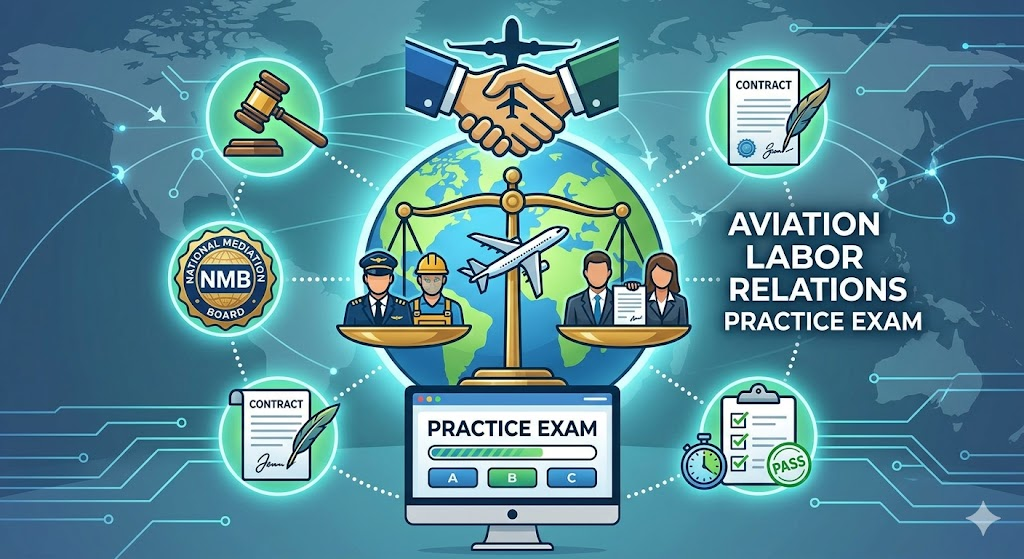
Additional Information
What the Course Entails and Exam Details
The course of study prepares professionals to understand and implement the unique legal obligations of airline labor management, focusing heavily on the administration and jurisdiction of the National Mediation Board (NMB). Students will explore the history of the RLA and why its primary purpose is to avoid any interruption to interstate commerce. A significant focus of the curriculum is dedicated to the distinction between "Major Disputes" and "Minor Disputes."
Major dispute topics include the complex processes of collective bargaining, the issuance of Section 6 notices, mandatory mediation periods, and the strict adherence to the "status quo" rules during negotiations. Minor dispute studies focus on contract administration, including the grievance procedure, the role of System Boards of Adjustment, and final, binding arbitration. Furthermore, the course covers representational disputes, identifying the nuances of "craft or class" designations, election procedures managed by the NMB, and statutory obligations regarding "good faith" bargaining.
What to Expect in the Final Exam
The final certification exam is a computer-based, multiple-choice assessment that strictly measures both theoretical knowledge and practical, scenario-based application. Students should expect between 75 and 100 questions, designed to be completed within a strict two-hour (120-minute) time limit. The passing score is typically set at 75% or higher, reflecting the need for a high level of accuracy in a regulatory environment where mistakes are costly.
The exam format often includes case studies, presenting a real-world negotiation stalemate or grievance and asking the candidate to identify the legally mandated next step according to RLA procedures. Candidates must demonstrate proficiency in identifying timelines, mediation triggers, when the NMB may proffer arbitration, and the specific circumstances that permit self-help (strikes or lockouts) in the aviation industry.
How to Study and Exam Centers
Preparation for this exam requires a strategic study plan that prioritizes the specialized nature of the RLA over general labor law knowledge. Begin your study journey by referencing the National Mediation Board’s (NMB) own knowledge base and statutory texts. Focus your practice heavily on acronyms and procedural definitions: ensure you can instantly differentiate CBA (Collective Bargaining Agreement), SBA (System Board of Adjustment), and RLA (Railway Labor Act). Study actual airline collective bargaining agreements to understand how grievance and arbitration clauses are drafted. Utilize practice exams to mimic the timed, scenario-based environment of the actual test.
The registration and location for the exam vary by the specific organization providing the certification. Many professional aviation training schools allow you to take the exam remotely via online proctoring portals. Physical exam centers are also available through nationwide networks such as Pearson VUE or at authorized aviation universities and specific airline training facilities. Candidates must register in advance through their approved course provider’s designated system to secure an exam slot.
Job Opportunities from the Course
A robust understanding of Aviation Labor Relations, validated by passing this exam, opens diverse and specialized career paths within the airline industry, government agencies, and labor organizations. Graduates are uniquely positioned for roles that require strategic negotiation and statutory compliance. Key job opportunities unlocked by this course include:
Director of Labor Relations (Air Carrier)
Airline Human Resources Specialist
Labor Relations Manager
Union Contract Administrator
Flight Attendant or Pilot Union Representative
Conflict Resolution Mediator (Specializing in Transportation)
NMB Representational Specialist
Airport Operations Manager
Frequently Asked Questions
Reviews
5.0
Based on 0 reviews
Leave a Review
No reviews yet. Be the first to review!