
Aviation Machinist Mate (AD) "A" School Week 2 Practice Test
$69.00
- Buy to unlock unlimited access to all Quiz questions and Answers in this Quiz.
- After purchase you can print a PDF of the whole quiz at any point. The PDF will contain the questions and the correct answers.
About this Exam
The Aviation Machinist's Mate (AD) "A" School Week 2 Practice Test is a crucial diagnostic tool designed for U.S. Navy Sailors currently enrolled in their initial technical training. This early assessment targets junior Sailors who have completed the introductory week of instruction and are transitioning into the core principles of aircraft powerplants and related systems. The test serves a dual purpose: it allows students to gauge their understanding of the fundamental concepts introduced in the first few days of training, and it identifies specific areas where they may need additional study before progressing to more complex modules.
Ready to test your knowledge?
Buy Now to Access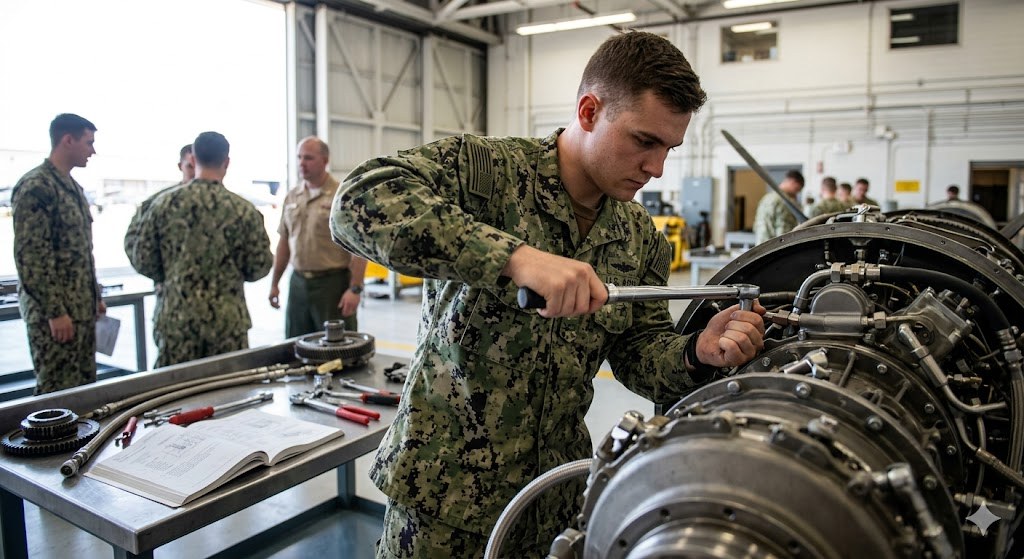
Additional Information
What the Course Entails and Exam Details
This Week 2 practice exam is specifically structured to cover the introductory, foundational knowledge that underpins the entire AD rating. While the complete AD "A" School curriculum spans several months and involves advanced, hands-on maintenance, this early assessment focuses primarily on theoretical knowledge and essential safety protocols.
Students can expect questions covering the following areas:
Safety Fundamentals: This is a critical component of initial training. Topics include General Shop Safety, Tool Control Programs, Foreign Object Damage (FOD) prevention, Hazardous Materials (HAZMAT) handling, and basic Operational Risk Management (ORM).
Aviation Ratings Overview: Understanding the structure of Navy Aviation organizational levels (O-level, I-level, and D-level maintenance) and the specific responsibilities of the Aviation Machinist's Mate rating.
Basic Aircraft Identification: Familiarization with the general characteristics and purposes of key naval aircraft platforms.
Introduction to Technical Publications: Understanding how to locate and read Basic Technical Manuals, Maintenance Instruction Manuals (MIMs), and the basics of the Naval Aviation Maintenance Program (NAMP).
Fundamental Tools and Hardware: Initial identification of common hand tools, basic measuring devices, and the basic nomenclature of aviation fasteners and hardware.
What to Expect in the Final Exam
It is essential to understand that this is a practice test, not a high-stakes final exam. The primary objective is diagnostic feedback. However, to maximize its effectiveness, it mimics the format of the regular written knowledge tests that students will encounter throughout the course.
Format: The practice test is entirely multiple-choice. This format is designed to quickly evaluate recall of specific facts, terminology, and safety protocols.
Time Limits: While usually less restrictive than a graded exam, the practice test is typically administered within a defined time block (e.g., 45 to 60 minutes) to simulate real testing conditions and gauge pacing.
Passing Score: There is generally no official "passing" or "failing" score for this initial practice test. Instead, instructors provide students with a percentage breakdown of their performance, often emphasizing which specific curriculum sub-topics require remedial focus.
Rules: Standard military classroom conduct applies. Students are expected to complete the test without using unauthorized materials or collaborating with peers.
How to Study and Exam Centers
Preparation for this initial practice test should be integrated immediately into daily study habits during the first week of class.
Actionable Study Strategies:
Prioritize Safety First: Commit all safety rules and acronyms (like FOD, ORM, and HAZMAT protocols) to memory. Safety is non-negotiable in aviation maintenance and is heavily emphasized.
Master the Terminology: The military uses a specific, precise vocabulary. Create flashcards for new terms, acronyms, and organizational definitions.
Use Active Recall: Don't just re-read notes; practice recalling the information from memory. Close the book and list the steps of ORM, or identify the five different levels of maintenance.
Review Instructor Handouts and Slides: Focus on the material emphasized by your primary instructors during lectures. The practice test will likely align closely with these core concepts.
Exam Centers: This practice test is not administered by external agencies like Pearson VUE. It is a localized, internal military training event.
Where: The test is given in the assigned "A" School classroom at the Naval Air Technical Training Center (NATTC) located on Naval Air Station (NAS) Pensacola, Florida.
How: Students are automatically registered as part of their class. The test is administered on-site, usually via computer-based training terminals or printed answer sheets.
Job Opportunities from the Course
Successfully navigating AD "A" School, beginning with assessments like this practice test, is the first step toward a fulfilling career as a naval aviation maintenance professional. Completion of this course unlocks a specific, critical military career field and provides skills that are highly valued in civilian aviation.
The course unlocks the following career paths:
United States Navy:
Aviation Machinist's Mate (AD): The core rating assigned upon graduation. ADs perform intermediate and organizational maintenance on aircraft engines, fuel systems, and related systems.
Flight Line Maintenance Technician: Specializing in the launch, recovery, and immediate servicing of aircraft on the flight deck or runway.
Intermediate (I-Level) Maintenance Technician: Conducting more in-depth repairs on engine components that have been removed from the aircraft.
Quality Assurance (QA) Inspector: A career milestone that involves inspecting maintenance actions and ensuring compliance with safety and procedural standards.
Naval Aircrewman (Mechanical): Experienced ADs can volunteer to fly as aircrew on large maritime patrol or transport aircraft.
Civilian Sector (Post-Service):
FAA Certified Airframe and Powerplant (A&P) Mechanic: Military training often counts significantly toward the experience requirements needed for this mandatory FAA certification, which is the gold standard for civilian aviation maintenance.
Airline Maintenance Technician: Working for major airlines at airports around the world.
General Aviation Mechanic: Specializing in light aircraft and private aviation maintenance.
Technical Representative (Tech Rep) for Engine Manufacturers: Working directly for companies like General Electric, Pratt & Whitney, or Rolls-Royce.
Aerospace Manufacturing and Assembly: Utilizing high-precision technical skills in the creation of new aircraft and aerospace components.
Frequently Asked Questions
Reviews
5.0
Based on 0 reviews
Leave a Review
No reviews yet. Be the first to review!