
Aviation Machinist Mate (AD) Week 1 Practice Test
$69.00
- Buy to unlock unlimited access to all Quiz questions and Answers in this Quiz.
- After purchase you can print a PDF of the whole quiz at any point. The PDF will contain the questions and the correct answers.
About this Exam
The Aviation Machinist Mate (AD) rating is one of the most vital career paths in the United States Navy, responsible for the inspection, maintenance, and repair of advanced aircraft engines and systems. This Week 1 practice test is specifically designed for newly enlisted Sailors attending the Navy's "A" School. This comprehensive practice exam serves as an essential readiness checkpoint to help students gauge their knowledge before sitting for the first official evaluation of the curriculum. It is tailored to test the fundamental concepts introduced in the initial days of training.
Sample Questions
Explanation:
Explanation:
Explanation:
Explanation:
Explanation:
Ready to test your knowledge?
Buy Now to Access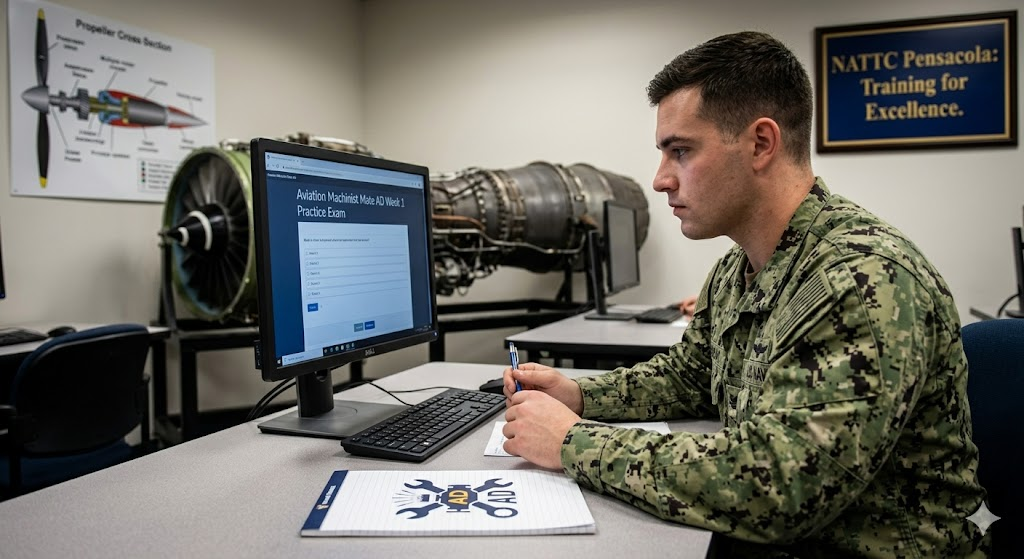
Additional Information
What the Course Entails and Exam Details
The standard Aviation Machinist Mate "A" School curriculum begins with foundational concepts that are crucial for safely working around sophisticated naval aviation technology. The first week focuses heavily on the essential knowledge required before students advance to hands-on engine work.
The primary topics and skills covered in the initial training phase, which this practice test replicates, include:
Navy Shop Safety: Mastering safety protocols, including the correct use of personal protective equipment (PPE), understanding hazardous materials, and identifying common workshop dangers.
Basic Technical Manuals (TMs): Learning how to navigate and utilize official technical documentation and manuals, which are the authoritative sources for all maintenance procedures.
Fundamental Maintenance Practices: Introductory concepts regarding maintenance organization, procedures, and responsibilities.
Introduction to Hand Tools: Identification, safe handling, and proper application of the core hand tools used in aircraft engine maintenance.
Introduction to Quality Assurance (QA): An overview of the principles behind QA and why meticulous record-keeping is critical in aviation.
This practice exam will present questions derived directly from these weekly learning objectives.
What to Expect in the Final Exam
While this specific resource is a practice test, it is designed to mirror the format and rigor you will encounter in the actual "A" School testing environment. For the actual evaluation, you should prepare for the following format:
Test Format: The exam will be a multiple-choice assessment, testing your conceptual knowledge and factual recall. It is administered in a controlled environment to ensure integrity.
Passing Score: To succeed in Navy training, high standards must be met. You will generally need to achieve a score of 80% or higher to demonstrate mastery of the Week 1 content.
Time Limit: You will be provided a specific time block, typically between 60 to 90 minutes, which is ample time to answer all questions if you are well-prepared.
Specific Rules: This will be a "closed-book" examination. All outside materials, including smartphones and notes, are prohibited during testing.
Successfully passing this early evaluation is key to moving forward in your AD training journey.
How to Study and Exam Centers
This Week 1 evaluation tests fundamental knowledge, meaning memory and precise understanding of technical concepts are required. Implement these study strategies for success:
Review Your Rates: Utilize the specific student guides and training materials (known as "Rates" in the Navy) that you receive in your first few days of class.
Focus on Technical Terms: Pay special attention to acronyms, safety procedures, and official tool names, as these are frequently tested points.
Utilize Practice Quizzes: Use online study aids and practice questions to familiarize yourself with the language and structure of military multiple-choice exams.
Form Study Groups: Collaborating with your fellow classmates in "A" School to quiz each other is one of the most effective ways to reinforce information.
Exam Location: This official military exam is not taken at civilian centers like Pearson VUE. The Aviation Machinist Mate AD Week 1 Exam is administered on-site at the Naval Air Technical Training Center (NATTC) facility, typically in a designated, secure testing classroom within the schoolhouse in Pensacola, Florida.
Job Opportunities from the Course
Successfully completing the entire Aviation Machinist Mate (AD) "A" School opens the door to a challenging and rewarding career path within Naval Aviation. The AD certification directly unlocks the following career opportunities and job roles:
Aircraft Engine Mechanic (Navy Ratings): The main entry-level position, where you will perform organizational and intermediate maintenance on jet and turboprop engines.
Propeller System Technician: Specializing in the maintenance of turboprop engines and aircraft propeller systems.
Test Cell Operator: Testing repaired engines in a controlled environment to ensure performance standards before installation on an aircraft.
Flight Line Maintenance Crew: Working directly on the flight deck or flight line to troubleshoot engines and perform pre-flight inspections.
Aviation Quality Assurance Representative (QA): A senior role responsible for inspecting all maintenance work to ensure safety and compliance with standards.
Civilian A&P Mechanic (Future Path): The skills and training received as a Navy AD provide a massive step toward obtaining an FAA Airframe and Powerplant (A&P) license, which is highly coveted in the commercial aviation industry.
Frequently Asked Questions
Reviews
5.0
Based on 0 reviews
Leave a Review
No reviews yet. Be the first to review!