
Aviation Machinist’s Mate (AD) Advancement Practice Exam
$69.00
- Buy to unlock unlimited access to all Quiz questions and Answers in this Quiz.
- After purchase you can print a PDF of the whole quiz at any point. The PDF will contain the questions and the correct answers.
About this Exam
The Aviation Machinist's Mate (AD) rating is a cornerstone of Naval Aviation, responsible for the maintenance and repair of complex aircraft propulsion systems. Sailors in this rating, known as ADs, are specialized aircraft engine mechanics who ensure the readiness of the Navy's air fleet, working on jet, turboshaft, and turboprop engines, as well as propellers and related systems. The AD Advancement Practice Exam is a crucial professional military education tool designed to prepare active-duty and reserve Sailors to compete for promotion within this rating. It serves as a benchmark of technical knowledge, readiness, and skill mastery required for the next paygrade. This exam is designed for Sailors already designated as Aviation Machinist's Mates who seek to advance in their military careers and demonstrate their commitment to excellence in their craft.
Ready to test your knowledge?
Buy Now to Access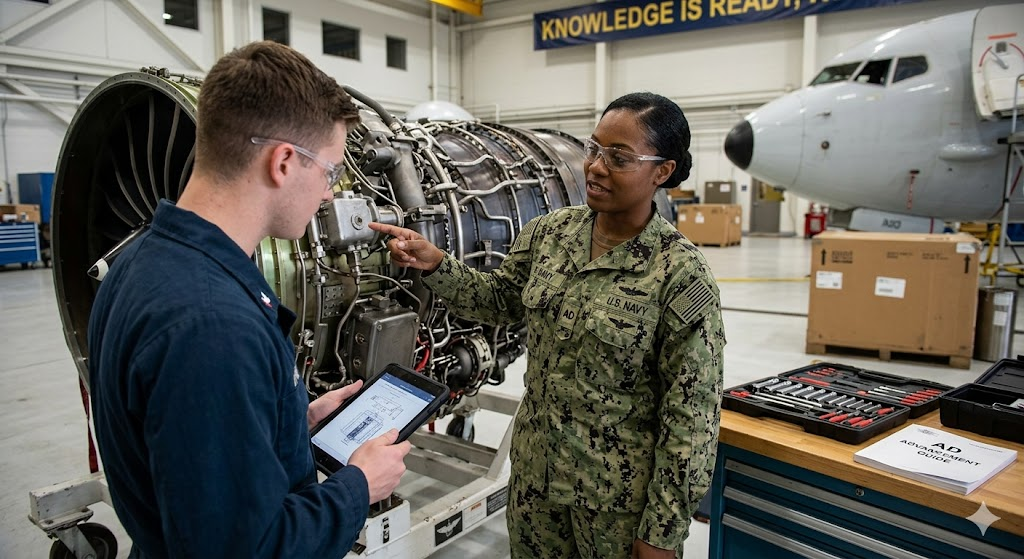
Additional Information
What the Course Entails and Exam Details
The path to passing the AD Advancement Exam is built upon formal Navy schooling, comprehensive on-the-job training, and persistent self-study. The core of your technical knowledge begins with AD Core and Strand “A” School, where you are taught the fundamentals of aviation basic theory, physics, gas turbine engine components, and the basic skills required for the rating.
Following school, your daily responsibilities involve maintaining and servicing crucial aircraft systems, including engine fuel and lubrication systems, handling aircraft ashore and aboard ship, and performing complete turboshaft and turboprop engine repairs.
The exam itself is a comprehensive test of this accumulated knowledge, structured by paygrade. While specific contents are updated regularly, the primary domains of knowledge always center on the essential duties of an AD, including but not limited to:
Engine Systems Maintenance (Turbofan, Turboshaft, Turboprop).
Propeller Systems Maintenance.
Fuel, Lubrication, and Accessory Gearbox Systems.
Auxiliary Power Systems and APU Maintenance.
Line Maintenance and Flight Deck Operations.
Aircraft Corrosion Control.
Maintenance Administration and Quality Assurance.
What to Expect in the Final Exam
The final step in your advancement journey is the Navy-Wide Advancement Exam (NWAE), a rigorous assessment of your technical skills. You can expect a structured exam consisting of approximately 175 multiple-choice questions designed to test your understanding of the material specified in your paygrade’s bibliography. The exam is typically time-limited, often allowing for three clock hours of testing time.
The final score on this exam is a critical component of your Final Multiple Score (FMS), which is the number used to determine your advancement among all candidates. Scoring is competitive, meaning you are being ranked against your peers Navy-wide; therefore, a high score is essential for a high probability of selection. Specific rules and eligibility requirements, such as time-in-rate and commanding officer recommendation, are strictly enforced, and you should always refer to the latest NAVADMIN messages and MyNavyHR guidance for the most current regulations.
How to Study and Exam Centers
Effective preparation requires a disciplined and multifaceted study strategy. Your primary resource must always be the official Bibliography for the Advancement Exam (BIB), which is updated for every exam cycle and lists the specific references from which every question is drawn.
Implement these actionable strategies for success:
Create a Timeline: Start your preparation at least four months before the exam date.
Analyze Profile Sheets: Review your previous exam profile sheets to identify weak areas.
Active Recall: Utilize flashcards for key terms, systems, and procedures.
Form Study Groups: Collaborating with peers allows for knowledge sharing and mutual encouragement.
Hands-On Learning: Leverage your daily tasks; perform maintenance "by the book," as the exam focuses on standardized procedures.
The Navy-Wide Advancement Exam is administered under the direction of your command's Educational Services Officer (ESO) and is taken at your specific duty station, whether at sea aboard a ship or ashore at a naval installation, airstrip, or training command. These exams are scheduled events occurring twice a year for E4-E6 candidates, with specialized scheduling for other paygrades and reserve components.
Job Opportunities from the Course
A successful career and the resulting advancements within the Aviation Machinist's Mate rating unlock a progression of military roles, specialized career paths, and valuable skills that are highly transferable to the civilian sector.
Your advancement paves the way for the following specific job titles and career paths:
Navy Advanced Roles: AD3 (Third Class Petty Officer), AD2 (Second Class Petty Officer), AD1 (First Class Petty Officer), ADC (Chief Petty Officer), ADCS (Senior Chief Petty Officer), ADCM (Master Chief Petty Officer).
Navy Specializations: Positions in Quality Assurance, Maintenance Administration, specialized Aircraft Intermediate Maintenance Detachments (AIMD), and flight deck or flight line troubleshooters.
Civilian Industry Paths: Aircraft Powerplant Mechanic (A&P license required), Jet Engine Technician, Turboprop Mechanic, Aerospace Quality Control Inspector, CNC or Conventional Machinist, First-Line Supervisor of Mechanics, Engine and Machine Assembler, maintenance roles within major airlines or aerospace manufacturers.
By mastering the AD Advancement Practice Exam and the subsequent official exam, you ensure your future readiness and open the door to a rewarding and influential career in both military and civilian aviation maintenance.
Frequently Asked Questions
Reviews
5.0
Based on 0 reviews
Leave a Review
No reviews yet. Be the first to review!