
Aviation Ordnanceman (AO) Advancement Practice Exam
$69.00
- Buy to unlock unlimited access to all Quiz questions and Answers in this Quiz.
- After purchase you can print a PDF of the whole quiz at any point. The PDF will contain the questions and the correct answers.
About this Exam
The Aviation Ordnanceman (AO) rating is the backbone of the Navy's aerial strike capability. AOs are responsible for the handling, servicing, and inspection of all air-launched weapons, including bombs, rockets, missiles, and ammunition. This advancement exam is designed to validate the technical knowledge, safety consciousness, and leadership potential of AOs as they progress through the ranks. It is a critical milestone, ensuring that only those with the demonstrated competence and responsibility are entrusted with the powerful ordnance that defines this rating. This practice exam is designed for enlisted Navy personnel current in, or striking for, the AO rating.
Ready to test your knowledge?
Buy Now to Access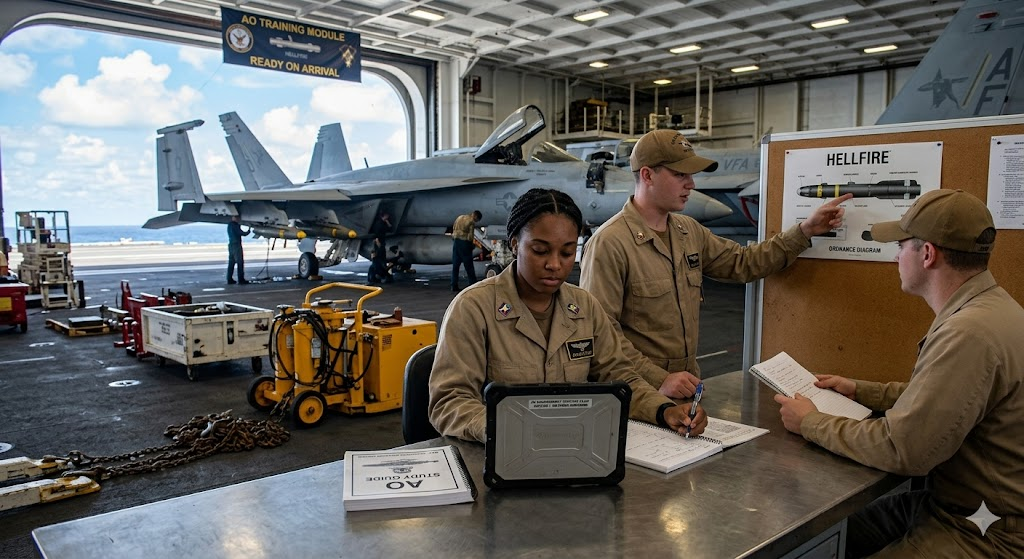
Additional Information
What the Course Entails and Exam Details
This examination does not originate from a single 'course' but rather assesses the culmination of your on-the-job training (OJT), formal 'A' and 'C' school instruction, and self-study of professional military education (PME). The core topics covered in the AO advancement exam align with the applicable Naval Education and Training Command (NAVEDTRA) manuals and Navy Wide Advancement Exam (NWAE) topic lists for your specific paygrade. Key areas include:
Ordnance Safety: This is paramount. Expect heavy emphasis on HERO (Hazards of Electromagnetic Radiation to Ordnance) classifications, safe handling procedures, and storage regulations.
Weapons Systems: Comprehensive knowledge of various air-launched munitions (missiles, bombs, rockets, torpedoes), their components, and guidance systems.
Ordnance Handling Equipment (OHE): Operation, maintenance, and safety inspections of bomb hoists, trucks, skids, and other handling gear.
Armament Weapons Support Equipment (AWSE): Testing and maintenance of the equipment used to verify weapons system functionality.
Aircraft Armament Systems: Understanding the specific racks, launchers, and gun systems installed on various Navy aircraft (e.g., F/A-18, P-8, MH-60).
Magazines and Stowage: Rules for proper ammunition stowage, compatibility groups, and magazine sprinkler systems.
Administration and Quality Assurance (QA): Knowledge of OPNAV instructions, maintenance technical manuals, and QA procedures crucial for ordnancemen.
What to Expect in the Final Exam
The actual Navy Wide Advancement Exam (NWAE) for AO is a formal, closed-book, multiple-choice test administered by the Navy. The specifics can vary slightly by paygrade cycle, but you should generally expect the following:
Format: The exam consists entirely of multiple-choice questions. These questions are designed to test your recall of facts, understanding of concepts, and ability to apply safety principles.
Number of Questions: For E-4 through E-6 candidates, the exam typically contains 175 questions, with 150 technical (rating-specific) and 25 professional military knowledge (PMK) questions.
Time Limit: You will usually have three hours to complete the examination.
Passing Score: There isn't a single 'passing' score in the traditional sense. Your Final Multiple Score (FMS), which combines your exam performance with other factors like performance evaluations (PMA) and time-in-rate, determines your ranking against your peers. Higher scores increase your advancement opportunity.
Specific Rules: No external materials are permitted. The exam is proctored, and strict adherence to integrity guidelines is mandatory.
How to Study and Exam Centers
Effective preparation requires a structured approach and active engagement with the material.
Study Actionable Strategies:
Prioritize the Bibs: Your most important resource is the Bibliography for Advancement (Bibs). This official list, released by the Navy Advancement Center, tells you exactly which manuals and instructions are used to write the exam. Focus your studying primarily on these references.
Take Practice Exams: Utilize available practice exams. These help you get familiar with the question format, identify your knowledge gaps, and practice managing your time. Analyze your mistakes on practice tests to focus your remaining study time effectively.
Focus on Safety: Since safety is critical in the AO rating, dedicate significant study time to HERO classifications, handling procedures, and compatibility charts. You can expect multiple questions in this area.
Create Flashcards: Use physical or digital flashcards for key terms, equipment types, and specific regulatory instructions.
Form Study Groups: Collaborating with other AOs, especially those at different experience levels, can provide new perspectives and clarify difficult concepts.
Utilize the PMK-EE: Ensure you have completed your Professional Military Knowledge Eligibility Exam (PMK-EE) online via MyNavy Portal well before the NWAE date, as it is a prerequisite for advancement.
Exam Centers and How to Take the Exam:
The Navy Wide Advancement Exam is not taken at civilian testing centers like Pearson VUE.
The exam is typically administered twice a year (March and September for E-4 through E-6) on your military installation or onboard your ship.
Coordination is handled through your command's Educational Services Officer (ESO) and training department. They will provide information on the exact date, time, and location of your exam. Ensure you communicate regularly with your ESO to verify you are on the eligibility list and have completed all requirements.
Job Opportunities from the Course
Advancing in the Aviation Ordnanceman rating opens doors to increased responsibility, leadership roles, and specialized technical paths within Naval Aviation. The skills you master directly translate to various critical roles:
AO Petty Officer Third Class (E-4): Initial leadership role, responsible for supervising small teams in ordnance handling and basic maintenance.
AO Petty Officer Second Class (E-5): Leading complex ordnance operations, conducting detailed weapon systems inspections, and acting as a primary instructor for junior personnel.
AO Petty Officer First Class (E-6): Section Leader or Quality Assurance (QA) Representative, managing large-scale ordnance evolutions, ensuring regulatory compliance, and leading entire shifts.
Chief Aviation Ordnanceman (E-7 and above): Senior enlisted leadership, managing entire divisions, overseeing all aviation ordnance operations for a squadron or ship, and advising the command on ordnance readiness.
Specialized Roles: Career paths can lead to specialized billets like Explosive Ordnance Disposal (EOD) technician (after rigorous selection and training), Fleet Readiness Center (FRC) component repair, or instruction at AO 'A' or 'C' schools.
Your dedication to studying for this advancement exam directly impacts not only your career progression but also the readiness and safety of your squadron and the entire Fleet. Approach your preparation with diligence and professionalism. Good luck, Ordnanceman!
Frequently Asked Questions
Reviews
5.0
Based on 0 reviews
Leave a Review
No reviews yet. Be the first to review!