
Aviation Ordnanceman (AO) Advancement Practice Exam.
$69.00
- Buy to unlock unlimited access to all Quiz questions and Answers in this Quiz.
- After purchase you can print a PDF of the whole quiz at any point. The PDF will contain the questions and the correct answers.
About this Exam
The Aviation Ordnanceman (AO) Advancement Exam is not a single certification, but a series of competitive tests used by the United States Navy to determine eligibility for promotion within the AO rating.
Aviation Ordnancemen are the backbone of Navy air power, responsible for the handling, stowage, inspection, assembly, and loading of all types of aviation ammunition, missiles, and bombs carried on Navy aircraft.
This advancement pathway is designed specifically for enlisted active-duty and reserve sailors serving in the AO rating who meet the required time-in-service and superior performance criteria.
Successfully passing this exam is crucial for rising in rank, increasing responsibilities, and unlocking the professional rewards of leading other ordnancemen in high-stakes environments.
Ready to test your knowledge?
Buy Now to Access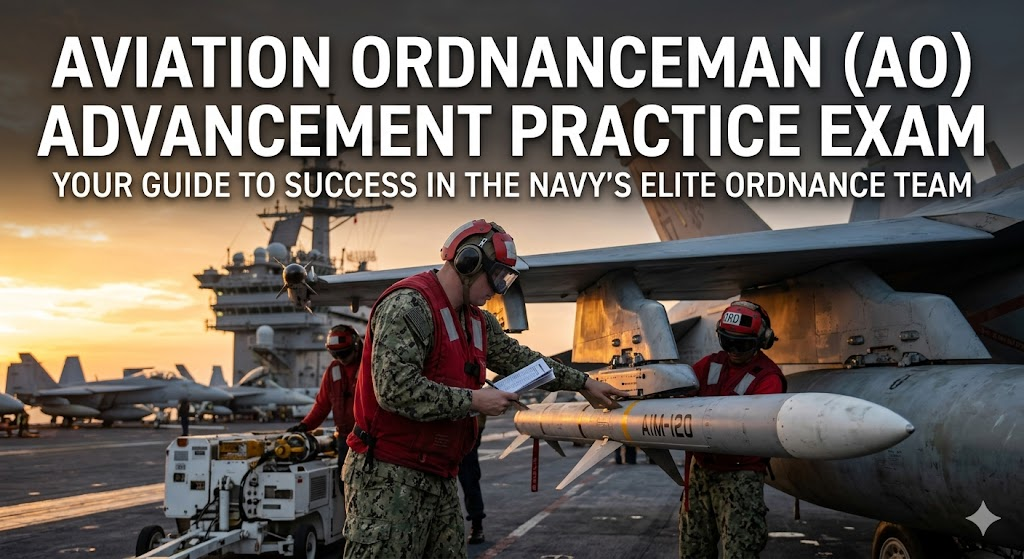
Additional Information
What the Course Entails and Exam Details
Preparing for this advancement requires mastering a vast body of knowledge rather than completing a single course, focusing heavily on official Navy publications, technical manuals, and explosive safety regulations.
Sailors must possess comprehensive knowledge of ammunition stowing and issuing procedures, including the strict adherence to regulations required when working with explosive materials.
Core technical skills covered include the complex assembly, testing, and loading of all types of aviation ammunition, torpedoes, missiles, and rockets used across various naval aircraft platforms.
The bibliography of study materials includes instructions on how to operate and maintain aircraft gun systems, bomb releasing mechanisms, and complex launching devices.
Furthermore, ordnancemen must understand advanced electrical and mechanical troubleshooting for ordnance systems and the required quality assurance documentation.
What to Expect in the Final Exam
The official Navy-Wide Advancement Exam (NWAE) is a rigorous, comprehensive closed-book test administered physically at military installations or designated testing locations globally.
It consists entirely of multiple-choice questions, which typically number around 175, testing your rapid recall and theoretical understanding of technical data.
Questions are strictly derived from the official "bibliography" (or "bibs") assigned for your specific rank (e.g., E-4, E-5, E-6, or E-7) and advancement cycle.
You will have a strict time limit, typically three hours, to complete the exam.
There is no fixed "passing score"; your score contributes to your overall Final Multiple Score (FMS), and you must score higher than your peers based on the Navy's advancement quotas for that cycle to earn promotion.
How to Study and Exam Centers
The key to unlocking your promotion is active and consistent studying; do not rely on passive reading or cramming at the last minute.
Your first step must be obtaining the official bibliography (bibs) from MyNavyHR for your desired paygrade, as this documents exactly what technical publications the questions will be based on.
Create or utilize existing flashcards (both physical and digital) for complex formulas, safety procedures, ammunition color codes, and technical weapon specifications.
Form study groups within your division to quiz each other and discuss tricky technical scenarios that may appear as scenarios on the exam.
Maximize your On-the-Job Training (OJT), as seeing, handling, and troubleshooting the actual ordnance equipment will solidify technical knowledge better than reading a manual alone.
Take advantage of Navy Advancement Center (NAC) resources, including practice quizzes and topic breakdowns, available on Navy e-Learning or through your command’s Educational Services Officer (ESO).
The official exam is taken at your command or designated military testing site, usually twice a year in March and September, and cannot be taken online outside of authorized military channels.
Job Opportunities from the Course
Earning advancements through this process significantly alters your military career path and boosts your leadership potential within the global structure of the Navy.
Each advancement increases your rank, pay, and leadership responsibilities, positioning you to lead ordnance teams on aircraft carriers, amphibious assault ships, and at naval air stations worldwide.
While primarily a military advancement, the deep technical knowledge of explosive safety, complex logistics, and advanced hydraulic and mechanical systems you master is highly sought after by major civilian defense contractors.
This dedication to advancement qualifies you for various rewarding career paths, including:
Aviation Ordnanceman Petty Officer (E-4 to E-6)
Aviation Ordnanceman Chief Petty Officer (E-7)
Explosive Safety Specialist (Military and Civilian Defense)
Defense Contractor Munitions Maintainer
Quality Assurance Inspector (Ordnance)
Aerospace Armament Systems Technician
Hazardous Materials Manager
Frequently Asked Questions
Reviews
5.0
Based on 0 reviews
Leave a Review
No reviews yet. Be the first to review!