
Aviation Safety and Security Practice Exam
$69.00
- Buy to unlock unlimited access to all Quiz questions and Answers in this Quiz.
- After purchase you can print a PDF of the whole quiz at any point. The PDF will contain the questions and the correct answers.
About this Exam
The aviation industry operates on a foundation of trust, where safety and security are non-negotiable priorities. The Aviation Safety and Security Practice Exam is a critical diagnostic tool designed for students, aspiring professionals, and current personnel preparing for formal certification or departmental assessments. This exam validates comprehensive knowledge of the protocols, regulations, and technologies used to safeguard passengers, crew, and infrastructure from accidental harm and malicious intent. It is specifically tailored for individuals pursuing careers as Aviation Security Officers (ASOs), Airport Safety Managers, Safety Management System (SMS) coordinators, ground handling supervisors, and regulatory compliance staff. Passing this assessment demonstrates a commitment to the industry’s most vital principles.
Ready to test your knowledge?
Buy Now to Access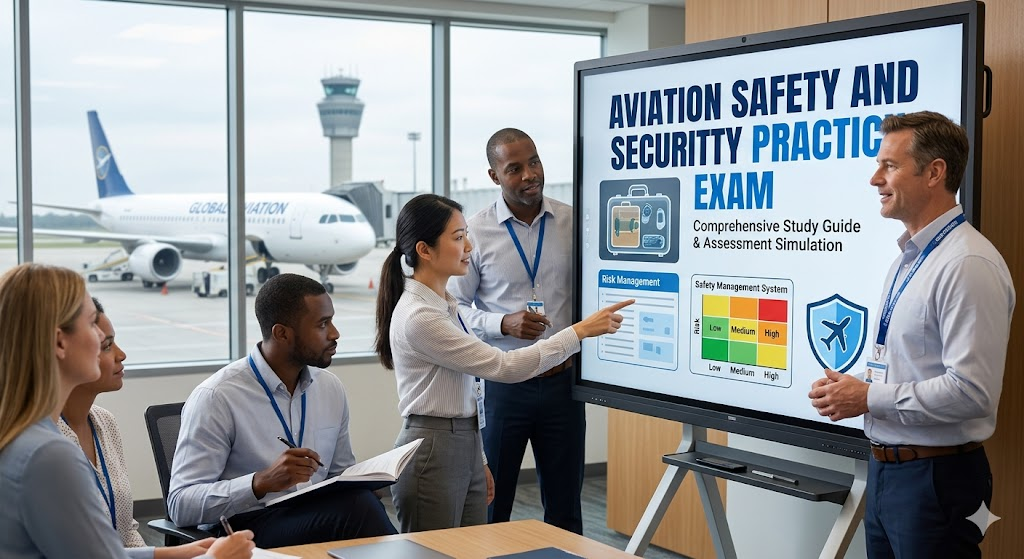
Additional Information
What the Course Entails and Exam Details
To succeed on this exam, candidates must possess a thorough understanding of the distinct yet integrated domains of safety (preventing accidents) and security (preventing intentional acts of harm). The underlying course of study traditionally entails a deep dive into international and national regulatory frameworks, including guidelines set by the International Civil Aviation Organization (ICAO) and specific state bodies like the TSA or EASA.
Key modules covered within the syllabus include:
Safety Management Systems (SMS): Understanding the four pillars of SMS—Safety Policy, Safety Risk Management, Safety Assurance, and Safety Promotion.
Aviation Security (AVSEC) Protocols: Master Passenger and Baggage Screening, Access Control, and Threat Detection.
Risk Assessment and Mitigation: Learning how to identify hazards, analyze risk levels, and implement effective controls.
Human Factors in Aviation: Analyzing how human performance, fatigue, and communication impact operational safety.
Emergency Response Planning: Developing protocols for incidents such as hijackings, bomb threats, and aircraft accidents.
Transportation of Dangerous Goods (DG): Recognizing classification, labeling, and handling procedures for hazardous materials.
Physical Security and Technology: Understanding the use of X-ray scanners, biometric systems, and CCTV in airport environments.
What to Expect in the Final Exam
While the format can vary depending on the certifying body, final exams in Aviation Safety and Security are rigorously designed to test both theoretical knowledge and practical application through scenario-based assessment. Candidates can generally expect a computer-based test consisting of multiple-choice questions, which may include interactive image interpretation (e.g., identifying threats in X-ray images).
Standard final exams typically have the following parameters:
Format: 60 to 100 Multiple-Choice Questions (MCQs).
Duration: Between 90 and 120 minutes, requiring efficient time management.
Passing Score: Usually between 70% and 80%, depending on the specific certification required by the employer or regulator.
Scenario Focus: Many questions will present a realistic operational scenario and ask for the most appropriate safety or security response.
Closed Book: Most assessments are strictly closed-book, demanding full recall of regulatory codes and procedures.
How to Study and Exam Centers
Effective preparation is key to conquering the Aviation Safety and Security assessment. The most successful approach is a tiered study strategy that begins with the official curriculum and utilizes practice exams iteratively. When taking practice tests, do not simply aim for the correct answer; analyze why the distractors are incorrect to deepen your conceptual understanding. Spend significant time reviewing ICAO Annex 17 (Security) and Annex 19 (Safety Management), alongside relevant local regulations. Simulate the real testing environment by taking a full-length practice exam under strict time constraints to build stamina and confidence.
Official examinations are typically administered in highly secure environments to maintain the integrity of the certification. Candidates have two primary options for taking the test:
Authorized Testing Centers: Many global certifications use recognized proctoring networks such as Pearson VUE or PSI, which have physical centers located worldwide.
Authorized Training Organizations (ATOs): If your certification is part of a university degree or specialized academy, you may take the exam at their authorized campus facilities.
Online Proctoring: Some modern platforms offer secure live online proctoring, allowing you to take the exam from a private room, provided your system meets strict technical and security specifications.
Job Opportunities from the Course
Earning a certification supported by an Aviation Safety and Security Practice Exam unlocks diverse career paths across the entire aviation sector, from airlines and airport authorities to regulatory bodies and private security firms.
The specific job titles and career paths this course prepares you for include:
Aviation Security Officer (ASO)
Airport Safety Manager
Safety Management System (SMS) Coordinator
Regulatory Compliance Inspector
Airport Operations Supervisor
Air Cargo Security Specialist
Ground Handling Safety Officer
Airline Security Manager
Aviation Accident Investigator
Human Factors Specialist
Frequently Asked Questions
Reviews
5.0
Based on 0 reviews
Leave a Review
No reviews yet. Be the first to review!