
Aviation Standard Test Battery-E (ASTB E) Practice Test
$69.00
- Buy to unlock unlimited access to all Quiz questions and Answers in this Quiz.
- After purchase you can print a PDF of the whole quiz at any point. The PDF will contain the questions and the correct answers.
About this Exam
Mastering the Aviation Standard Test Battery-E (ASTB-E) is the first critical step toward a distinguished career as a commissioned officer in naval aviation. The ASTB-E is the primary aptitude test used by the U.S. Navy, Marine Corps, and Coast Guard to select candidates for pilot and Naval Flight Officer (NFO) training programs.
This comprehensive exam does not just measure academic knowledge; it evaluates the specific intellectual abilities and personality traits essential for success in the high-stakes, dynamic environment of military flight. Whether you are a college student in NROTC, attending Officer Candidate School (OCS), or a civilian applying through a recruiter, your ASTB-E scores are a pivotal component of your application package.
A strong performance demonstrates your potential to handle the rigorous academic and practical demands of flight school, paving the way for you to lead at the forefront of military aviation.
Ready to test your knowledge?
Buy Now to Access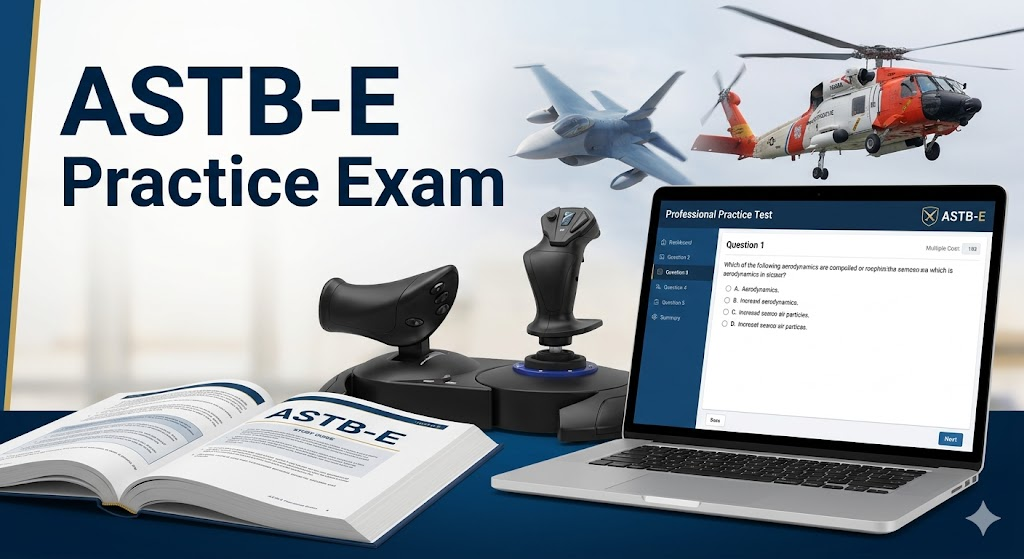
Additional Information
What the Course Entails and Exam Details
Preparing for the ASTB-E requires a multifaceted approach, as the exam is designed to test a wide spectrum of abilities. It is important to understand that the "course" is your own dedicated study regiment, as there is no single official prep course.
Your preparation must cover the seven core subtests that comprise the complete battery:
Math Skills Test (MST): This section tests your proficiency in arithmetic reasoning, algebra, geometry, and basic probability.
Reading Comprehension Test (RCT): You will need to extract meaning from technical and academic passages, identifying main ideas and making logical inferences.
Mechanical Comprehension Test (MCT): This subtest measures your understanding of basic physics principles, including mechanics, electricity, and fluid dynamics, as applied to simple machines and engines.
Aviation and Nautical Information Test (ANIT): This is a knowledge-based test covering aviation history, basic aerodynamics, flight rules, aircraft components, and nautical terminology.
Naval Aviation Trait Facet Inventory (NATFI): This personality assessment evaluates traits relevant to success in aviation training.
Performance Based Measures Battery (PBM): This unique, interactive section uses a joystick and throttle to measure your dexterity, situational awareness, and multitasking abilities through tracking tasks and dichotic listening.
Biographical Inventory with Response Validation (BI-RV): This questionnaire gathers information about your educational background and life experiences to predict success in flight training.
Students focusing solely on non-aviation officer roles may only be required to take the Officer Aptitude Rating (OAR), which consists only of the MST, RCT, and MCT sections. However, aspiring pilots and NFOs must complete the entire battery.
What to Expect in the Final Exam
The ASTB-E is a modern, computer-adaptive test (CAT) administered through the APEX system. This means the exam adapts to your ability level; answering a question correctly will lead to a more challenging subsequent question, while an incorrect answer will result in an easier one.
This format provides a precise measure of your aptitude but requires consistent focus. Because it is adaptive, you cannot skip questions or go back to change previous answers within the academic sections.
You should expect a testing session that lasts approximately 2 hours and 30 minutes for the full battery. While some sections are timed, others, like the personality inventories, are self-paced. The PBM section is particularly dynamic, requiring physical interaction with flight controls.
The scoring system is complex, yielding three component scores used for aviation selection: the Academic Qualifications Rating (AQR), the Pilot Flight Aptitude Rating (PFAR), and the Naval Flight Officer Flight Aptitude Rating (NFAR). It is vital to prepare thoroughly, as there is a strict lifetime limit of three attempts to take the ASTB-E, and you must wait at least 30 days between attempts.
How to Study and Exam Centers
Success on the ASTB-E demands a structured and rigorous study plan. Begin by taking a diagnostic ASTB-E practice test to identify your strengths and weaknesses across the different subtests.
For the MST and MCT, focus on reviewing fundamental mathematical concepts and physics principles. Utilize standard high school and college textbooks, or dedicated military flight aptitude test study guides.
For the ANIT, immerse yourself in aviation and nautical culture. Study basic aerodynamics manuals, review historical timelines of major aviation milestones, and familiarize yourself with naval terminology and ship classifications.
To prepare for the RCT, practice reading complex technical documents and summarizing their key points quickly and accurately. The PBM section is unique and benefits from practice with flight simulation software or specific ASTB preparation apps that mimic the multitasking and tracking challenges you will encounter.
The ASTB-E is administered electronically at specialized testing locations. These include Navy Recruiting Districts (NRDs), Military Entrance Processing Stations (MEPS), Naval Reserve Officers Training Corps (NROTC) units at various universities, and other authorized military installations. You must coordinate with your military recruiter or NROTC advisor to schedule your exam at an authorized center.
Job Opportunities from the Course
A qualifying score on the ASTB-E opens the door to the most coveted and challenging roles in military aviation. This exam is the key that unlocks specialized training pipelines, leading to dynamic careers across three military branches.
Here are the specific job titles and career paths this certification unlocks:
Naval Aviator (Pilot): Fly advanced fighter jets, helicopters, or maritime patrol aircraft from Navy aircraft carriers or air stations around the world.
Naval Flight Officer (NFO): Operate the advanced weapons systems, navigation, and communications equipment on aircraft like the F/A-18F Super Hornet or E-2D Advanced Hawkeye.
Marine Corps Pilot: Fly close air support missions in attack helicopters, operate transport aircraft, or pilot stealth fighters like the F-35B Lightning II.
Marine Corps Naval Flight Officer: Serve as the tactical systems operator in multi-crew Marine Corps aircraft.
Coast Guard Aviator: Perform critical search and rescue missions, enforce maritime laws, and conduct homeland security patrols flying helicopters or fixed-wing aircraft.
Frequently Asked Questions
Reviews
5.0
Based on 0 reviews
Leave a Review
No reviews yet. Be the first to review!