
Aviation Structural Mechanic Test 1 Practice
$69.00
- Buy to unlock unlimited access to all Quiz questions and Answers in this Quiz.
- After purchase you can print a PDF of the whole quiz at any point. The PDF will contain the questions and the correct answers.
About this Exam
The Aviation Structural Mechanic Test 1 is a pivotal assessment designed for aspiring aviation maintenance professionals seeking to specialize in airframes. This certification, often the first major hurdle for military personnel in the AM rating (Aviation Structural Mechanic) or civilian technicians aiming for their FAA Airframe rating, validates a candidate’s foundational knowledge of aircraft structures.
It is specifically designed for individuals who have completed initial technical training and are ready to demonstrate their competence in repairing, maintaining, and inspecting the vital structural components of fixed-wing and rotary-wing aircraft. Achieving success on this exam proves you possess the core technical skills necessary to ensure fleet readiness and flight safety.
Ready to test your knowledge?
Buy Now to Access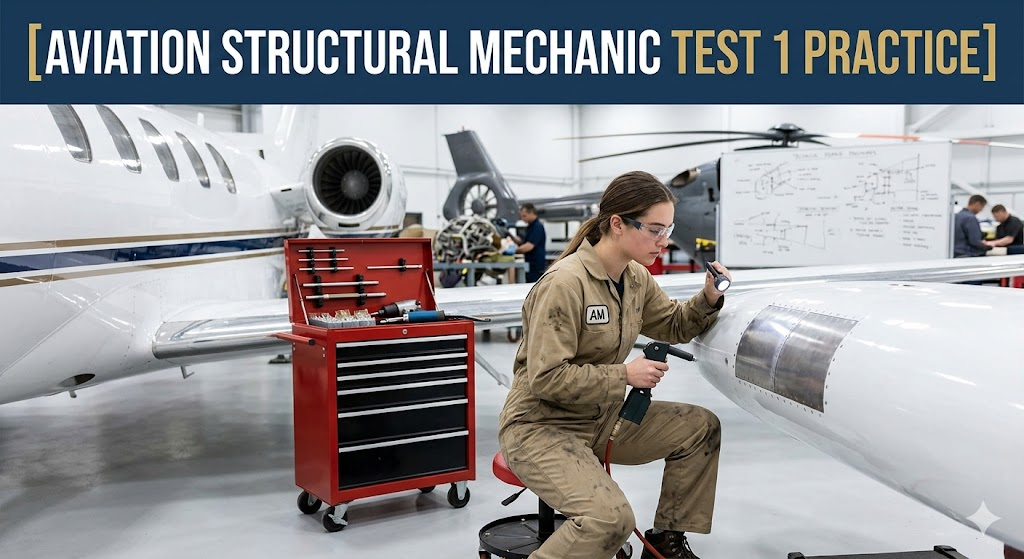
Additional Information
What the Course Entails and Exam Details
This comprehensive practice guide targets the diverse array of topics covered in the official syllabus. The exam evaluates your understanding of both theoretical concepts and practical applications across several key domains:
Aircraft Metallurgy and Materials: Identification, properties, and heat treatment of aerospace metals (aluminum, titanium, steel alloys) and composite materials.
Structural Repair Methods: Principles of sheet metal fabrication, riveting techniques, fastener installation, repair layout, and composite void/delamination repair.
Welding and Cutting: Fundamentals of oxy-fuel, TIG, and MIG welding processes applied to aviation structures, including safety and joint design.
Corrosion Control: Identification of various types of corrosion, inspection methods, prevention strategies, and approved removal and treatment processes.
Nondestructive Inspection (NDI): Basic understanding of NDI methods such as Dye Penetrant, Magnetic Particle, Eddy Current, and Ultrasonic testing.
Blueprint Reading and Technical Manuals: Interpreting engineering drawings, structural repair manuals (SRMs), and maintenance publications.
What to Expect in the Final Exam
While the exact format can vary slightly between military branches or specific civilian testing organizations, the final exam typically adheres to a standardized structure.
You should expect a rigorous, computer-based knowledge test consisting primarily of multiple-choice questions.
Number of Questions: The exam usually contains between 60 and 100 questions.
Time Limit: Candidates are typically allotted between 2 and 3 hours to complete the test.
Passing Score: A minimum score of 70% or higher is generally required to pass.
Format: The exam is closed-book. No outside reference materials, manuals, or smart devices are permitted within the testing area. A calculator may be provided by the testing center if required for specific math-based questions.
How to Study and Exam Centers
Effective preparation requires a mixture of study strategies. Do not rely solely on one method.
First, master the core publications. For military personnel, this means the relevant Naval Education and Training Professional Development Center (NETPDC) courses and NavAir manuals. For civilians, the FAA-H-8083 series (AMT Handbooks) are indispensable.
Second, utilize practice exams extensively. Taking a timed Aviation Structural Mechanic Test 1 Practice exam helps you identify knowledge gaps and get accustomed to the question phrasing and time pressure.
Third, engage in hands-on practice whenever possible. Reviewing structural repairs on an actual airframe reinforces theoretical knowledge.
Regarding exam centers: The physical test is administered at authorized locations. For US Navy personnel, this typically occurs via the Navy Advancement Center’s electronic testing system at your command or designated testing facilities. Civilian technicians will take their knowledge test at an FAA-approved Knowledge Testing Center, often managed by vendors like PSI or Pearson VUE, located at airports or aviation technical schools. You must register in advance and bring valid identification and required endorsements.
Job Opportunities from the Course
Earning this certification opens the door to numerous vital roles within the aerospace industry. By mastering these skills, you qualify for specialized positions in both military and civilian sectors.
Career paths unlocked by this qualification include:
Aviation Structural Mechanic (AM) - Military
Aircraft Structural Technician - Civilian
Sheet Metal Technician
Composite Repair Specialist
Airframe and Powerplant (A&P) Mechanic (upon completion of remaining requirements)
Aviation Maintenance Inspector
Nondestructive Inspection (NDI) Technician
Aircraft Manufacturing Technician
Frequently Asked Questions
Reviews
5.0
Based on 0 reviews
Leave a Review
No reviews yet. Be the first to review!