
Aviation Warrant Officer Intermediate Course (AWOIC) Entrance Practice Exam
$69.00
- Buy to unlock unlimited access to all Quiz questions and Answers in this Quiz.
- After purchase you can print a PDF of the whole quiz at any point. The PDF will contain the questions and the correct answers.
About this Exam
The Aviation Warrant Officer Intermediate Course (AWOIC) is a critical professional military education (PME) milestone for Army Aviators. This course is designed to transition Chief Warrant Officer 2s into senior Chief Warrant Officer 3s by enhancing their tactical, technical, and leadership skills. It moves beyond the foundational pilot skills learned in the Basic Course (WOBC) and focuses on integrating aviation assets into complex Unified Land Operations. If you are an Army Aviation Warrant Officer preparing for the next phase of your career leadership, this practice exam is an essential tool to validate your readiness and ensure you are prepared for the course’s rigorous academic demands.
Ready to test your knowledge?
Buy Now to Access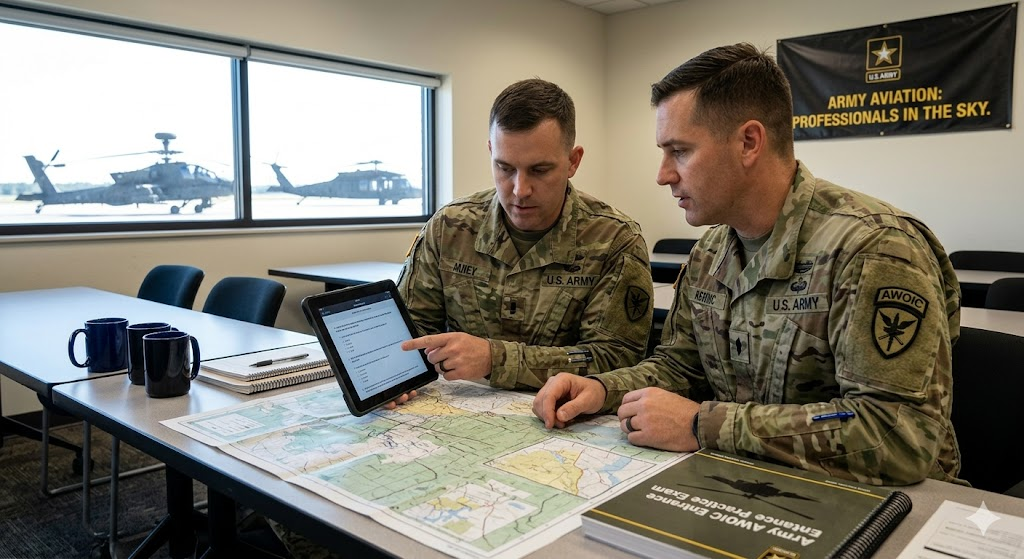
Additional Information
What the Course Entails and Exam Details
The AWOIC curriculum focuses on advanced leadership, staff operations, and the Military Decision-Making Process (MDMP). It prepares officers to function as effective members of a battalion or brigade staff. The course integrates multi-domain operations, risk management, and training management. The entrance practice exam evaluates your retention of core prerequisite knowledge from WOBC and operational experience.
The core topics you must master, which are covered in the pre-course assessment and this practice guide, include:
Army Doctrine and Leadership: In-depth knowledge of FM 3-0 (Operations), ADP 6-22 (Army Leadership), and aviation-specific doctrine (FM 3-04).
Mission Command and Staff Roles: Understanding the role of the Warrant Officer within the staff and the synchronization of aviation with ground forces.
Aviation Operations: Rules and regulations of flight (AR 95-1), standardized safety procedures, and aircraft general knowledge.
Tactical Employment: Planning and executing complex aviation missions, including Air Assault and Medevac operations.
What to Expect in the Final Exam
While AWOIC includes various graded elements during the resident phase, the prerequisite validation is your first major hurdle. The entrance practice exam is modeled after the types of standardized evaluations administered by the U.S. Army Aviation Center of Excellence.
You can generally expect the prerequisite evaluation to have the following characteristics:
Format: A timed, computerized assessment consisting primarily of multiple-choice and matching questions.
Scoring: Candidates must typically achieve a score of 80% or higher to validate prerequisite knowledge.
Focus: A heavy emphasis on memory recall and scenario-based application of current Army regulations and doctrine.
Integrity: The assessment is taken under strict academic integrity standards, reflecting the professionalism expected of an intermediate-grade officer.
Using this practice guide will help you build the speed and accuracy required to pass this assessment efficiently.
How to Study and Exam Centers
Effective study for AWOIC requires a return to doctrinal fundamentals rather than relying solely on operational experience.
Actionable Study Strategies:
Back to Basics: Review your WOBC materials and current Field Manuals. If it has been several years since you attended PME, do not rely on memory alone.
Use the Practice Exam: Take the practice exam early to identify weaknesses. Review the detailed explanations for every missed answer to understand the "why" behind the regulation.
Active Study: Create flashcards for key acronyms, regulatory requirements from AR 95-1, and the steps of the MDMP.
Study Groups: Collaborate with peers who have recently completed the course to understand the current focus of the curriculum.
Exam Centers:
The AWOIC resident course and its initial validation assessments are held exclusively at the U.S. Army Aviation Center of Excellence at Fort Novosel (formerly Fort Rucker), Alabama. Some pre-course material or prerequisite exams may be administered via distant learning portals (such as Blackboard or the Army Learning Management System), but the core course and final validation are completed in person.
Job Opportunities from the Course
Successful completion of AWOIC is mandatory for promotion to Chief Warrant Officer 3 (CW3). Graduating from this course significantly increases your competitiveness and eligibility for advanced key staff roles within your aviation unit.
This certification and the subsequent increase in rank unlock several specific career paths and job titles, including:
Battalion or Brigade-level Operations Officer (S-3 staff).
Aviation Tactical Operations Officer (TACOPS).
Standardization Instructor Pilot (SI/SP).
Senior Aviation Safety Officer (ASO).
Aviation Maintenance Officer leadership roles.
Eligibility for follow-on assignments at the Division or Corps level.
Prerequisite for eventual attendance at the Warrant Officer Senior Service Education (WOSSE).
Frequently Asked Questions
Reviews
5.0
Based on 0 reviews
Leave a Review
No reviews yet. Be the first to review!