
Aviation Weather (WX) 301 Test 1 Practice
$69.00
- Buy to unlock unlimited access to all Quiz questions and Answers in this Quiz.
- After purchase you can print a PDF of the whole quiz at any point. The PDF will contain the questions and the correct answers.
About this Exam
Prepare to elevate your understanding of meteorological phenomena with the Aviation Weather WX 301 Test 1 Practice! This study guide is tailored specifically for students enrolled in or preparing for advanced aviation weather coursework (often part of a professional pilot, air traffic controller, or dispatcher training program). The underlying WX 301 course moves beyond basic weather concepts, deep-diving into the critical interpretation and practical application of weather data for flight operations. This practice test is an essential tool to gauge your readiness for the first major assessment of this demanding and highly relevant material.
Ready to test your knowledge?
Buy Now to Access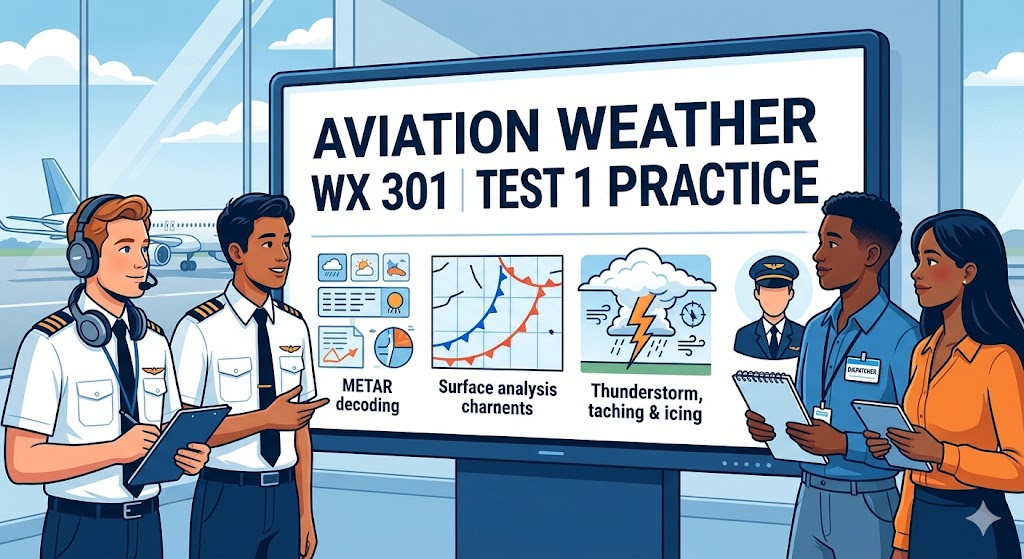
Additional Information
What the Course Entails and Exam Details
The comprehensive WX 301 course focuses on understanding the atmosphere, recognizing hazards, and proficiently using meteorological reports and forecasts. The first major exam (Test 1) typically covers a significant portion of the foundational and observational aspects. You can expect topics such as:
Advanced Atmospheric Dynamics: Deep understanding of pressure systems, air masses, and frontal boundaries.
Interpretation of Meteorological Reports: Mastery of METARs, TAFs, PIREPs, and surface analysis charts.
Aviation Weather Services: In-depth knowledge of various weather briefing resources and products.
Weather Hazards: Identification and analysis of phenomena like turbulence, icing, fog, and thunderstorms, with a focus on their impact on flight.
The course aims to equip you with the skills to make critical go/no-go decisions based on accurate weather interpretation.
What to Expect in the Final Exam
The actual WX 301 Test 1 is typically a rigorous, timed assessment designed to test both knowledge and speed of application. While specific formats vary by institution, it is generally structured as follows:
Format: Primarily multiple-choice questions, which may include matching and true/false. Many questions are scenario-based, requiring you to interpret real weather charts or reports.
Time Limit: Usually between 60 to 90 minutes. Efficiency is crucial.
Passing Score: A strong understanding is required, typically with a minimum passing grade around 70-80%, reflecting the critical nature of weather in aviation.
Specific Rules: Often, no outside materials, phones, or unauthorized aids are allowed. Scratch paper and a calculator may be permitted, depending on the test setting.
How to Study and Exam Centers
To succeed in this challenging exam, consistent and varied study is paramount. We recommend the following actionable strategies:
Review Course Material: Thoroughly go over your lecture notes, textbooks, and any specific WX 301 study guides provided by your instructors.
Practice with Real Reports: Don't just memorize codes; practice decoding and interpreting a variety of live and historical METARs, TAFs, and charts. Make sure you can visualize the weather they describe.
Use Simulators and Online Tools: Utilize online weather resources, flight simulators, and interactive modules to see weather dynamics in action.
Form Study Groups: Collaborating with peers can provide new insights and help clarify difficult concepts.
Take Practice Tests: Actively engage with practice questions, like those found here, to familiarize yourself with the question style and manage your time effectively.
The WX 301 Test 1 is typically administered in person at your specific university, flight school, or aviation academy. Online test portals may be used by some institutions, but proctored physical settings are most common. Consult your course syllabus or administrator for exact location details.
Job Opportunities from the Course
Completing advanced aviation weather coursework unlocks numerous career paths within the aviation industry, where meteorology is a critical component. Specific job opportunities include:
Commercial Pilot: Essential for safe flight planning and decision-making.
Air Traffic Controller: Critical for directing air traffic around hazardous weather conditions.
Aircraft Dispatcher: Responsible for planning flight routes, calculating fuel, and ensuring safety, all heavily reliant on weather analysis.
Flight Instructor: Teaches subsequent generations of pilots about aviation weather.
Aviation Meteorologist: Works for weather services or airlines specializing in aviation forecasts.
Airport Manager: Uses weather knowledge for ground operations and safety protocols.
Good luck with your preparation for the Aviation Weather WX 301 Test 1 Practice! With dedicated study and practice, you will be well on your way to mastering this vital subject.
Frequently Asked Questions
Reviews
5.0
Based on 0 reviews
Leave a Review
No reviews yet. Be the first to review!