
Avionics Corrosion Control Practice Test
$69.00
- Buy to unlock unlimited access to all Quiz questions and Answers in this Quiz.
- After purchase you can print a PDF of the whole quiz at any point. The PDF will contain the questions and the correct answers.
About this Exam
The world of aviation maintenance demands specialized knowledge to ensure the safety and reliability of complex aircraft systems. Among the most insidious threats to these systems is chemical degradation. The Avionics Corrosion Control qualification is a specialized certification designed for aviation maintenance professionals who seek to master the detection, prevention, and remediation of electrochemical degradation within sensitive aerospace electronics. This certification is ideal for certified Airframe and Powerplant (A&P) mechanics, specialized avionics technicians, and students enrolled in aviation maintenance technology programs who want to distinguish themselves in a competitive job market. Possessing this knowledge demonstrates a commitment to preserving critical systems like communication, navigation, and flight control arrays in commercial, military, and general aviation sectors.
Ready to test your knowledge?
Buy Now to Access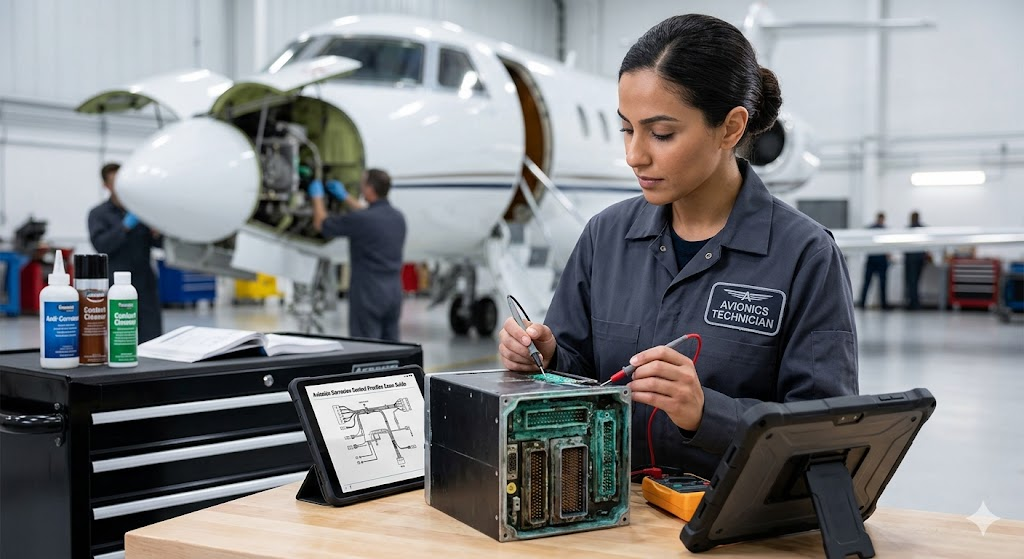
Additional Information
What the Course Entails and Exam Details
This comprehensive course delves deeply into the science of electrochemical degradation within aerospace environments. You will learn not just what corrosion is, but exactly how it forms and travels within critical electronic components. The syllabus covers the microscopic interactions between different metals, environmental factors, and electrical currents. You will master standard practices for treating hidden damage in wiring harnesses, connectors, antenna bases, and complex line-replaceable units (LRUs or "black boxes"). Core topics typically include:
Fundamentals of Corrosion Theory and Electrochemical Cells
Types of Corrosion Specific to Electronics (Galvanic, Fretting, Pitting)
Identification of Corrosion-Prone Areas in Avionics Bays
Advanced Visual and Non-Destructive Inspection (NDI) Techniques
Chemical and Mechanical Corrosion Removal Methods
Application of Protective Coatings, Sealants, and Lubricants
Documentation Standards, Safety Protocols, and Environmental Regulations
What to Expect in the Final Exam
The final certification exam is rigorously designed to test both your theoretical understanding and your practical application skills regarding real-world maintenance scenarios. While specific formats can vary by issuing organization, candidates should generally prepare for a challenging computerized knowledge assessment.
Format: The primary component is a multiple-choice knowledge exam. Some premium certifications might also include a separate practical evaluation where you must demonstrate proper inspection or remediation techniques.
Number of Questions: The written exam typically consists of 50 to 100 questions, balanced across the major topic areas outlined in the syllabus.
Time Limit: You will usually have between 90 and 120 minutes to complete the knowledge exam, requiring efficient time management and confidence in your recall.
Passing Score: Achieving a passing grade typically requires a minimum score of 70% or 80%. Expect many questions to focus on diagnosing issues based on visual scenarios (photographs of damaged components) and selecting the correct FAA-approved remediation procedure for a specific alloy or component type.
How to Study and Exam Centers
Maximizing your success on the Avionics Corrosion Control exam requires a structured study plan that combines theoretical study with practical familiarity.
Actionable Study Strategies:
Study Official Documentation: Your primary study resources should be official FAA Advisory Circulars, particularly AC 43-1A, "Acceptable Methods, Techniques, and Practices - Aircraft Inspection and Repair," and the relevant volumes of FAA-H-8083-31A (Aviation Maintenance Technician Handbook—Airframe). Military technicians should focus on their specific technical manuals (TMs).
Take Practice Tests Repeatedly: The single most effective way to prepare is by using the [Avionics Corrosion Control Practice Test]. This simulates the actual testing environment, helps you manage your time, identifies your knowledge gaps, and familiarizes you with the phrasing of standard maintenance questions.
Use Flashcards for Chemical Compounds: Memorize the specific uses, limitations, and safety hazards of various anti-corrosion compounds, solvents, and sealants. You must know which chemicals are safe for specific types of electrical connectors.
Seek Practical Observation: If you are currently working in a maintenance facility, ask experienced technicians to show you corrosion "hot spots" on aircraft currently undergoing heavy maintenance. Seeing the damage in person is invaluable context for the theoretical questions.
Exam Centers and Registration:
This certification is not typically administered at general testing facilities like Pearson VUE. Instead, testing is usually facilitated through Federal Aviation Administration (FAA) approved Part 147 Aviation Maintenance Technician Schools, specialized technical colleges, or authorized military training centers. Many large Maintenance, Repair, and Overhaul (MRO) facilities offer the training and testing in-house for their employees. You must register for the exam directly through the authorized training provider or educational institution administering the course.
Job Opportunities from the Course
Earning a specialist qualification in Avionics Corrosion Control makes you a highly valued asset to airlines, defense contractors, and specialized MRO facilities, as preventing electronic failure is much more cost-effective than replacing entire systems.
Potential career paths and job titles include:
Lead Avionics Technician
Avionics Corrosion Control Specialist
Aircraft Maintenance Inspector (QA/QC)
Fleet Maintenance Supervisor
Maintenance, Repair, and Overhaul (MRO) Technician
Component Overhaul Specialist
Military Aircraft Systems Repairer
Frequently Asked Questions
Reviews
5.0
Based on 0 reviews
Leave a Review
No reviews yet. Be the first to review!