
Avionics Fundamentals Practice Test
$69.00
- Buy to unlock unlimited access to all Quiz questions and Answers in this Quiz.
- After purchase you can print a PDF of the whole quiz at any point. The PDF will contain the questions and the correct answers.
About this Exam
The Avionics Fundamentals exam is a foundational assessment designed for individuals aspiring to enter the field of aviation electronics (avionics). It is typically intended for entry-level technicians, aircraft mechanics looking to specialize, and students enrolled in aviation maintenance programs. This certification validates a basic understanding of electrical theory, aircraft systems, and safe maintenance practices required to work on sophisticated aircraft electronics. Achieving success on this exam demonstrates readiness for more advanced, specialized avionics training.
Ready to test your knowledge?
Buy Now to Access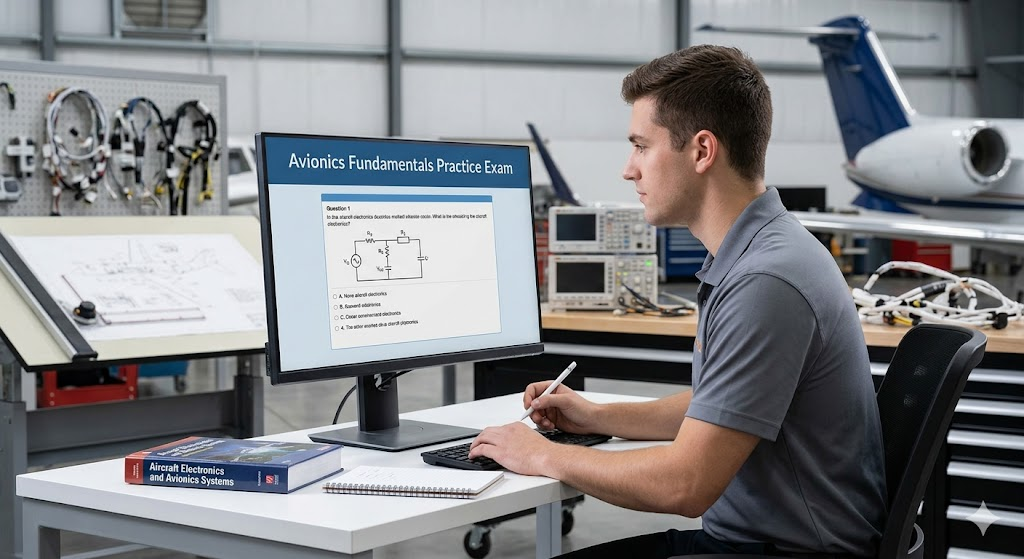
Additional Information
What the Course Entails and Exam Details
The material covered by the Avionics Fundamentals exam focuses on core competencies essential for an electronics technician in the aviation industry. Key areas of the syllabus usually include:
Basic Electricity and Electronics: A thorough understanding of AC/DC circuits, voltage, current, resistance, Ohm's law, and Kirchhoff's laws is critical. You must be comfortable with schematics and electrical components.
Digital Electronics and Logic Gates: This section covers binary numbers, logic gates (AND, OR, NOT), and the basic principles of digital systems prevalent in modern aircraft.
Aircraft Wiring and Installation Practices: Proper techniques for handling wires, installing connectors, shielding, and adhering to aviation standards for wiring maintenance are emphasized.
Communication and Navigation Systems: Candidates must understand the fundamentals of aircraft radios (VHF/UHF), antenna principles, and basic navigation systems like VOR and ILS.
Test Equipment and Troubleshooting: Knowing how to use multimeters, oscilloscopes, and specialized avionics test sets to diagnose electrical problems safely is a major component of the exam.
What to Expect in the Final Exam
The Avionics Fundamentals final exam typically follows a standardized, objective format designed to test both knowledge and application.
Format: The exam is almost universally presented as a computer-based test consisting of multiple-choice questions. There is usually no practical hands-on component for this specific fundamentals knowledge exam.
Passing Score Requirements: A passing score is typically set in the range of 70% to 75%. It is important to aim higher during your preparation to ensure a solid margin.
Time Limits: Candidates are usually allotted a specific time limit to complete the exam, typically ranging from 90 to 120 minutes. Efficient time management is crucial.
Specific Rules: This is typically a closed-book exam. No reference materials, calculators with advanced functions, or personal electronic devices are permitted during the testing session.
How to Study and Exam Centers
Preparation for the Avionics Fundamentals exam requires a combination of self-study and practical application.
Active Recall and Practice Tests: This is the single most effective study method. Utilize resources like the specific "Avionics Fundamentals Practice Test" mentioned in the title to familiarize yourself with the question style and identify your weak areas. Take timed practice exams repeatedly.
Utilize Industry Handbooks: The Federal Aviation Administration (FAA) provides excellent, free study resources. Handbooks such as the FAA-H-8083-30A (Addendum) and the Avionics Technician Handbook (FAA-H-8083-31A) are invaluable.
Hands-on Practice: Whenever possible, reinforce theoretical knowledge with practical experience. Practice building basic circuits on breadboards and using a multimeter for testing.
Where to Take the Exam: The exam is often administered through authorized industry certification organizations, such as the National Center for Aerospace & Transportation Technologies (NCATT) or specific examining boards associated with aviation maintenance schools. Testing is typically conducted at proctored computer centers, including professional networks like Pearson VUE, or at authorized testing facilities within Part 147 aviation maintenance schools. You must register in advance and provide valid identification.
Job Opportunities from the Course
Obtaining an Avionics Fundamentals certification is a critical first step toward several rewarding career paths in the aviation maintenance sector. Graduates and certified individuals are prepared for entry-level roles such as:
Avionics Technician
Aircraft Electronics Mechanic
Aircraft Electrical Technician
Line Maintenance Technician (with focus on avionics)
Bench Technician (testing and repairing components off-aircraft)
In-flight Entertainment (IFE) Technician
This certification provides the necessary foundation to pursue advanced ratings, FAA Airframe and Powerplant (A&P) mechanics licenses, or specialized certifications from avionics manufacturers, all of which significantly expand career potential and earning power.
Frequently Asked Questions
Reviews
5.0
Based on 0 reviews
Leave a Review
No reviews yet. Be the first to review!