
AWF Test 9 Practice Exam
$69.00
- Buy to unlock unlimited access to all Quiz questions and Answers in this Quiz.
- After purchase you can print a PDF of the whole quiz at any point. The PDF will contain the questions and the correct answers.
About this Exam
Embarking on the journey to become a Naval Aircrewman – Mechanical (AWF) places you at the heart of naval aviation operations, where technical expertise, split-second decision-making, and teamwork are paramount. AWF personnel are the unsung heroes ensuring the mechanical integrity, safety, and operational readiness of complex Navy aircraft across diverse missions, from maritime patrol to strategic communications. This certification, and specifically the "Test 9," represents a significant milestone, designed for dedicated Navy personnel undergoing training to join this prestigious and highly specialized community. It validates the foundational and advanced knowledge required to operate and maintain critical aircraft systems in demanding environments, preparing you for the multifaceted challenges of flying duty and mechanical responsibility. Passing this test demonstrates your readiness to take on the role of a vital mechanical specialist in the fleet.
Ready to test your knowledge?
Buy Now to Access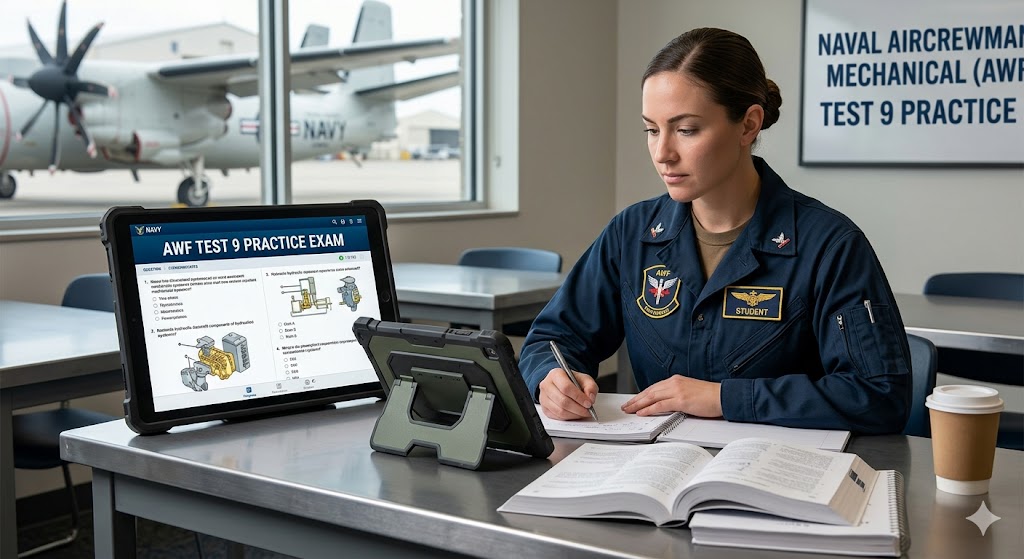
Additional Information
What the Course Entails and Exam Details
The AWF training pipeline is rigorous and comprehensive, covering a vast spectrum of aeronautical and mechanical subjects. Test 9, as a key component of this progression, deeply assesses your understanding across core areas, which typically include:
Aircraft Structures & Materials: Grasping the fundamentals of airframe construction, fatigue, and various materials used in aviation.
Hydraulic and Pneumatic Systems: Understanding the intricate power systems that actuate landing gear, flight controls, and other critical components.
Electrical Systems: Detailed knowledge of aircraft power generation, distribution, and essential avionics interfaces.
Powerplants and Propulsion: In-depth study of reciprocating and turbine engines, their components, operational principles, fuel systems, and troubleshooting techniques.
Flight Theory and Principles: Solid understanding of aerodynamics, stability, control, and performance factors for different types of Navy aircraft.
Aircraft Operational Procedures and Safety: Mastery of standard operating procedures, emergency protocols, and mandatory safety regulations for ground and in-flight operations.
Maintenance Fundamentals: Insight into Navy maintenance programs, documentation, inspection processes, and quality assurance standards.
The specific "Test 9 Practice" you are undertaking is a targeted tool, simulating the type and depth of questions you will encounter, enabling you to gauge your proficiency in these crucial mechanical and operational subjects. The ultimate AWF course itself is highly demanding, combining classroom instruction, extensive self-study, and practical, hands-on training tailored to the specific aircraft and duties you will be assigned to in the fleet. Succeeding in this test confirms your readiness to transition towards becoming a proficient operator and mechanic within a specialized aviation squadron.
What to Expect in the Final Exam
While exact details can be specific to current Navy training protocols, students can generally anticipate the final AWF Test 9 to be a rigorous, proctored knowledge-based examination. It is typically administered in a multiple-choice, matching, or diagram-based format, heavily emphasizing technical accuracy and procedural understanding rather than rote memorization. Candidates must achieve a high passing score, with standards that reflect the critical nature of the role. Be prepared for a substantial number of questions covering all the intricate systems and procedures detailed above. The time limit for the exam is carefully calculated to be challenging yet sufficient for a well-prepared candidate to think through complex scenarios and detailed systems, ensuring you can demonstrate your readiness under simulated operational constraints. Expect stringent closed-book conditions, where you must rely entirely on your learned knowledge and the extensive materials provided during your training.
How to Study and Exam Centers
Preparing for the AWF Test 9 requires dedication, a strategic approach, and consistent effort. Leverage these actionable study methods to maximize your chances of success:
Intense Study of Navy Manuals: Deeply engage with the primary Naval Air Training and Operating Procedures Standardization (NATOPS) manuals, technical publications, and training curricula provided to you. Treat these as your authoritative guides.
Utilize Practice Questions and Exams: Actively use this "Test 9 Practice" resource. Go beyond just checking answers; understand why each answer is correct or incorrect, and refer back to your source material for every question you struggle with. Simulating exam conditions is incredibly effective.
Group Study Sessions: Collaborate with fellow students. Explaining complex systems to others or having them teach you is one of the most powerful ways to solidify understanding and uncover knowledge gaps.
Visual Aids and Diagrams: Draw systems, color-code schematics, and create clear flowcharts for emergency procedures. Visual representation is crucial for understanding interconnected aircraft systems.
Practical Application: Whenever possible, relate theoretical knowledge to actual aircraft during practical training. Visually locating components and understanding their real-world function makes studying more concrete and memorable.
Consistent Review: Dedicate focused time each day or week to review past material. Spaced repetition is key to long-term retention.
Seek Clarification: Don't hesitate to ask your instructors and experienced aircrewman for clarification on any challenging topics. They are your best resource for expert insights.
Regarding exam locations, the AWF Test 9 is administered exclusively through standard official Navy channels. This typically occurs within secure testing facilities located directly at Naval Air Stations, Training Commands (such as Pensacola), or designated training schools associated with the Aircrewman pipeline. You will be scheduled for the exam through your command and training leadership, and you must adhere strictly to all official scheduling and logistical instructions. It is not taken at commercial Pearson VUE centers, but within the secure, proctored environment of standard military training commands.
Job Opportunities from the Course
Successfully completing the AWF training program and passing Test 9 opens the door to a challenging yet exceptionally rewarding career path as a vital member of the Naval Aircrewman – Mechanical community. This qualification is the direct prerequisite for a variety of critical roles on both fixed-wing and rotary aircraft throughout the Navy, including:
Naval Aircrewman – Mechanical (AWF): The primary designation, reflecting your mechanical expertise on operational aircraft.
Flight Engineer (FE): On aircraft like the P-3C Orion or E-6B Mercury, you will be responsible for pre-flight inspections, monitoring and controlling critical systems during flight, and managing aircraft power and mechanical well-being, directly contributing to mission success.
Crew Chief: Taking overall mechanical responsibility for aircraft, coordinating maintenance, and overseeing crew operations for specific rotary-wing and fixed-wing platforms.
Loadmaster: Planning and supervising the safe loading, securing, and offloading of cargo and passengers on versatile transport aircraft like the C-130 Hercules, CMV-22 Osprey, and others, ensuring proper weight, balance, and procedural adherence.
Maintenance Specialist: Leveraging your training to become a subject matter expert in aircraft systems, progressing into leadership roles within squadron maintenance departments.
Instructor: Upon gaining significant fleet experience, qualified aircrewman often return to training commands to instruct the next generation of AWF trainees, shaping the future of the rating.
UAS Mission Commander/Pilot/Operator: Utilizing your knowledge in unmanned systems operations for specific naval platforms.
This specialization also provides invaluable, highly transferrable technical and operational skills, well-regarded in civilian aviation, opening doors to careers in aircraft maintenance, operations management, and engineering in the private sector later on, leveraging your extensive military training and qualification.
Frequently Asked Questions
Reviews
5.0
Based on 0 reviews
Leave a Review
No reviews yet. Be the first to review!