
Axis Network Video Certification Practice Exam
$69.00
- Buy to unlock unlimited access to all Quiz questions and Answers in this Quiz.
- After purchase you can print a PDF of the whole quiz at any point. The PDF will contain the questions and the correct answers.
About this Exam
The Axis Certified Professional designation is the industry gold standard for validating expertise in IP video surveillance. This certification proves that you possess the advanced knowledge required to design, install, troubleshoot, and manage complex network video solutions. It is specifically designed for security professionals, network engineers, system architects, technical sales specialists, and installers who work extensively with Axis products and technologies. Earning this credential not only validates your technical skills but also demonstrates your commitment to quality and best practices in the rapidly evolving world of networked security systems. It is often a requirement for organizations aiming to become certified Axis partners.
Ready to test your knowledge?
Buy Now to Access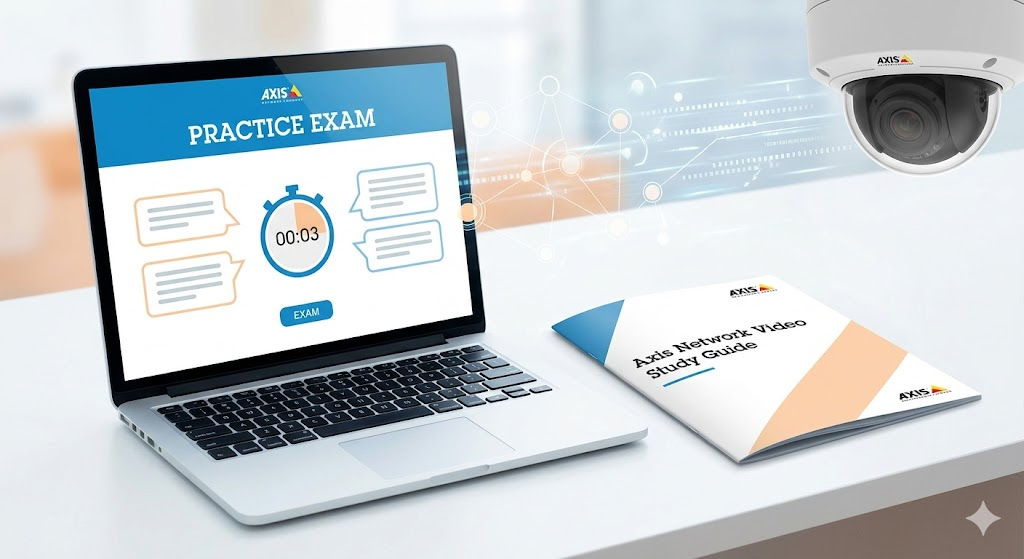
Additional Information
What the Course Entails and Exam Details
Preparing for the Axis Network Video Exam requires mastering a comprehensive syllabus that merges foundational networking theory with practical application. The official preparatory path often involves the "Network Video Fundamentals" training, although experienced professionals may choose self-study. The course and the subsequent exam cover five primary knowledge domains. These include System Design (matching camera capabilities to site requirements and calculating storage), Network Video Technology (understanding optics, image sensors, and compression standards like H.264/H.265), Networking (mastering IPv4/IPv6, PoE, QoS, and switching), Installation (best practices for mounting and lightning protection), and Cybersecurity (safeguarding the surveillance ecosystem). The exam consists of approximately 50 to 70 questions that must be completed within 90 minutes. It uses a scaled scoring system ranging from 200 to 800 points, with a passing score typically set at 600 points.
What to Expect in the Final Exam
You should expect a rigorous, computer-based testing experience managed by Pearson VUE. The final exam environment is closed-book and strictly proctored, ensuring the integrity of the certification. The questions are primarily multiple-choice (single or multiple correct answers) and may also include interactive drag-and-drop scenario questions that test your ability to configure or design a system visually. There is no partial credit for multiple-answer questions; you must select all correct options to receive points for that item. However, there are no deductions for incorrect answers, so it is beneficial to attempt every question. While the base testing time is 90 minutes, you should allocate additional time for the pre-exam tutorial and post-exam survey. Upon completion, you will receive an immediate pass/fail result at the testing center or online portal.
How to Study and Exam Centers
Actionable study strategies are crucial for success on the Axis Network Video Exam. You should start by thoroughly reviewing the official Axis Exam Preparation Guide to understand the weight of each topic. The most effective method is to combine official Axis Academy training (either instructor-led virtual sessions or in-person workshops) with extensive hands-on experience using Axis products and the Technical Guide to Network Video. Utilize the official Axis Knowledge Check and the full Axis Practice Exam available on the Axis Communications website; these tools mimic the final exam’s structure and difficulty level.
Regarding exam locations, Axis Communications partner with Pearson VUE to administer the test globally. You can take the exam at a physical Pearson VUE authorized testing center, which offers a structured, distraction-free environment. Alternatively, you may opt for online proctoring via Pearson VUE’s OnVUE system, allowing you to take the exam from your home or office while monitored by a live proctor through your webcam. Both options require pre-registration and payment through the Pearson VUE portal.
Job Opportunities from the Course
Earning the Axis Certified Professional designation unlocks numerous high-demand career paths within the physical security and IT integration sectors. This certification is highly regarded by employers because it validates that a candidate is job-ready and possesses standardized knowledge of the leading IP video platform.
The certification unlocks specific job titles, including:
Security Systems Technician
IP Video Field Engineer
Network Surveillance Architect
Security System Designer
Pre-Sales Technical Engineer (Security Solutions)
Physical Security IT Consultant
Frequently Asked Questions
Reviews
5.0
Based on 0 reviews
Leave a Review
No reviews yet. Be the first to review!