
Backflow Prevention Practice Exam
$69.00
- Buy to unlock unlimited access to all Quiz questions and Answers in this Quiz.
- After purchase you can print a PDF of the whole quiz at any point. The PDF will contain the questions and the correct answers.
About this Exam
The Backflow Prevention certification is essential for professionals dedicated to safeguarding public health by ensuring the integrity of potable water systems. This certification validates expertise in identifying cross-connections, understanding hydraulic principles, and correctly installing, testing, and maintaining backflow prevention assemblies. It is primarily designed for individuals working in plumbing, pipefitting, water distribution, irrigation installation, and fire sprinkler systems who are responsible for preventing contaminated water from flowing backward into clean water supplies.
Ready to test your knowledge?
Buy Now to Access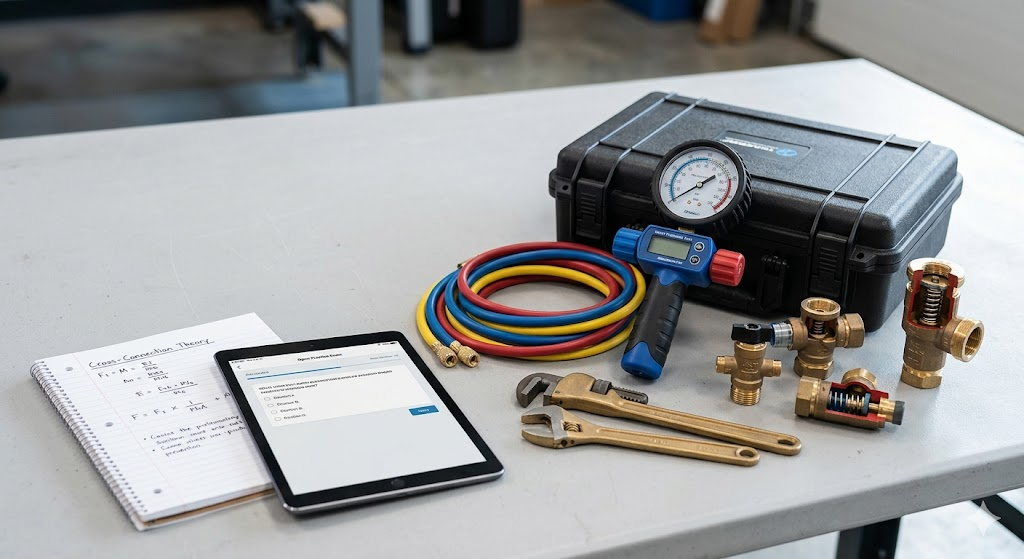
Additional Information
What the Course Entails and Exam Details
Preparing for the Backflow Prevention exam involves a comprehensive understanding of both theory and practical application. The course syllabus typically covers the following core topics:
Cross-Connection Control Theory: Understanding the definitions, types, and risks associated with cross-connections in various piping systems.
Hydraulics and Backflow Mechanics: Mastery of the principles of backpressure and backsiphonage, the two primary causes of backflow.
Backflow Prevention Assemblies: In-depth study of different types of assemblies, including Reduced Pressure Zone (RPZ) assemblies, Double Check Valve (DCV) assemblies, Pressure Vacuum Breakers (PVB), and Atmospheric Vacuum Breakers (AVB), including their application and limitations.
Testing Procedures: Learning the precise, step-by-step field test procedures required by regulatory agencies (such as ASSE standards) for each type of backflow assembly using specialized test gauges.
Troubleshooting and Maintenance: Developing skills to diagnose common assembly failures and perform necessary repairs or maintenance.
Codes and Regulations: Familiarity with the relevant plumbing codes (e.g., IPC, UPC) and environmental regulations (e.g., EPA Safe Drinking Water Act) governing cross-connection control.
What to Expect in the Final Exam
The Backflow Prevention exam is typically a rigorous evaluation divided into two distinct components: a written examination and a practical hands-on test. Candidates must successfully pass both sections to achieve certification.
Written Exam:
Format: Usually consists of multiple-choice questions designed to test knowledge of theory, regulations, and testing mechanics.
Time Limit: Candidates typically have 2-3 hours to complete this section.
Passing Score: Requirements vary by jurisdiction, but a passing score of 70% to 80% is common.
Practical Exam:
Format: This section requires candidates to demonstrate their ability to correctly perform the field test procedures on actual, operational backflow prevention assemblies. An examiner observes the candidate and grades them based on proper equipment usage, sequence of steps, accurate gauge readings, and correctly identifying pass/fail conditions.
Time Limit: There is usually a time limit (e.g., 1 hour) to test all required assemblies.
Passing Requirement: This section is often graded on a pass/fail basis, requiring flawless execution of the test procedures.
How to Study and Exam Centers
Effective preparation requires combining theoretical study with hands-on practice.
Study Strategies:
Use Practice Exams: Utilizing resource-specific practice exams is crucial for familiarizing yourself with the types of questions and the time constraints of the written section. Review the explanations for both correct and incorrect answers.
Study the Standards: Thoroughly review the testing procedures outlined by the American Society of Sanitary Engineering (ASSE) 5000 series or the foundation for Cross-Connection Control and Hydraulic Research (FCCCHR-USC) manual, depending on which standards your local jurisdiction recognizes.
Hands-on Practice is Key: Dedicate significant time to practicing testing procedures in a wet lab environment. If possible, volunteer to work with a certified tester.
Form Study Groups: Collaborating with colleagues can help clarify difficult concepts and reinforce testing sequences.
Where to Take the Exam:
Backflow Prevention exams are typically administered through state-approved training providers, local unions, trade schools, or specialized testing agencies. After completing the required coursework, you will schedule your exam through one of these authorized centers. In some regions, the written portion may be offered at computer-based testing centers such as Pearson VUE, while the practical portion must be completed at a dedicated facility with testing labs. Always verify the approved testing proctors and locations with your state or local water control agency.
Job Opportunities from the Course
Earning a Backflow Prevention certification unlocks numerous specialized career opportunities in the water quality and infrastructure sectors.
Certified Backflow Assembly Tester: Specialized technicians employed by plumbing companies or municipalities to perform mandatory annual testing of backflow assemblies in commercial and residential properties.
Plumbing Inspector: Working for local governments to enforce plumbing codes, including verifying correct backflow prevention installations.
Water Distribution Operator: Key personnel responsible for maintaining the safe operation of municipal water systems, ensuring cross-connection control is prioritized.
Irrigation Specialist: Designing and installing irrigation systems that comply with backflow regulations to protect potable water.
Fire Sprinkler Technician: Maintaining fire suppression systems, which must include appropriate backflow protection to safeguard the public water supply.
Frequently Asked Questions
Reviews
5.0
Based on 0 reviews
Leave a Review
No reviews yet. Be the first to review!