
Bar Exam Practice Questions
$69.00
- Buy to unlock unlimited access to all Quiz questions and Answers in this Quiz.
- After purchase you can print a PDF of the whole quiz at any point. The PDF will contain the questions and the correct answers.
About this Exam
The Bar Examination is the definitive licensing test for aspiring attorneys in the United States, serving as the final, rigorous hurdle between law school graduation and the official practice of law. This comprehensive assessment is designed for law school graduates who seek admission to a state or jurisdiction’s bar association, ensuring they possess the minimum competence required to represent clients ethically and effectively. More than just a test of memorization, it evaluates a candidate's ability to apply legal principles to complex, hypothetical scenarios. Mastery of the material, which is often consolidated through extensive use of specialized bar exam practice questions, is essential for success and signifies readiness for a rewarding legal career.
Ready to test your knowledge?
Buy Now to Access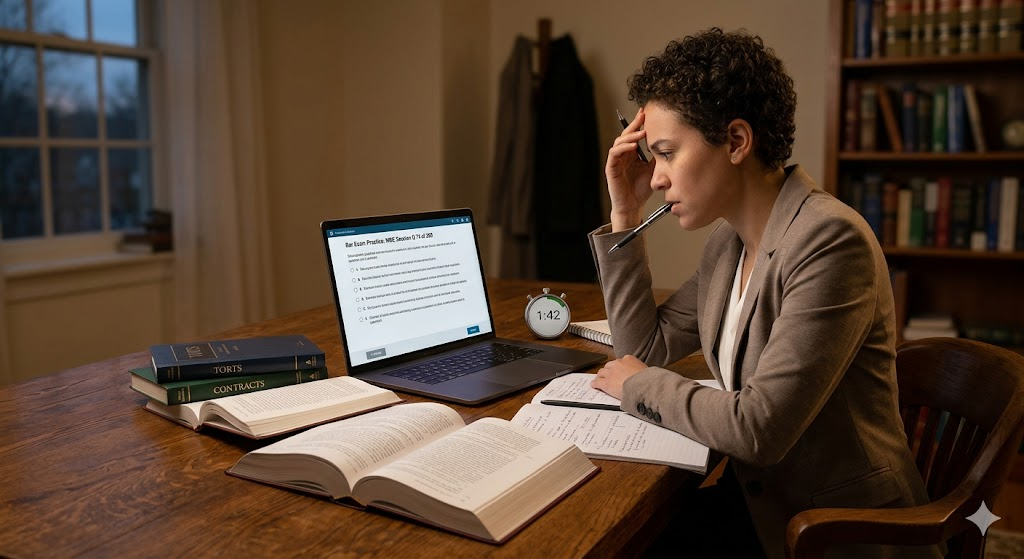
Additional Information
What the Course Entails and Exam Details
Preparing for the Bar Exam requires a mastery of dozens of foundational legal subjects and lawyering skills. While candidate preparation often involves a formal "bar review course," the exam itself tests knowledge across several standardized components. The core of the modern Bar Exam is the Uniform Bar Exam (UBE), which has been adopted by a majority of jurisdictions and consists of three parts.
The Multistate Bar Examination (MBE) is the multiple-choice segment, focusing on seven core areas: Civil Procedure, Constitutional Law, Contracts, Criminal Law and Procedure, Evidence, Real Property, and Torts.
The Multistate Essay Examination (MEE) requires candidates to draft detailed legal analyses in response to six hypothetical problems. The MEE tests the seven MBE subjects plus additional areas such as Business Associations, Conflict of Laws, Family Law, Secured Transactions, and Trusts and Estates.
Finally, the Multistate Performance Test (MPT) assesses practical "lawyering skills" rather than substantive knowledge. It tasks candidates with completing realistic legal assignments, such as writing a client memo or a persuasive brief, using a provided "file" of facts and a "library" of relevant law.
What to Expect in the Final Exam
The final Bar Examination is a demanding, standardized test typically administered over two consecutive days, twice per year in February and July. Candidates must be prepared for a marathon session, with each day consisting of approximately six hours of active testing time.
In UBE jurisdictions, Day One is usually dedicated to the written components, the MEE and MPT. Candidates have three hours to complete the two MPT tasks and another three hours to answer the six MEE essay questions.
Day Two is entirely focused on the multiple-choice MBE. This day consists of two three-hour sessions, each requiring candidates to answer 100 questions, totaling 200 MBE questions.
Passing scores are determined individually by each state’s Board of Law Examiners and typically range from 260 to 280 on a 400-point scaled score for UBE jurisdictions. The exam is administered under strict proctoring conditions, with specific rules regarding prohibited items and acceptable identification.
How to Study and Exam Centers
Successfully navigating the Bar Exam requires an aggressive, organized, and strategic study plan, which must heavily incorporate bar exam practice questions and simulation. An effective strategy involves dedicating two to three months of full-time study, utilizing a combination of passive and active learning techniques.
You should first master the black letter law through outlines and lectures, but the majority of your time must be spent on active practice. This includes solving thousands of multiple-choice questions from the MBE, ensuring you review the explanations for every answer choice—both correct and incorrect. Additionally, you must practice writing full MEE essays and completing MPT tasks under strictly timed conditions to build stamina and issue-spotting skills.
The exam itself is not taken at a standard Pearson VUE or computer-based center. Instead, the Bar Exam is administered at physical testing centers specifically designated by each state's Board of Law Examiners. These venues are typically large public spaces such as convention centers, armories, or major hotel ballrooms. Registration is managed directly through the specific state’s bar admissions portal.
Job Opportunities from the Course
Passing the Bar Exam and receiving a license to practice law unlocks the entire legal profession. This licensure is a mandatory requirement for almost every career path involving the direct representation of clients in a legal capacity.
Successful candidates can pursue a vast array of job opportunities across public and private sectors, including:
Associate Attorney at a law firm (ranging from small local practices to international "Big Law" firms).
Public Defender, representing indigent clients in criminal cases.
Prosecutor or District Attorney, representing the government in criminal proceedings.
In-House Counsel for corporations, managing internal legal affairs and compliance.
Government Attorney at local, state, or federal agencies.
Judicial Clerk, assisting judges with legal research and drafting opinions.
Legal Aid Attorney, providing civil legal services to low-income populations.
Staff Attorney for non-profit organizations or advocacy groups.
Political or Policy Analyst, leveraging legal knowledge to shape legislation.
Disclaimer: "Bar Exam Practice Questions" is a method of study; the actual licensing exam is the Bar Exam, often utilizing components like the Uniform Bar Exam (UBE) and Multistate Bar Examination (MBE).
Frequently Asked Questions
Reviews
5.0
Based on 0 reviews
Leave a Review
No reviews yet. Be the first to review!