
Barbering Infection Control Practice Test
$69.00
- Buy to unlock unlimited access to all Quiz questions and Answers in this Quiz.
- After purchase you can print a PDF of the whole quiz at any point. The PDF will contain the questions and the correct answers.
About this Exam
The Barbering Infection Control domain is the absolute cornerstone of the modern barbering profession. It is not just a section on an exam; it is the fundamental commitment to public safety that every licensed professional must uphold.
This specific focus area is designed for barber students preparing for their State Board licensure, as well as licensed barbers moving between states who need to re-certify their knowledge of current health standards.
Mastering this content proves to regulatory boards and your future clients that you possess the knowledge required to prevent the spread of diseases, manage blood exposure incidents safely, and maintain a sterile, professional environment. It represents the highest level of professional responsibility in the grooming industry.
Ready to test your knowledge?
Buy Now to Access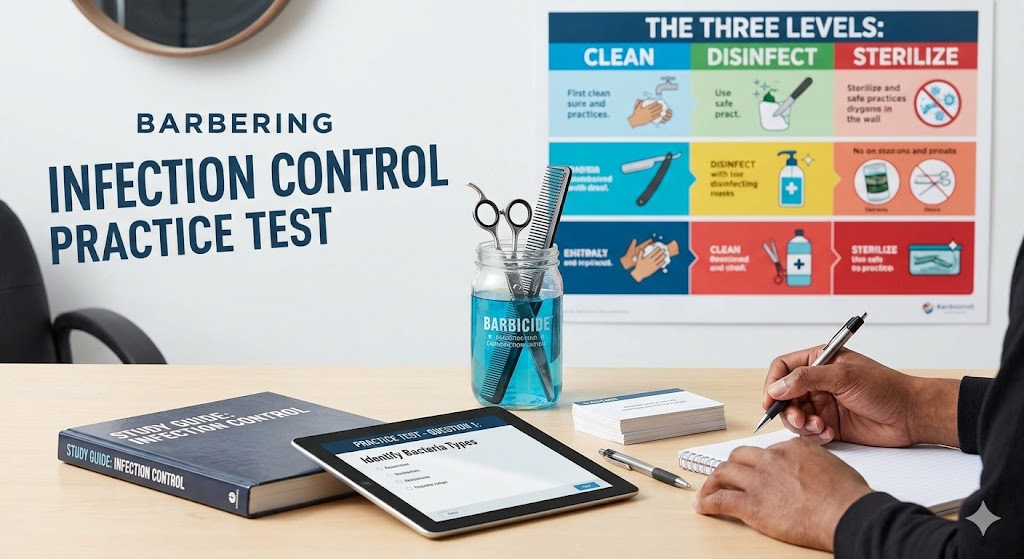
Additional Information
What the Course Entails and Exam Details
This segment focuses entirely on microbiology and the practical application of sanitation protocols within a barbershop setting.
You are not just learning definitions; you are learning how to create a defense system against unseen pathogenic dangers. The course of study generally covers the primary classifications of bacteria, viruses, fungi, and parasites, including how they are transmitted and the diseases they cause.
The detailed syllabus includes: identifying common skin and scalp disorders; the distinct levels of infection control (cleaning, disinfection, and sterilization); the specific use of EPA-registered, hospital-grade disinfectants; appropriate blood-exposure procedures (first aid for both client and barber); safety data sheet (SDS) interpretation; and understanding the strict regulations set by state boards, OSHA, and the CDC.
What to Expect in the Final Exam
You must prepare for infection control to be tested in two distinct phases of your state licensure exam: the written (theory) component and the practical (hands-on) component.
In the written exam, you will encounter numerous multiple-choice questions specifically targeting microbiology, chemical usage rules, and regulatory compliance. You might be asked to differentiate between a virus and bacteria, or identify the correct contact time for a specific disinfectant solution. The total theory exam often contains between 60 and 100 questions, with a heavy weighting (often 25-35%) placed on the scientific concepts and infection control section. Passing scores typically require a minimum of 70% to 75%.
In the practical exam, infection control is not a standalone section, but a set of criteria you are graded on throughout the entire test. Every time you set up your station, sanitize your hands, drop an implement, or prepare for a new service, examiners are watching to ensure you maintain perfect sanitation. A single major breach in infection control—such as double-dipping an implement or failing to correctly handle a simulated blood spill—can result in an automatic failure of the practical exam, regardless of how good your haircutting skills are.
How to Study and Exam Centers
Success requires a blend of theory retention and habit formation. Your primary resources should be the official standard textbooks designated by your state, such as the Milady or Pivot Point barbering series.
We highly recommend using spaced repetition flashcards for mastering scientific terms, such as the different types of pathogenic bacteria (e.g., staphylococci, bacilli). Additionally, you should take several timed practice tests. These are essential for learning the phrasing of State Board questions and ensuring you can manage the written exam's time constraints. For the practical exam, you must treat every haircut you perform during your schooling as if it were the State Board; normalize the habit of hand sanitizing and implement disinfection so it becomes second nature before test day.
The licensure exams are not taken at a central, national location; rather, they are administered state-by-state. You must register through your specific state's Board of Barbering or Cosmetology portal. Most states utilize third-party testing contractors, such as PSI, Pearson VUE, or Prometric, which have secure, authorized physical testing centers located throughout your state. You must check your specific Candidate Information Bulletin (CIB) to confirm the exact testing provider and the location nearest you.
Job Opportunities from the Course
Mastering the principles of infection control is not an "extra" qualification; it is the absolute legal prerequisite to obtaining your license and entering the industry. Once you have passed this exam and received your license, numerous career paths become available to you.
Unlocking this certification allows you to pursue careers as:
Licensed Professional Barber
Master Barber
Barbershop Manager or Owner (where you are responsible for the entire shop's compliance)
Barbering Instructor (teaching these vital safety protocols to new students)
State Board Inspector or Examiner (evaluating the sanitation standards of other barbers and shops)
Salon/Spa Safety Compliance Officer
Educational Platform Artist (specializing in safe, modern technique demonstrations)
By excelling in your infection control studies, you don't just pass a test; you build a foundation of trust that will define your career. Good luck!
Frequently Asked Questions
Reviews
5.0
Based on 0 reviews
Leave a Review
No reviews yet. Be the first to review!