
Barron/Elsevier Critical Care Registered Nurse (CCRN) practice test
$69.00
- Buy to unlock unlimited access to all Quiz questions and Answers in this Quiz.
- After purchase you can print a PDF of the whole quiz at any point. The PDF will contain the questions and the correct answers.
About this Exam
The Critical Care Registered Nurse (CCRN) certification is the premier credential for registered nurses working with acutely or critically ill adult patients. Administered by the American Association of Critical-Care Nurses (AACN), this advanced specialty certification validates your specialized knowledge, clinical judgment, and dedication to providing elite patient care in high-stakes environments. While the official certification is granted upon passing the AACN CCRN exam, utilizing high-quality preparation materials like the Barron/Elsevier CCRN practice test is an essential component of a successful study strategy. This guide is designed to help you navigate your preparation journey using these expert resources to achieve your professional milestones.
Ready to test your knowledge?
Buy Now to Access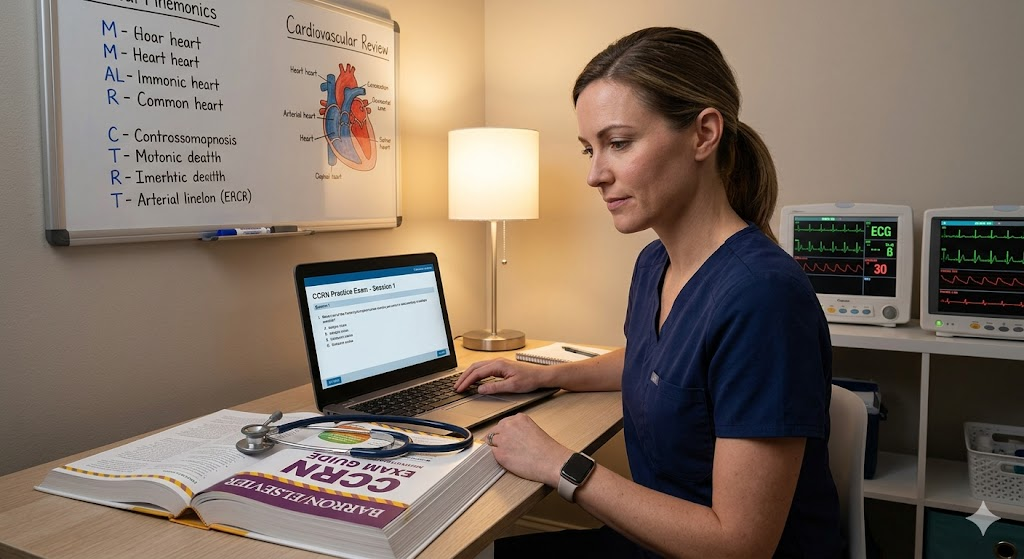
Additional Information
What the Course Entails and Exam Details
Preparing for the CCRN certification involves mastering a robust spectrum of clinical scenarios and professional standards. The content of both the final exam and comprehensive practice tools, such as the Barron/Elsevier materials, are strictly aligned with the AACN’s blueprint. The core of your study will be divided into two primary segments: Clinical Judgment, which accounts for approximately 80% of the material, and Professional Caring and Ethical Practice, which makes up the remaining 20%.
Within the Clinical Judgment section, you must demonstrate deep knowledge across several adult body systems and multisystem conditions, including:
Cardiovascular (e.g., heart failure, shock states, ACS)
Respiratory (e.g., mechanical ventilation, ARDS, ABG interpretation)
Endocrine and Hematology/Immunology
Renal and Gastrointestinal
Neurologic and Multisystem
The Professional Caring segment evaluates your ability to advocate for patients, maintain moral agency, manage ethical dilemmas, and facilitate collaborative care within the critical care ecosystem. The Barron/Elsevier practice test is structured to mirror this complexity, offering rigorous, evidence-based questions that prepare you for the intellectual demands of the real exam.
What to Expect in the Final Exam
When you sit for the actual AACN CCRN certification exam, you can expect a comprehensive, computer-based assessment. The final exam consists of 150 multiple-choice questions. It is important to note that of these 150 questions, only 125 are scored. The remaining 25 are pre-test items that are being evaluated for potential inclusion in future tests; however, you will not know which questions are unscored, so you must treat every question with equal seriousness.
You will have a total of three hours to complete the examination. The passing score is not a fixed number, but rather a "scaled score" determined by the complexity of the specific exam version you take; however, successful candidates generally need to answer approximately 83 to 89 of the 125 scored questions correctly. While the Barron/Elsevier practice tests help you practice speed and recall, the final environment will be a secure proctored setting.
How to Study and Exam Centers
Effective study requires a structured approach that goes beyond simple memorization. The key to success is simulating the testing environment. Plan to take full-length practice tests, such as those provided by Barron/Elsevier, in a quiet, undisturbed setting, aiming to complete the 150 questions within the three-hour time limit. This helps build the stamina required for exam day.
Crucially, do not just check your answers; meticulously review the rationales for both correct and incorrect responses. Understanding why an answer is right is more valuable than knowing that it is. Utilize spaced repetition to review weaker systems and consider joining an online peer study group to discuss complex case scenarios.
The official CCRN exam is administered at secure computer-based testing facilities across the nation. AACN partners with established testing vendors, primarily PSI or Prometric. You do not sign up for the actual exam through a publisher; instead, you must register, fulfill eligibility requirements (which include active RN licensure and specific clinical practice hours), and pay the examination fee directly through the AACN website. Once authorized, you will schedule your specific time and location at an approved authorized testing center in your region.
Job Opportunities from the Course
Earning your CCRN certification is a substantial career accelerator. It is not just a title; it signifies to employers, colleagues, and patients that you possess a verifiable level of expertise and dedication to evidence-based practice. Beyond the personal achievement, this credential unlocks advanced career paths and often correlates with increased salary potential and job security. A CCRN certification is particularly vital for the following career roles:
ICU/Critical Care Registered Nurse
Trauma/ER Registered Nurse
Progressive Care Nurse
Flight/Transport Nurse
Clinical Nurse Educator (Critical Care focus)
Cardiovascular ICU Specialist
ICU Nurse Manager or Assistant Manager
Clinical Research Coordinator in Critical Care
Nurse Practitioner (often a required or preferred credential for specialized NP programs)
Frequently Asked Questions
Reviews
5.0
Based on 0 reviews
Leave a Review
No reviews yet. Be the first to review!