
Basic and Clinical Sciences (BCSE) Practice Exam
$69.00
- Buy to unlock unlimited access to all Quiz questions and Answers in this Quiz.
- After purchase you can print a PDF of the whole quiz at any point. The PDF will contain the questions and the correct answers.
About this Exam
The Basic and Clinical Sciences Examination (BCSE) is a critical milestone for internationally trained veterinarians seeking licensure in the United States and Canada. This comprehensive assessment is designed specifically for graduates of non-AVMA accredited veterinary schools. Its primary purpose is to evaluate if your knowledge base in essential veterinary sciences matches that of a new graduate from an accredited North American institution. Passing the BCSE is a fundamental requirement to advance within the Educational Commission for Foreign Veterinary Graduates (ECFVG) or the National Examining Board (NEB) certification programs. It serves as your gateway to subsequent practical and licensing examinations, bringing you one step closer to achieving your dream of practicing veterinary medicine in North America.
Ready to test your knowledge?
Buy Now to Access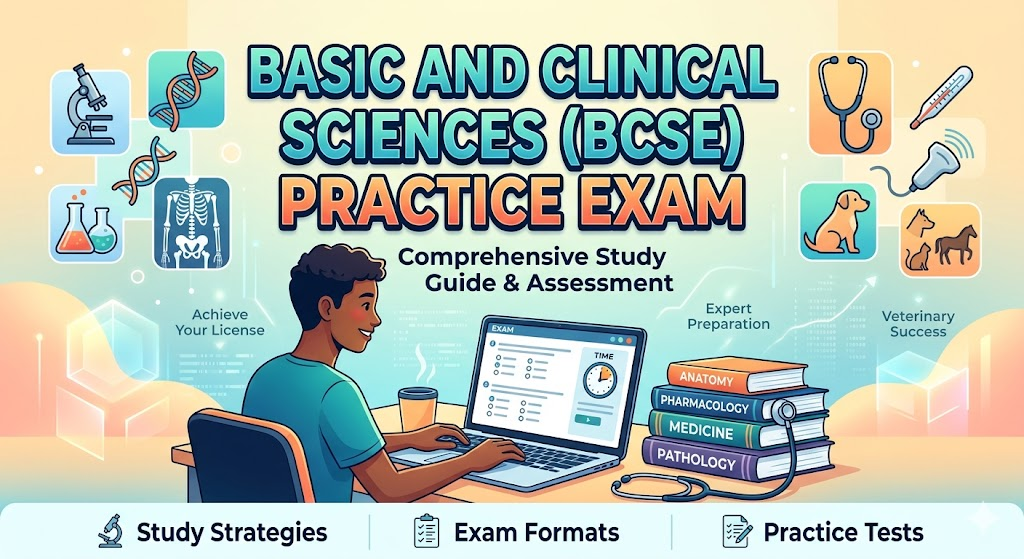
Additional Information
What the Course Entails and Exam Details
While the BCSE is an examination rather than a taught course, it encompasses the core syllabus of a standard Doctor of Veterinary Medicine (DVM) program. To succeed, candidates must demonstrate proficiency across eight major scientific domains. These key areas include Anatomy and Physiology, which form the bedrock of understanding animal structure and function. Pharmacology and Toxicology are critical for knowing how to select and administer therapies safely. Pathology covers the mechanics of disease processes within the body. The largest section is Medicine, which includes the etiology, diagnosis, and treatment of conditions in both small animal (canine, feline) and large animal (equine, bovine) species. Anesthesia and Surgery test fundamental procedural skills and perioperative management. Finally, Diagnostics, Preventive Medicine, and Animal Welfare address imaging, population health, and ethical care practices.
What to Expect in the Final Exam
The BCSE is a rigorous, computer-based standardized test. The entire testing appointment lasts four hours, which includes a tutorial and an exit survey. You will have approximately 220 minutes (3 hours and 40 minutes) of actual testing time. The exam consists of 225 multiple-choice questions. It is important to note that only 200 of these questions are scored; the remaining 25 are pretest items used for future exam development and do not impact your final score. However, these pretest items are intermingled with the scored questions, so you must treat every question as if it counts. The scores are scaled rather than a simple percentage. A scaled score of 580 is generally the requirement to achieve a passing grade, demonstrating the minimum competency required of an entry-level veterinarian.
How to Study and Exam Centers
Effective preparation for the BCSE requires a structured, multi-month study plan. Your primary resources should include the recommended reference textbooks used by accredited North American veterinary schools. Many candidates find immense value in enrolling in reputable BCSE-specific online review courses that offer high-yield notes and question banks. A crucial strategy is regular exposure to a BCSE practice exam. Using simulated exams allows you to familiarize yourself with the question formats, build your stamina for the four-hour session, and identify specific knowledge gaps. Create flashcards for active recall of key concepts in anatomy, pharmacology, and pathology. The BCSE is administered globally. You must register through the ECFVG or NEB portal first. Once approved, you can schedule your testing appointment at an authorized Prometric testing center located in many major cities worldwide. Currently, this exam is only taken at these physical, secure computer centers and is not available via remote online proctoring.
Job Opportunities from the Course
Passing the Basic and Clinical Sciences Examination is the prerequisite step to becoming a licensed veterinarian in the United States and Canada. Achieving full certification and subsequently passing the NAVLE licensing exam unlocks diverse and rewarding career paths. Licensed veterinarians enjoy high demand across several sectors.
Veterinary General Practitioner (Small Animal Practice)
Veterinary General Practitioner (Large or Mixed Animal Practice)
Emergency and Critical Care Veterinarian
Veterinary Public Health Officer (for government agencies)
Regulatory Medicine Veterinarian (food safety and inspection)
Research Veterinarian (in pharmaceutical or biomedical sectors)
Academic Veterinary Instructor
Shelter Medicine Veterinarian
Corporate Veterinary Consultant
Frequently Asked Questions
Reviews
5.0
Based on 0 reviews
Leave a Review
No reviews yet. Be the first to review!