
Basic and Clinical Sciences Examination (BCSE) – Canine Physical Practice Exam
$69.00
- Buy to unlock unlimited access to all Quiz questions and Answers in this Quiz.
- After purchase you can print a PDF of the whole quiz at any point. The PDF will contain the questions and the correct answers.
About this Exam
The Basic and Clinical Sciences Examination (BCSE) is a critical milestone for veterinary professionals, particularly those seeking licensure through the Educational Commission for Foreign Veterinary Graduates (ECFVG) program.
This specific canine physical practice module is designed to bridge the gap between foundational veterinary science and hands-on clinical application.
It is tailored specifically for veterinary students, foreign veterinary graduates, and professionals aiming to master the canine physical assessment.
By mastering this practice exam, candidates ensure they are fully prepared to accurately diagnose and treat canine patients in a fast-paced clinical setting.
Ready to test your knowledge?
Buy Now to Access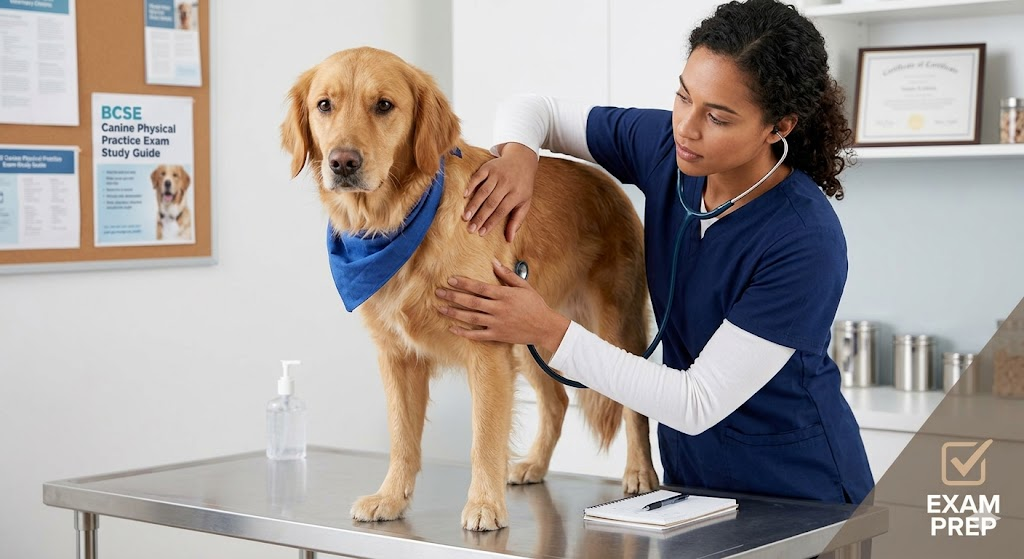
Additional Information
What the Course Entails and Exam Details
This comprehensive study module covers the core biological, physiological, and clinical sciences required to expertly evaluate a canine patient.
You will dive deep into fundamental veterinary disciplines, including canine anatomy, pharmacology, pathology, and diagnostic imaging.
The syllabus heavily emphasizes the practical application of these sciences through the lens of a routine and comprehensive physical exam.
Students will review the step-by-step processes for assessing canine vital signs, performing cardiovascular auscultation, conducting neurological and orthopedic evaluations, and identifying dermatological abnormalities.
Additionally, the curriculum covers proper animal handling, restraint techniques, and how to effectively communicate physical findings in clinical records.
What to Expect in the Final Exam
The actual BCSE is a computer-based, multiple-choice examination designed to test your deep understanding of basic and clinical veterinary sciences.
While the official BCSE focuses on written theoretical knowledge, questions regarding canine physical exams will require you to interpret clinical scenarios, diagnostic results, and physical symptoms.
You can expect to face 225 multiple-choice questions in the official exam, of which 200 are scored and 25 are pretest questions.
Candidates are given a strict time limit of 220 minutes to complete the test, meaning time management is absolutely crucial.
To pass, you must achieve a scaled score of at least 580.
Strict rules apply at the testing centers, including the prohibition of personal items, notes, or electronics in the examination room.
How to Study and Exam Centers
Success on the BCSE requires a balanced approach of rigorous textbook study and practical, hands-on repetition.
Start by utilizing high-yield veterinary flashcards, comprehensive textbook reviews, and timed online practice tests to build your theoretical knowledge base.
For the canine physical aspects, actively practice your exam steps on live, cooperative dogs to build muscle memory for palpation, auscultation, and reflex testing.
Forming study groups with fellow veterinary candidates can also be incredibly helpful for running mock clinical scenarios and testing each other's diagnostic reasoning.
When you are ready to take the official exam, you will need to register through the American Veterinary Medical Association (AVMA) portal.
The exam is administered globally at authorized Prometric Testing Centers, giving candidates flexible options to schedule their tests at physical locations in major cities around the world.
Job Opportunities from the Course
Successfully passing the BCSE and earning your veterinary credentials unlocks a wide variety of lucrative and rewarding career paths in the animal healthcare industry.
Licensed Veterinarian You can step into a general practice, providing primary care, preventative medicine, and routine surgeries for companion animals.
Emergency and Critical Care Veterinarian This fast-paced role involves treating acute injuries, stabilizing trauma patients, and performing life-saving emergency procedures.
Veterinary Associate Many new graduates start as associates in established clinics to gain mentorship and hands-on experience under senior doctors.
Shelter Veterinarian You can work with rescue organizations and animal shelters, overseeing the health, vaccination, and spay/neuter programs for large populations of animals.
Veterinary Specialist With further residency and training, you can specialize in fields such as canine orthopedics, internal medicine, oncology, or neurology.
Veterinary Consultant This role involves working with pharmaceutical companies, pet food manufacturers, or public health organizations to provide expert medical insights.
Frequently Asked Questions
Reviews
5.0
Based on 0 reviews
Leave a Review
No reviews yet. Be the first to review!