
Basic Automotive Electrical Diagnostics Practice Test
$69.00
- Buy to unlock unlimited access to all Quiz questions and Answers in this Quiz.
- After purchase you can print a PDF of the whole quiz at any point. The PDF will contain the questions and the correct answers.
About this Exam
The Basic Automotive Electrical Diagnostics Practice Test is an essential preparatory tool designed for aspiring automotive technicians, current students enrolled in automotive technology programs, and dedicated Do-It-Yourself (DIY) enthusiasts seeking to master vehicle electronics. This practice exam serves as a crucial stepping stone, allowing individuals to gauge their understanding of fundamental electrical principles and diagnostic procedures before attempting official industry certifications, such as the ASE A6 Electrical/Electronic Systems test, or concluding a formal educational course. It is intended for anyone who needs to build confidence in troubleshooting modern vehicle systems, which are increasingly reliant on complex electrical networks.
Ready to test your knowledge?
Buy Now to Access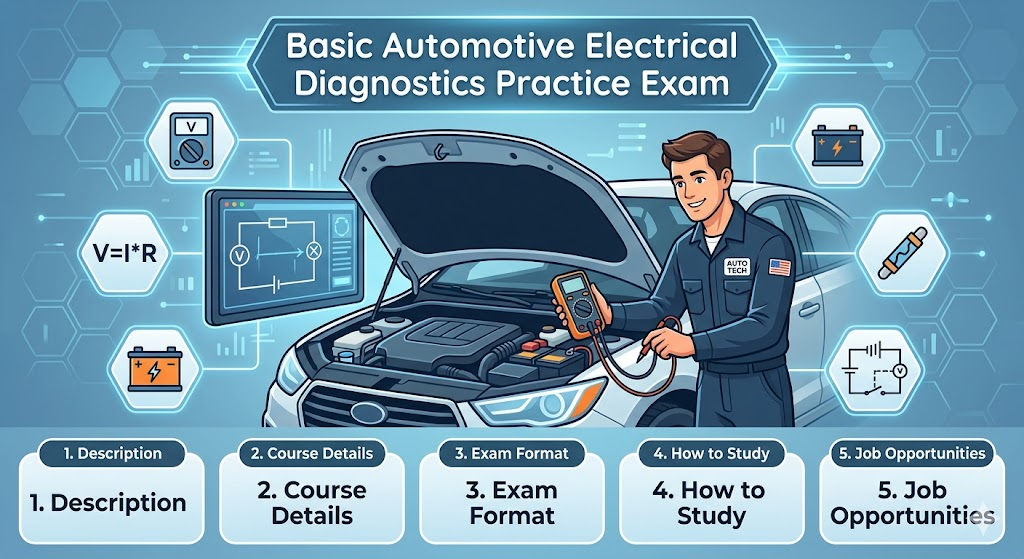
Additional Information
What the Course Entails and Exam Details
This practice exam comprehensively covers the foundational knowledge required to diagnose and repair basic automotive electrical issues. Students must demonstrate proficiency in electrical theory, including a strong command of Ohm’s Law to calculate voltage, current, and resistance within a circuit. The test delves into the correct application and interpretation of essential diagnostic tools, primarily the Digital Multimeter (DVOM), test lights, and jumper wires. Key subject areas include understanding circuit types—series, parallel, and series-parallel—and their distinct characteristics. Test-takers will also be evaluated on their ability to interpret automotive wiring diagrams and schematics, trace circuits, identify component locations, and understand the operation of critical starting, charging, and battery systems.
What to Expect in the Final Exam
While the exact format can vary depending on the platform providing the practice test, most versions are structured as a timed, multiple-choice examination. This format mimics the standard style of official certification testing. The exam typically consists of 40 to 60 questions that require both factual recall and the application of diagnostic logic to scenario-based problems. Students are generally given a time limit of 60 to 90 minutes to complete the test, emphasizing efficiency in problem-solving. A passing score, often set around 80% for practice scenarios, indicates a strong readiness for official certification. It is important to note that this is a knowledge-based practice test and does not usually include a hands-on practical component, although mastering these concepts is prerequisite for practical success.
How to Study and Exam Centers
Effective study strategies for this practice test must combine theoretical review with hands-on application. Students should begin by thoroughly reviewing textbooks on automotive electrical systems and utilizing online interactive tutorials that simulate circuit behavior. It is vital to practice using a Digital Multimeter (DVOM) on a real vehicle to measure voltage drops, resistance, and continuity in various circuits. Taking multiple practice test attempts is highly recommended to become familiar with the question phrasing and time constraints. Because this is a practice exam, it is conveniently taken online through educational portals, school learning management systems, or specialized test preparation websites. It does not require visiting a physical testing center like Pearson VUE, which are reserved for final, official certification exams.
Job Opportunities from the Course
Mastering the skills validated by this practice test unlocks a clear pathway to numerous entry-level positions within the automotive service industry. A strong foundation in electrical diagnostics is one of the most sought-after skills by employers today. Potential career paths and job titles include:
Entry-Level Automotive Technician
Maintenance and Light Repair (MLR) Technician
Express Service/Lube Technician
Electrical Apprentice Technician
Parts Specialist (requires knowledge of electrical components)
Automotive Service Advisor
Mobile Repair Technician (performing basic diagnostics)
Frequently Asked Questions
Reviews
5.0
Based on 0 reviews
Leave a Review
No reviews yet. Be the first to review!