
Basic COMSEC Policies and Procedures Practice Test
$69.00
- Buy to unlock unlimited access to all Quiz questions and Answers in this Quiz.
- After purchase you can print a PDF of the whole quiz at any point. The PDF will contain the questions and the correct answers.
About this Exam
This certification area focuses on the fundamental requirements for safeguarding classified and sensitive information. It is designed for personnel who are newly assigned to duties involving the handling, storage, operation, or destruction of Communications Security (COMSEC) material. Targeted professionals include military service members, government employees, and defense contractors working within secure environments. The course ensures that individuals understand their personal responsibilities and the mandatory regulations necessary to deny unauthorized access to United States government information.
Ready to test your knowledge?
Buy Now to Access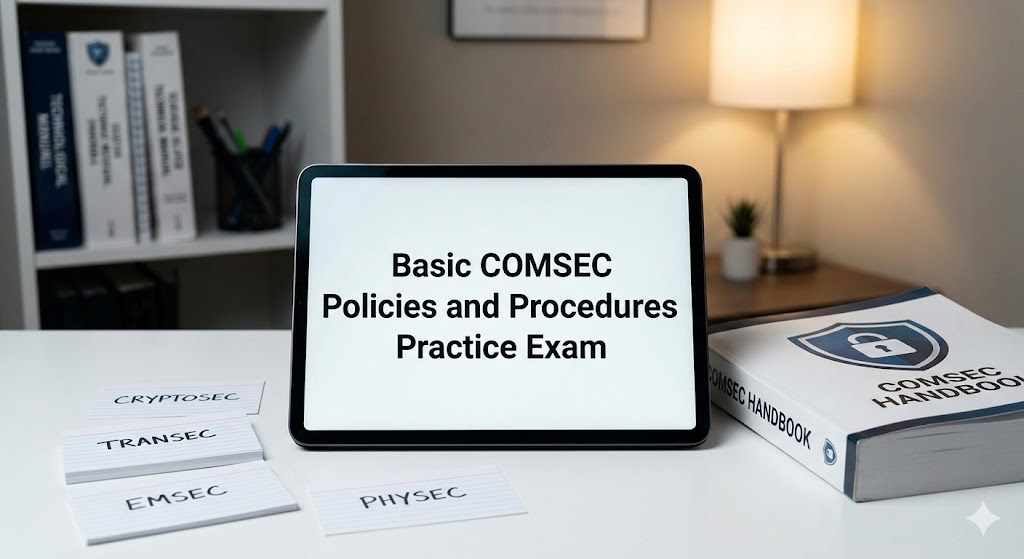
Additional Information
What the Course Entails and Exam Details
The course syllabus encompasses the core components of the COMSEC discipline. You must master the distinction between the four major types of COMSEC: Cryptographic Security (protecting keys), Transmission Security (protecting signals), Emission Security (controlling emanations or TEMPEST), and Physical Security (safeguarding materials). Students will learn about the role and responsibilities of the COMSEC Custodian and the alternate. The material details the lifecycle of COMSEC material from receipt and accounting through to final destruction. You will be tested on correct storage requirements for different classification levels. Crucially, the course covers proper incident reporting procedures following a suspected or actual compromise. It also defines Controlled Cryptographic Items (CCI) and their specific management rules.
What to Expect in the Final Exam
The final examination is designed to validate your practical knowledge and ability to apply regulations. It is typically a proctored, closed-book exam. The format usually consists of 50 to 75 multiple-choice questions, which may include scenario-based problems requiring correct policy application. The required passing score is generally between 70% and 80%, depending on the specific governing body or agency administering the test. Candidates are often allotted between 60 and 90 minutes to complete the exam. You will not be allowed outside reference material or electronic devices during the test. Verification of security clearance level is sometimes a prerequisite for attempting the examination.
How to Study and Exam Centers
The most effective study strategy is to thoroughly read and review the primary COMSEC manuals provided during training, such as agency-specific regulations or Committee on National Security Systems (CNSS) instructions. Utilize the provided practice test (linked in the title) to familiarize yourself with the question formatting and identify knowledge gaps. Create flashcards for the many acronyms and specific classification requirements. Pay close attention to scenario questions that ask "What do you do if..." as these often test immediate safety actions. Focus on mastering the exact procedures for receiving material, conducting inventories, and completing destruction logs. Examinations are rarely available in public settings. You will typically take the exam through your agency’s or unit’s authorized learning management portal. Alternatively, exams are administered at designated military schoolhouses or secure contractor training facilities upon verification of need and clearance.
Job Opportunities from the Course
A certification in Basic COMSEC Policies and Procedures is a foundational requirement for many vital national security roles. This credential unlocks career paths such as:
Communications Security (COMSEC) Custodian
Alternate COMSEC Custodian
Security Specialist
Information System Security Officer (ISSO)
Defense Contractor Handling CCI
Intelligence Analyst (with communication focus)
Information Assurance (IA) Specialist
Frequently Asked Questions
Reviews
5.0
Based on 0 reviews
Leave a Review
No reviews yet. Be the first to review!