
Basic Contingency Course (MFSS100) – MILPDS Practice Exam
$69.00
- Buy to unlock unlimited access to all Quiz questions and Answers in this Quiz.
- After purchase you can print a PDF of the whole quiz at any point. The PDF will contain the questions and the correct answers.
About this Exam
The Basic Contingency Course (MFSS100), often referred to as BCC, is a specialized training program designed primarily for United States Air Force Force Support Squadron (FSS) personnel. This includes officers, enlisted Airmen, and civilian employees who are tasked with supporting military operations in deployed or "contingency" environments.
The course provides foundational knowledge and functional skills required to establish, sustain, and recover Force Support capabilities at a forward operating location. These capabilities are critical for maintaining morale, accounting for personnel, and ensuring the well-being of the force during expeditionary missions. The MILPDS component specifically focuses on using the Military Personnel Data System to execute these tasks effectively.
Ready to test your knowledge?
Buy Now to Access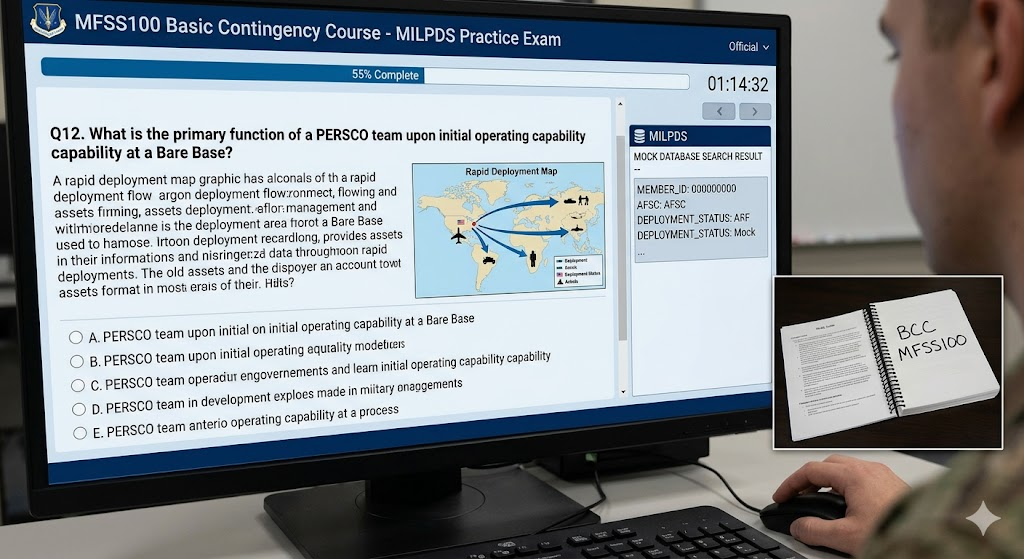
Additional Information
What the Course Entails and Exam Details
The Basic Contingency Course covers a wide range of operational topics vital for expeditionary Force Support. Students learn how to transition from in-garrison operations to a deployed footprint. The core syllabus includes several key functional areas.
One of the most critical topics is Personnel Support for Contingency Operations (PERSCO). Students learn total force accountability, casualty reporting, and the processing of personnel arriving at or departing from a deployed location. This is where proficiency in MILPDS is essential.
Another key area is Sustainment Services. This section details how to manage food operations, from deploying temporary kitchens to supervising meal services in the field. It also covers establishing and managing contingency lodging, ensuring adequate housing and linen services for thousands of service members.
Additionally, the course explores Fitness and Recreation programs tailored for deployed settings to keep personnel resilient. Finally, Mortuary Affairs training prepares FSS personnel to handle the search, recovery, and processing of fallen service members with the utmost dignity and respect. The final exam tests students' theoretical understanding of these doctrines and their practical ability to apply them.
What to Expect in the Final Exam
The final exam for the Basic Contingency Course (MFSS100) serves as the primary certification requirement for completion. It is designed to ensure that graduates can safely and effectively execute FSS responsibilities downrange. Students should expect a rigorous assessment of both knowledge and application.
The exam format typically consists of a closed-book, multiple-choice assessment that tests doctrine, terminology, and procedural knowledge. A common section includes scenario-based questions where students must determine the correct course of action for various contingency dilemmas, such as establishing accountability after an attack or managing a food service shortage.
Candidates will also face practical application components specifically testing MILPDS system proficiency. This may involve navigating simulation software to perform tasks like updating a member's deployment status, processing a deployment requirement (DRMD), or generating a casualty report. A minimum passing score—often 80%—is strictly required to be certified as "deployment ready" in these functional areas. The exam is usually timed, demanding that students demonstrate both accuracy and efficiency under pressure.
How to Study and Exam Centers
Preparation for the MFSS100 final exam requires a hybrid approach, combining a thorough review of doctrinal publications with hands-on practice. The official Air Force course materials provided through the Eaker Center's Force Support Professional Development School (FSPDS) are the foundation of all exam questions.
A primary study strategy must involve practicing within a simulated MILPDS environment. Many units provide access to a 'training environment' or simulation software. Repeatedly practicing core tasks—such as creating a gain/loss record or running a specialized report—until they become second nature is essential. Reviewing the Personnel Services Delivery (PSD) Guides related to deployment is also highly recommended.
The Basic Contingency Course (MFSS100) is predominantly administered in-residence at the Force Support Professional Development School, located at Maxwell Air Force Base, Alabama. However, mobile training teams or distance learning versions may be available. The final, official exam is administered securely by authorized instructors or within unit-specific testing centers, rather than through external commercial portals like Pearson VUE. Students must coordinate their exam scheduling directly through their Unit Training Manager (UTM).
Job Opportunities from the Course
Successfully completing the Basic Contingency Course and passing the MILPDS practice exam is not just a training requirement; it is a critical milestone that unlocks specific operational roles within the Air Force Force Support Squadron structure.
This certification directly qualifies you for deployment taskings where your proficiency in Force Support is mandated. It opens up specialized career paths in the following roles:
PERSCO Team Chief or Member: Leading total force accountability and casualty operations at deployed locations.
Force Support Squadron Deployment Manager (UDM): Supervising the readiness and deployment processing of squadron personnel.
Contingency Services Manager: Overseeing field kitchens, lodging operations, and fitness programs downrange.
Mortuary Affairs Officer or NCOIC: Managing sensitive search, recovery, and processing operations at a Forward Operating Location.
Force Support Readiness Planner: Developing base support plans and analyzing deployment requirements at the MAJCOM level.
Force Support Instructor: Teaching future FSS personnel at the FSPDS.
Frequently Asked Questions
Reviews
5.0
Based on 0 reviews
Leave a Review
No reviews yet. Be the first to review!