
Basic County Jailer Practice Test
$69.00
- Buy to unlock unlimited access to all Quiz questions and Answers in this Quiz.
- After purchase you can print a PDF of the whole quiz at any point. The PDF will contain the questions and the correct answers.
About this Exam
The Basic County Jailer certification is the primary credential required for individuals seeking employment in county correctional facilities, detention centers, and municipal jails. This vital exam ensures that prospective detention officers have mastered the fundamental knowledge, legal constraints, and safety protocols necessary to manage inmate populations securely and humanely. The course and final licensing exam are designed specifically for new recruits, current staff seeking official state licensing, or individuals aiming to begin a career in local law enforcement or corrections at the county level. It is the necessary starting point for a professional path dedicated to maintaining public safety within the localized justice system.
Ready to test your knowledge?
Buy Now to Access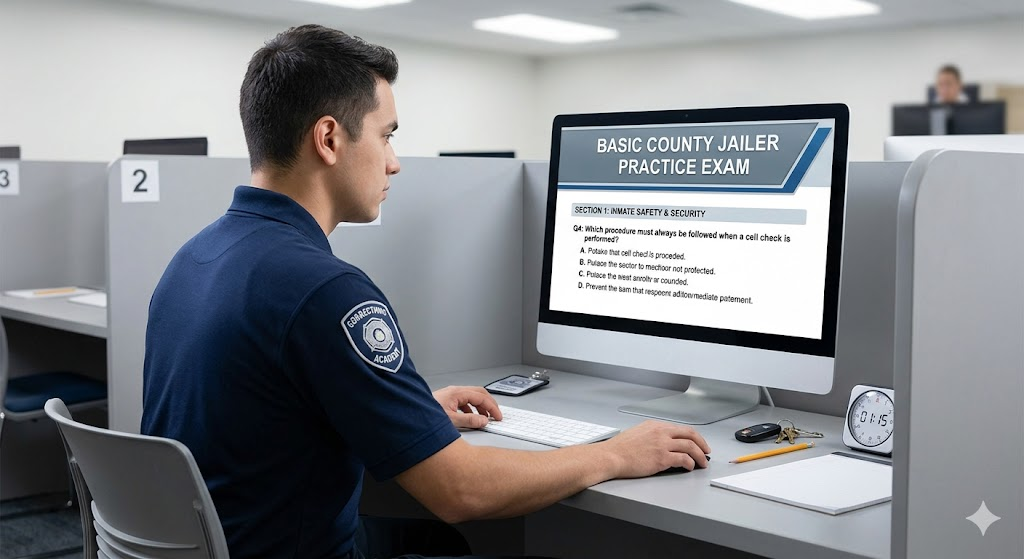
Additional Information
What the Course Entails and Exam Details
This comprehensive course covers a strict curriculum mandating understanding in legal principles, human relations, and operational security. Before attempting the practice test or the final licensing exam, candidates typically complete hundreds of hours of training.
The core syllabus usually encompasses several essential training domains, including:
Legal Foundations of Corrections: Candidates must grasp the constitutional rights of inmates, federal and state laws regarding detention, and the specific liability risks associated with jail operations.
Booking and Classification: Mastering the procedural requirements for intake, including fingerprinting, property management, and screening for medical or psychological alerts.
Facility Security Protocols: Learning the techniques for maintaining effective cell checks, preventing escapes, conducting thorough searches of persons and property, and managing contraband control.
Inmate Management and Human Relations: Focusing on de-escalation strategies, understanding mental health conditions, cultural diversity awareness, and managing specific populations within the facility.
Emergency and Crisis Procedures: Developing actionable knowledge regarding fire safety, responding to medical emergencies, and implementing riot or disturbance control plans.
Defensive Tactics and Use of Force: Training on the legal standards for use of force, appropriate options theory, and physical restraint techniques required for safety.
Professional Ethics and Communication: Emphasizing ethical decision-making, professional boundaries, and effective written and verbal communication, particularly in report writing.
What to Expect in the Final Exam
While the exact structure of the licensing exam can vary slightly by jurisdiction (e.g., depending on state law enforcement commissions like TCOLE in Texas or POST in other states), the general format remains remarkably consistent. The final examination is primarily a comprehensive, written assessment designed to test cognitive knowledge of the subjects listed above.
Here is what candidates can typically expect:
Exam Format: The test is almost exclusively comprised of objective, multiple-choice questions. These questions are designed to assess recall of facts, understanding of legal definitions, and the application of procedures to situational scenarios. There may also be limited true/false questions or matching sections.
Time Limits: Candidates are typically given a defined period, ranging from 90 minutes to two hours, to complete the exam. Time management is crucial, as the test is comprehensive.
Passing Score: To earn your Basic County Jailer license, candidates must achieve a minimum passing score, which is commonly set between 70% and 80?pending on the state authority.
Exam Rules: The exam is typically proctored and closed-book. Electronic devices are strictly prohibited. In many cases, if a physical physical skills component exists (such as defensive tactics), it must be passed independently from this written examination. Candidates must usually provide valid government identification on test day.
How to Study and Exam Centers
The key to success on the Basic County Jailer licensing exam is a structured study plan combined with realistic practice. It is not enough to simply read the material; you must apply it.
Start by obtaining the official study guide or learning objectives provided by your state’s law enforcement commission or your training academy. Break these objectives down and create detailed notes on key legal terms, facility rules, and the specific steps for booking and searching procedures. Using flashcards is highly effective for memorizing these strict definitions.
Integrating a comprehensive Basic County Jailer Practice Test into your study routine is perhaps the most vital step. A realistic practice test helps you diagnose your weak areas, get familiar with the wording of multiple-choice questions, and master your pacing under pressure. Simulate exam conditions: sit in a quiet room, set a timer, and put away your notes. Review every single answer after you finish, ensuring you understand why the correct answer is right and why you missed any questions.
Once you are fully prepared, you must follow the official path to take the actual licensing exam. Most states do not allow online testing at home for initial licensing. Instead, you will take the exam through one of these official channels:
Authorized Training Academies: For new recruits, the final exam is often administered on-site immediately following the completion of the basic training course.
State-Approved Testing Centers: Authorized third-party facilities or specified state buildings function as proctored hubs for various licensing exams.
Regional Sheriff’s Offices: In some jurisdictions, regional law enforcement headquarters serve as authorized testing sites for candidates within their area.
You must always register for your exam appointment well in advance, usually through an online portal managed by the state commission or your employer.
Job Opportunities from the Course
Earning your Basic County Jailer certification opens a clear, vital pathway into the field of criminal justice, offering stable employment and defined opportunities for career advancement. This credential is the specific requirement for multiple roles within the local justice system.
Unlocking this certification directly qualifies you for job titles such as:
County Detention Officer
County Jailer
Booking Officer / Intake Specialist
Corrections Transport Officer (County Level)
Municipal Jailer
With dedication and experience, this basic certification serves as the necessary foundation for advanced specialist roles, supervising staff (Sergeant, Lieutenant), or transitioning into broader law enforcement positions.
Frequently Asked Questions
Reviews
5.0
Based on 0 reviews
Leave a Review
No reviews yet. Be the first to review!