
Basic Damage Control Practice Exam
$69.00
- Buy to unlock unlimited access to all Quiz questions and Answers in this Quiz.
- After purchase you can print a PDF of the whole quiz at any point. The PDF will contain the questions and the correct answers.
About this Exam
The Basic Damage Control Practice Exam is a crucial tool designed to help individuals prepare for certifications that validate their knowledge of fundamental damage control principles and practices. Typically utilized within the maritime industry, naval forces, and relevant technical fields, these exams assess understanding of methods to mitigate and repair damage to vessels and structures. The course and final examination are ideally suited for aspiring mariners, naval personnel in training, and anyone seeking to demonstrate competency in basic emergency response, firefighting, and structural preservation in marine environments. Successfully preparing with this practice exam is an excellent step toward proving ready for practical applications and professional service.
Ready to test your knowledge?
Buy Now to Access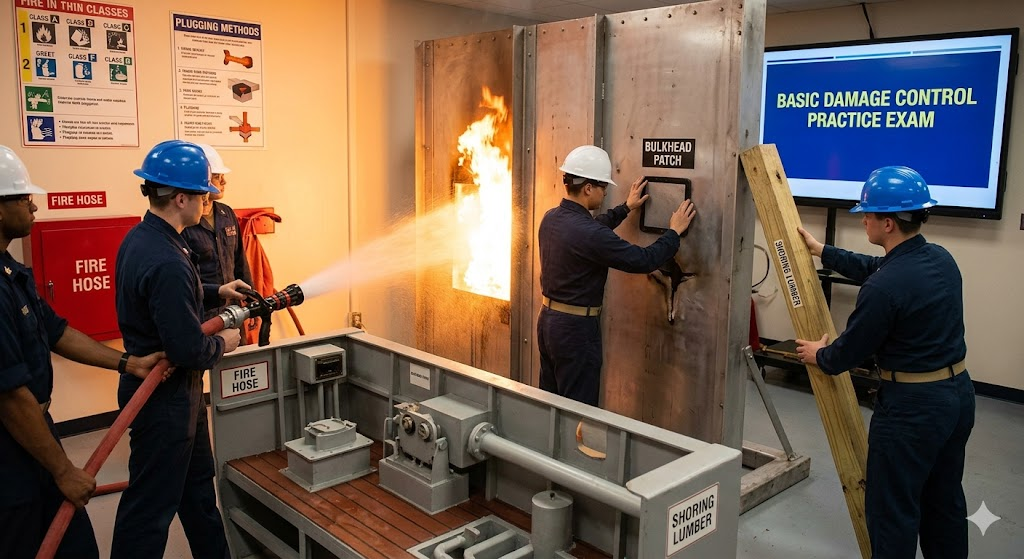
Additional Information
What the Course Entails and Exam Details
The training that this exam prepares you for covers a comprehensive range of topics essential for immediate damage control actions. You will learn the basics of different classes of fire and the correct procedures and equipment to fight them, including hoses, nozzles, and various types of fire extinguishers. Furthermore, the course teaches foundational skills in addressing flooding, such as effective plugging, patching, and dewatering techniques. Structural preservation methods, including shoring to reinforce damaged decks or bulkheads, are also a primary focus. Additionally, you will be introduced to material conditions, proper use of personal protective equipment (PPE), and essential safety communication protocols. The practice exam aims to cover all these syllabus points with challenging questions designed to build and test your practical knowledge.
What to Expect in the Final Exam
Understanding the final exam structure is critical for success, and this practice exam is modeled to reflect those standards. The official examination is generally a computer-based or paper-based test consisting of a set number of multiple-choice and potentially some short-answer questions. The exact number can vary, but is typically in the range of 40-60 questions. A strong focus is placed on procedural knowledge and safety. A passing score is usually required to be high, often around 70-80%, reflecting the critical nature of these skills. A specific time limit will be enforced, often 1-2 hours, demanding efficient problem-solving and clear understanding of the concepts. While a practice exam is typically knowledge-based, be aware that some actual certifications may also require a practical hands-on demonstration of certain damage control techniques separately.
How to Study and Exam Centers
Effective preparation involves a combination of strategies. To excel, thoroughly review the reference manuals and training materials provided during your course. Utilize this Basic Damage Control Practice Exam multiple times, carefully reviewing both your correct answers and your mistakes. Creating flashcards for key terms, equipment, and procedures can be immensely helpful for memorization. Practicing safety drills, if possible, can also reinforce your understanding. For information about taking the actual final exam and finding exam centers, you should consult your training provider or the relevant certification body. These are often administered at specific authorized maritime training schools, naval educational facilities, or other recognized testing centers. Some related components might even be available through secure online portals.
Job Opportunities from the Course
Obtaining a certification in Basic Damage Control opens doors to various rewarding career paths, primarily within the maritime and defense sectors.
Job titles and career paths this certification can unlock include:
Merchant Mariner (especially in entry-level deck or engine positions)
Deckhand on commercial vessels
United States Navy Sailor or Coast Guard Member (as part of basic training and specific ratings)
Port Operations Assistant
Oil and Gas Rig Safety Crew
Emergency Response Team Member in maritime facilities
Assistant Damage Control Officer (as you gain experience)
Maritime Safety Inspector (with further qualification)
Frequently Asked Questions
Reviews
5.0
Based on 0 reviews
Leave a Review
No reviews yet. Be the first to review!