
Basic Division Officer Course (BDOC) – Engineering Practice Test
$69.00
- Buy to unlock unlimited access to all Quiz questions and Answers in this Quiz.
- After purchase you can print a PDF of the whole quiz at any point. The PDF will contain the questions and the correct answers.
About this Exam
Welcome to your definitive guide to the Basic Division Officer Course (BDOC) Engineering module, a critical component in your journey to becoming a commissioned leader in the United States Navy’s Surface Warfare community. This module is specifically designed to transform newly commissioned Ensigns from civilian academic life into competent, confident shipboard leaders.
The BDOC Engineering assessment is not designed to turn you into a licensed marine engineer, but rather to ensure you possess the prerequisite understanding of the complex systems that make your warship operate. Mastering this knowledge is essential, as every Division Officer, regardless of their specific department, must understand their ship's Engineering Department Organization Regulations Manual (EDORM) and core engineering concepts to safely manage their team and execute the ship's mission.
Ready to test your knowledge?
Buy Now to Access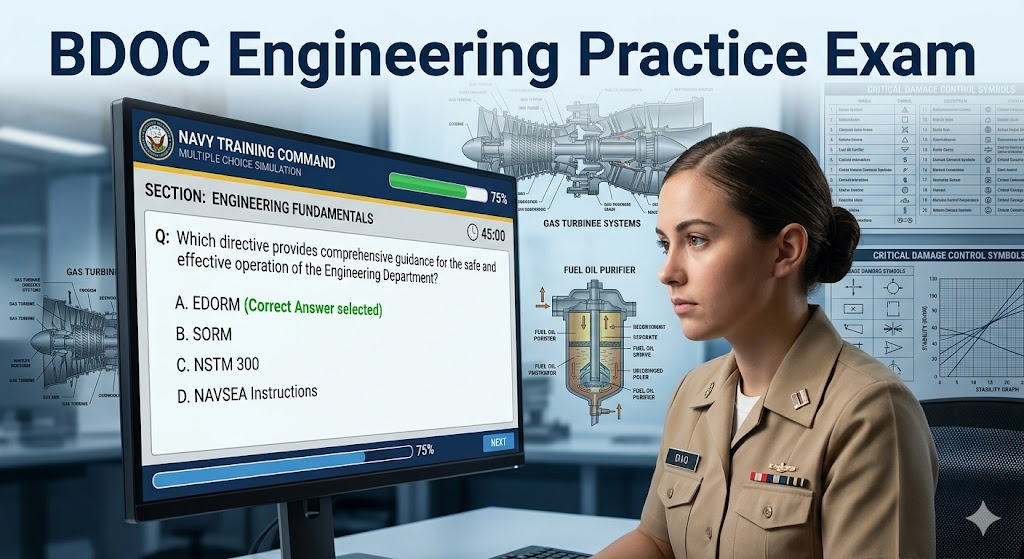
Additional Information
What the Course Entails and Exam Details
This module covers the foundational knowledge required of every newly assigned junior officer on a Surface Warfare vessel. The core topics are split between administrative requirements and technical understanding. A primary focus of the engineering training includes mastering the Engineering Department Organization Regulations Manual (EDORM), which details the roles, responsibilities, and chains of command within a ship's engineering department.
You will learn to identify key leaders, such as the Electrical Officer (ELECTRO) and the Damage Control Assistant (DCA). The course provides an introduction to shipboard naval engineering fundamentals, including the basic operational theories of main propulsion (gas turbines, steam, or diesel systems), the intricate shipboard electrical systems, auxiliary systems (including ventilation and water desalination), and critical fuel and oil management protocols. Finally, a significant portion of the instruction is dedicated to damage control, which combines firefighting fundamentals, flooding control techniques, and rapid stability assessments.
What to Expect in the Final Exam
While a practice test is your best tool for diagnostic preparation, you are ultimately preparing for the rigorous formal exam administered by the Surface Warfare Officers School Command. The final BDOC Engineering assessment is primarily a computerized exam featuring multiple-choice questions that test both conceptual understanding and specific rote memory from the EDORM.
Students should expect a strict time limit, requiring a strong recall of administrative procedures and organizational structures without hesitation. While the exact passing score requirement can be adjusted based on the current naval training command standards, it generally adheres to a high standard, frequently requiring a 75% or 80% to pass the milestone. You must pass this exam as part of your overall BDOC graduation criteria, making it a non-negotiable step toward your career in surface warfare.
How to Study and Exam Centers
The most effective study strategy is to treat the BDOC Engineering Practice Exam not as a single test, but as a diagnostic loop; identify your weak areas, review the standard references, and re-test. Focus your attention heavily on the EDORM—this manual provides standard operating procedures that Navy examiners expect you to know verbatim. Creating digital flashcards for key definitions, acronyms, and chains of command is highly effective for rapid recall.
Group study is strongly recommended, as reviewing auxiliary systems and propulsion mechanics with peers helps solidify your conceptual understanding and exposes you to different ways of approaching a problem. Regarding location, the formal BDOC course, including its engineering module and final exams, is taken in-residence at specific Navy instruction locations, typically the Surface Warfare Officers School (SWOS) command hubs in Newport, Rhode Island, and San Diego, California. Online proctoring sites such as Pearson VUE are generally not used for this mandatory military milestone examination.
Job Opportunities from the Course
Passing the BDOC Engineering exam is a crucial stepping stone toward unlocking your career as a Surface Warfare Officer (SWO) in the US Navy. While the exam itself does not provide a civilian job certification, it is the immediate prerequisite to qualifying as a Surface Warfare Officer and earning the coveted SWO pin. Success in this course allows you to begin your first sea tour with a foundational understanding of engineering and damage control, setting the stage for more advanced qualifications.
The career paths and leadership opportunities that begin after completing this course include:
Initial Sea Tour as a Division Officer aboard a guided missile destroyer (DDG), cruiser (CG), or amphibious ship (LPD).
Specialized Division Officer roles, such as serving as the Main Propulsion Assistant (MPA) or the Electrical Officer (ELECTRO) later in your tour.
Advancement toward qualifying as an Officer of the Deck (OOD) (Underway) on your respective ship.
Future competitive assignments as a Department Head, such as the Engineering Officer (CHENG) on a Surface Warfare vessel.
Long-term progression toward commanding a US Navy warship or commanding a squadron.
Frequently Asked Questions
Reviews
5.0
Based on 0 reviews
Leave a Review
No reviews yet. Be the first to review!