
Basic Engineering Common Core (BECC) 2 Practice Test
$69.00
- Buy to unlock unlimited access to all Quiz questions and Answers in this Quiz.
- After purchase you can print a PDF of the whole quiz at any point. The PDF will contain the questions and the correct answers.
About this Exam
The Basic Engineering Common Core (BECC) 2 Practice Exam is a vital training tool designed for individuals pursuing a technical career path within the United States Navy's engineering community.
Specifically, it is the second major assessment within the comprehensive BECC curriculum, which serves as the foundational "A" school training for all enlisted engineering rates. This program is engineered to transform new Sailors into capable engineering watchstanders by instilling the technical knowledge, safety mindsets, and procedural discipline required to operate and maintain complex shipboard engineering plants. This practice exam allows students to gauge their understanding of these critical concepts before facing the high-stakes final qualification test.
Ready to test your knowledge?
Buy Now to Access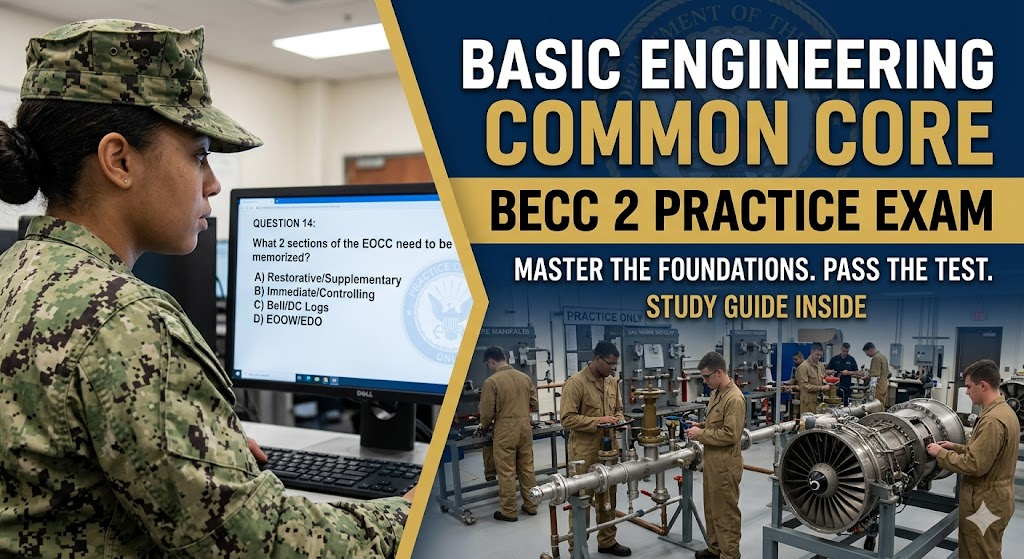
Additional Information
What the Course Entails and Exam Details
The full BECC course provides a thorough immersion into the mechanics, organization, and safety protocols of a naval vessel's engineering department. The "2" exam focuses specifically on the application of operational theory and casualty control.
Sailors studying for this test will cover a wide spectrum of essential topics. Core areas include detailed knowledge of Engineering Operational Sequencing System (EOSS) procedures, specifically the Engineering Operational Procedures (EOP) for alignment and the Engineering Operational Casualty Control (EOCC) for emergency response.
The exam also validates understanding of the chain of command, specific watchstander responsibilities (such as the Engineering Officer of the Watch and Engineering Duty Officer), and the management of legal engineering logs versus daily operating records. Safety remains paramount, covering topics from Tag-Out Users Manual (TUM) procedures to the use of specific Personal Protective Equipment (PPE) when handling hazardous materials like mercury or fuel.
What to Expect in the Final Exam
The final BECC 2 qualification exam is a comprehensive assessment that demands accuracy and rapid recall of critical procedures. It is typically administered in a secure, proctored computer laboratory at the training command.
The format is predominantly multiple-choice, focusing on operational scenarios, procedural steps, organizational roles, and safety regulations. A significant portion of the test evaluates the Sailor's ability to memorize and correctly order "Immediate" and "Controlling" actions for various engineering casualties (e.g., loss of lube oil pressure, major fuel leak).
The exam is timed, requiring candidates to demonstrate efficiency under pressure, mimicking real-world shipboard environments. A passing score, often set around 80%, is strictly enforced, and failure to meet this standard may require remediation and retraining before a retake is permitted.
How to Study and Exam Centers
Effective preparation for the BECC 2 exam relies on a mix of rote memorization, conceptual understanding, and practical application. Candidates are strongly encouraged to utilize the standard Navy training materials provided in class.
Actionable study strategies include creating flashcards for all key acronyms (TUM, EOSS, ORM, PPE) and organizational roles. The single most critical strategy is the memorization of the Immediate Actions within the EOCC—these must be recalled exactly. Practice with mock flowcharts of systems to understand valve alignments as detailed in the EOP. Forming small study groups to verbalize casualty procedures can significantly improve recall speed and accuracy.
BECC 2 exams are exclusive to military training pipelines. They are administered at authorized Naval Education and Training Command (NETC) learning sites, most notably the Surface Warfare Engineering School Command (SWESC) locations, such as Great Lakes, Illinois. These are dedicated physical testing centers within the naval base, and scheduling is managed directly through the student's command and training pipeline.
Job Opportunities from the Course
Successfully navigating the BECC curriculum is the mandatory gateway to specialization. This certification does not unlock a single civilian job immediately but rather opens the door to seven specialized United States Navy engineering ratings, each of which offers extensive technical training that is highly sought after in the civilian maritime, power generation, and manufacturing sectors after military service.
The specific job titles this path unlocks within the Navy include:
Machinist’s Mate (MM): Responsible for the operation and repair of ship propulsion machinery, auxiliary equipment, and steam systems.
Electrician's Mate (EM): Responsible for the operation, maintenance, and repair of a ship's electrical power generation and distribution systems.
Engineman (EN): Internal combustion engine specialists who operate and maintain diesel engines and related systems.
Gas Turbine Systems Technician - Mechanical (GSM): Specialists in the operation and mechanical maintenance of marine gas turbine engines.
Gas Turbine Systems Technician - Electrical (GSE): Specialists in the operation and electrical control systems of marine gas turbine engines.
Hull Maintenance Technician (HT): The ship's welders, metalworkers, and plumbers responsible for structural repairs and plumbing systems.
Damage Controlman (DC): The ship's firefighting and emergency response specialists, responsible for fire suppression, chemical/biological defense, and stability.
Machinery Repairman (MR): Skilled machine tool operators who fabricate repair parts using lathes, milling machines, and other precision tools.
Frequently Asked Questions
Reviews
5.0
Based on 0 reviews
Leave a Review
No reviews yet. Be the first to review!