
Basic Engineering Common Core (BECC) 3 Practice Test
$69.00
- Buy to unlock unlimited access to all Quiz questions and Answers in this Quiz.
- After purchase you can print a PDF of the whole quiz at any point. The PDF will contain the questions and the correct answers.
About this Exam
The Basic Engineering Common Core (BECC) Module 3 Exam is a critical assessment designed for military personnel, particularly within the naval engineering community.
It serves as a foundational benchmark, certifying that junior sailors and engineering candidates possess the essential knowledge required to operate safely and effectively aboard a ship.
This module focuses heavily on the practical applications of damage control, shipboard firefighting systems, and engineering organization.
It is designed for those seeking technical ratings in fields such as hull maintenance, machinery repair, and general shipboard engineering operations.
Passing this exam demonstrates a candidate's readiness to advance to more specialized "A" School training.
Ready to test your knowledge?
Buy Now to Access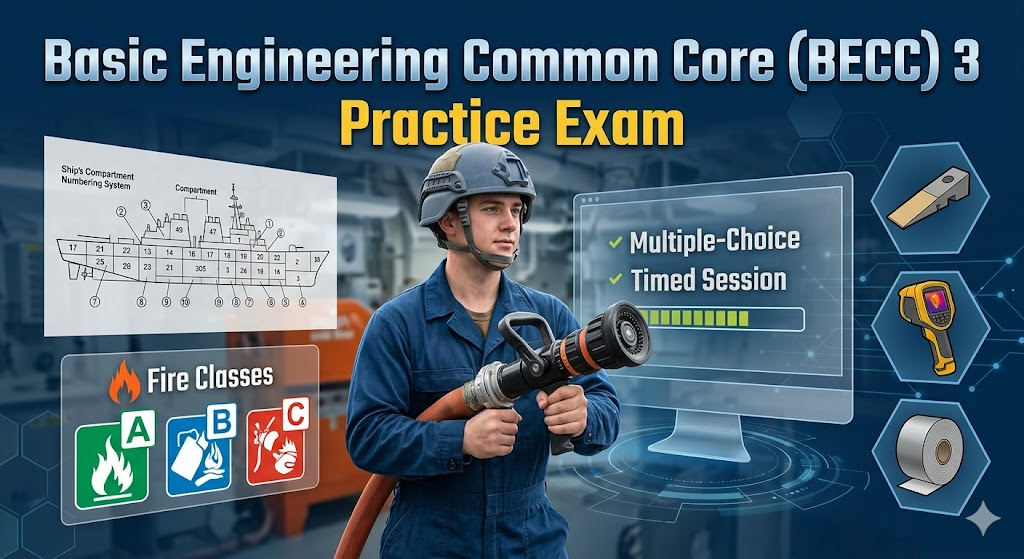
Additional Information
What the Course Entails and Exam Details
The course preparing you for the BECC 3 exam is intensive and focuses on survival and technical organization skills rather than theoretical mechanics.
It entails a thorough understanding of shipboard damage control procedures and the equipment used to implement them.
Key skills covered include identifying different classes of fires (Class Alpha, Bravo, Charlie, and Delta) and mastering the appropriate extinguishing agents for each, such as AFFF (Aqueous Film Forming Foam) or PKP (Potassium Bicarbonate).
Candidates must also understand material conditions of readiness, shipboard compartment numbering systems, and the organization of repair parties.
Furthermore, the syllabus includes instruction on specialized gear, such as thermal imagers, vari-nozzles, and pipe-patching kits.
What to Expect in the Final Exam
You should expect the BECC 3 Final Exam to be a challenging, standardized evaluation of your technical readiness.
The exam format is typically computer-based, consisting primarily of multiple-choice questions designed to test both factual recall and procedural application.
It is a timed exam, usually allowing candidates between 60 and 90 minutes to complete all sections.
Because of the safety-critical nature of the subject matter, the passing score requirement is high, often necessitating a score of 80% or greater to successfully pass the module.
Strict military testing protocols are enforced during the administration of the exam to ensure academic integrity.
How to Study and Exam Centers
Active preparation using the right strategy is key to mastering BECC Module 3.
We highly recommend using flashcards for active recall of key acronyms, fire classes, and equipment specifications.
Group study is exceptionally effective for this module, as you can role-play repair party scenarios and test each other on procedural steps.
Take advantage of every opportunity for hands-on practice with firefighting gear and damage control simulators if they are available to you during training.
Regarding exam centers, this test is not administered through standard civilian centers like Pearson VUE.
Candidates take the BECC 3 exam at authorized physical testing centers located within Naval Training Commands or authorized technical schools, often administered through military learning management systems.
Job Opportunities from the Course
Successfully mastering the BECC series is the foundational step toward a career in several critical military engineering ratings.
Unlocking these career paths leads to specialized technical training and responsibilities.
Specific job titles and paths this certification unlocks include:
Damage Controlman (DC)
Hull Maintenance Technician (HT)
Machinery Repairman (MR)
Engineman (EN)
Gas Turbine System Technician (GS)
Frequently Asked Questions
Reviews
5.0
Based on 0 reviews
Leave a Review
No reviews yet. Be the first to review!