
Basic Engineering Common Core (BECC) 6 Practice Test
$69.00
- Buy to unlock unlimited access to all Quiz questions and Answers in this Quiz.
- After purchase you can print a PDF of the whole quiz at any point. The PDF will contain the questions and the correct answers.
About this Exam
The Basic Engineering Common Core (BECC) 6 certification is a foundational credential designed to validate the essential knowledge and technical skills required for entry-level engineering roles.
This examination serves as a critical benchmark for individuals aiming to launch careers as technicians, operators, or junior specialists within mechanical, electrical, and structural engineering disciplines.
It is specifically tailored for students in technical training pipelines, individuals undergoing vocational retraining, or service members transitioning into technical ratings.
Passing the BECC 6 demonstrates that a candidate possesses the required fluency in core engineering vocabulary, safety protocols, and theoretical principles necessary to succeed in advanced, hands-on technical training.
Ready to test your knowledge?
Buy Now to Access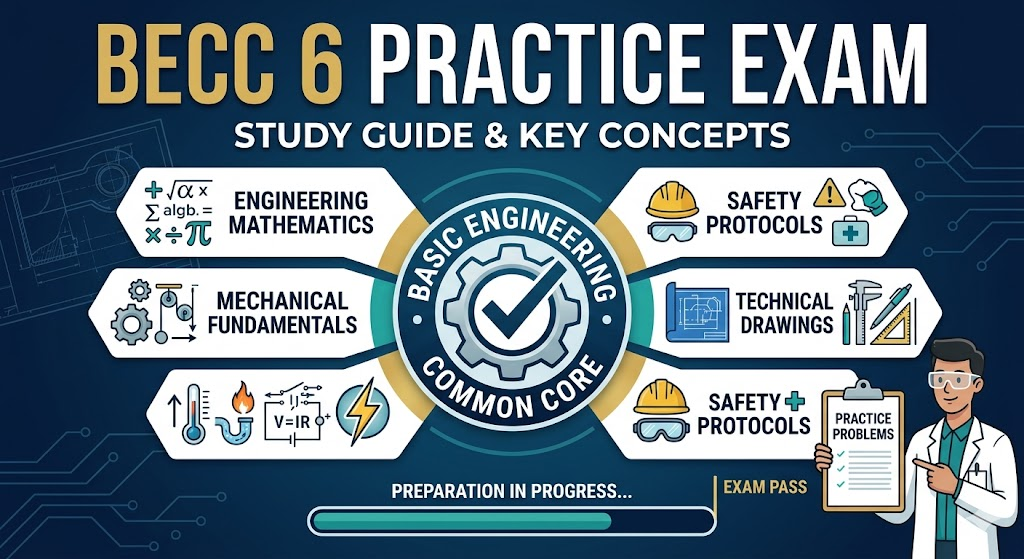
Additional Information
What the Course Entails and Exam Details
The preparatory curriculum for this exam covers the overarching "Common Core" principles that apply across multiple technical ratings.
Candidates must master a broad spectrum of theoretical and practical engineering concepts.
The core modules generally entail:
Engineering Mathematics: Proficiency in technical algebra, basic geometry, and applied trigonometry is required to solve practical calculation problems.
Mechanical Fundamentals: A deep understanding of force, motion, simple machines, gears, and basic hydraulics/pneumatics principles.
Basic Electricity and Electronics: Knowledge of Ohm’s Law, circuit theory, parallel and series circuits, and common electrical components.
Thermodynamics and Fluids: Basic concepts of heat transfer, energy conservation, pressure principles, and fluid dynamics within piping systems.
Reading Technical Drawings: The ability to interpret blueprints, schematic diagrams, and technical symbols accurately.
Safety and Hazardous Materials (HAZMAT): Comprehensive knowledge of workplace safety protocols, proper tool handling, lockout/tagout procedures, and material safety data sheet (MSDS) interpretation.
What to Expect in the Final Exam
The actual BECC 6 Final Exam is a rigorous, comprehensive assessment that strictly evaluates a candidate's readiness for operational technical environments.
It is typically administered as a Computer-Based Test (CBT) consisting of multiple-choice questions.
The examination often contains between 100 and 150 questions.
A strict time limit is enforced, usually ranging from two to four hours, depending on the specific administration protocol.
To achieve a passing score, candidates generally need to score 70% or higher, though certain high-consequence safety sections may require 100?curacy to validate competency.
No outside reference materials are permitted during the examination; however, necessary formula sheets or diagram booklets are often provided within the testing interface.
Candidates should expect questions to range from simple recall of definitions to complex scenario-based problems that require mathematical calculations.
How to Study and Exam Centers
Effective preparation for the BECC 6 requires a dedicated, multi-faceted study strategy.
We recommend the following actionable study methods:
Utilize Comprehensive Practice Tests: This is the most critical step. Consistently taking mock exams allows you to familiarize yourself with the question formatting, build stamina for the duration of the test, and identify your specific knowledge gaps.
Master the Fundamentals: Do not try to memorize advanced engineering theories. Focus 80% of your effort on mastering the fundamental calculations (e.g., Ohm’s Law, gear ratios, force vectors).
Review Technical Schematics: Practice reading and labeling common technical drawings daily until you can identify symbols and interpret flow paths effortlessly.
Simulate Exam Conditions: Periodically take a full-length practice exam in a quiet room, adhering strictly to the time limit to improve your pace.
Exam Centers and Administration:
The BECC 6 is generally administered through authorized, proctored testing facilities rather than publicly accessible portals.
If you are taking this as part of a formal training pipeline, the exam will be held at your specific authorized technical school or training facility.
For some standardized versions of the exam, registration and testing may be facilitated through professional computer-based testing networks such as Pearson VUE, which offers secure, proctored testing at physical locations globally.
You must verify the specific registration procedure with your course administrator or sponsoring organization.
Job Opportunities from the Course
Earning the BECC 6 certification validates your foundational technical competency and signals to employers that you possess the necessary aptitude for skilled technical roles.
This certification unlocks numerous entry-level career paths and specialized training opportunities, including:
Maintenance Technician (General)
Mechanical Technician (Entry-Level)
Plant Systems Operator
Industrial Electrician Apprentice
Facility Maintenance Specialist
Hull Technician Apprentice
Gas Turbine Systems Technician Apprentice
Junior Technical Field Service Representative
Frequently Asked Questions
Reviews
5.0
Based on 0 reviews
Leave a Review
No reviews yet. Be the first to review!