
Basic Fetal Heart Monitoring Certification Practice Exam
$69.00
- Buy to unlock unlimited access to all Quiz questions and Answers in this Quiz.
- After purchase you can print a PDF of the whole quiz at any point. The PDF will contain the questions and the correct answers.
About this Exam
The Basic Fetal Heart Monitoring Certification is a foundational credential designed for healthcare professionals working in intrapartum and antepartum settings. This certification validates a provider's fundamental ability to accurately observe, interpret, and articulate fetal heart rate (FHR) patterns. By establishing a standardized level of competency, it ensures that members of the perinatal team can collaborate effectively to safeguard maternal and fetal well-being. This exam is primarily intended for newly hired Labor and Delivery (L&D) nurses, nursing students, midwives, and obstetrical technicians who need to master electronic fetal monitoring (EFM) before advancing to complex clinical care.
Ready to test your knowledge?
Buy Now to Access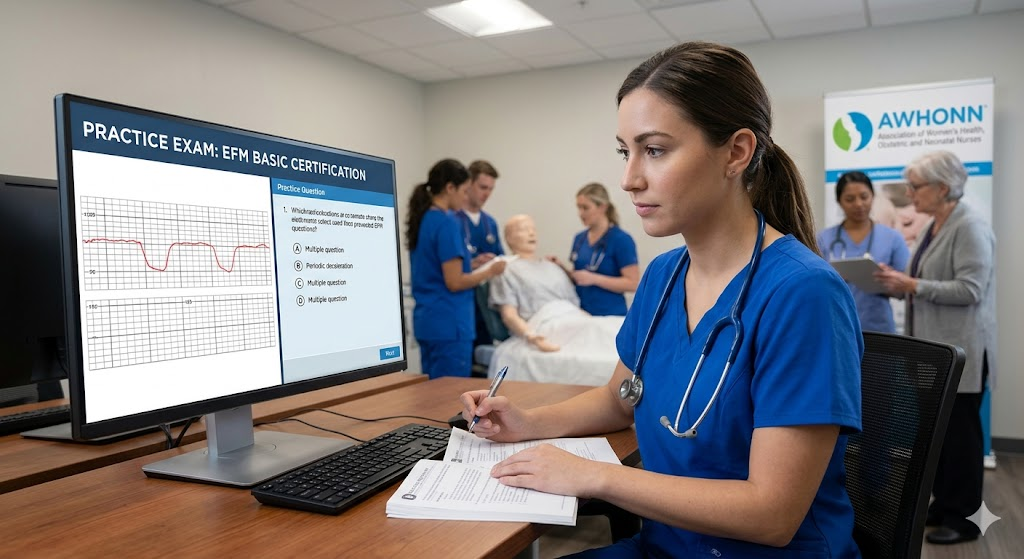
Additional Information
What the Course Entails and Exam Details
This comprehensive course covers essential physiological principles and the standardized terminology needed to analyze electronic fetal monitoring strips. Candidates will study the 3-Tier Fetal Heart Rate Interpretation System established by the National Institute of Child Health and Human Development (NICHD). Core modules include identifying fetal heart rate baseline, determining variability, recognizing accelerations, and distinguishing between different types of decelerations (early, late, variable, and prolonged). The syllabus also details the instrumentation of monitoring, including the mechanics of external transducers versus internal fetal scalp electrodes and intrauterine pressure catheters (IUPC). Additionally, the course reviews how maternal uterine activity impacts fetal oxygenation and outlines appropriate communication protocols for the perinatal team.
What to Expect in the Final Exam
The final certification exam is a comprehensive assessment of both knowledge and practical tracing interpretation. The standard format consists of 50 to 100 multiple-choice and multi-select questions. A critical component of the test involves analyzing actual electronic fetal monitoring strips displayed on the screen; candidates must diagnose the patterns shown and recommend appropriate nursing interventions. While the passing score can vary slightly depending on the specific authorized provider, it is typically set between 75% and 80%. The time limit usually ranges from 60 to 120 minutes, depending on the number of interpretation scenarios. The exam emphasizes safe clinical decision-making based on recognized national standards rather than institutional-specific policies.
How to Study and Exam Centers
Preparation for this certification should focus on mastering strip analysis through active practice rather than passive reading. Candidates are encouraged to utilize a specialized study guide, such as this practice exam, which replicates the format and complexity of the final test. Mnemonics like VEAL CHOP can be incredibly helpful for rapidly categorizing deceleration types. Standardized workshops, such as those provided by AWHONN (Association of Women's Health, Obstetric and Neonatal Nurses), offer an excellent mix of didactic learning and hands-on strip review. Because this is a "Basic" level certification, exams are frequently administered online through secure learning management systems or hospital-based education portals. Some authorized healthcare facilities also host the exam within their simulation centers or specific physical testing sites.
Job Opportunities from the Course
Earning a Basic Fetal Heart Monitoring Certification is a significant asset that can open doors to several rewarding career paths within the perinatal field. Below is a list of job opportunities this certification can help unlock or enhance.
Registered Nurse, Labor & Delivery (L&D)
Registered Nurse, Antepartum/Postpartum Unit
Registered Nurse, Perinatal Surveillance Unit
Certified Nurse Midwife (CNM)
Obstetrical Technician/OB Tech
L&D Clinical Educator
Family Medicine Physician (Obstetric Track)
Traveling Perinatal Nurse
Nurse Practitioner, Women’s Health
Frequently Asked Questions
Reviews
5.0
Based on 0 reviews
Leave a Review
No reviews yet. Be the first to review!