
Basic Infantry Knowledge Practice Test
$69.00
- Buy to unlock unlimited access to all Quiz questions and Answers in this Quiz.
- After purchase you can print a PDF of the whole quiz at any point. The PDF will contain the questions and the correct answers.
About this Exam
The Basic Infantry Knowledge assessment is designed to validate foundational competencies crucial for success in entry-level ground combat roles. It serves as a preliminary gateway for individuals aspiring to join tactical units, particularly within the US Army (11B) and US Marine Corps (0311) occupational specialties. This test is aimed at candidates entering initial entry training (such as One Station Unit Training or OSUT), recruits preparing for basic training, or current service members looking to brush up on their essential skills. It ensures a baseline understanding of infantry tactics, techniques, and procedures necessary for effective functioning in a platoon environment.
Ready to test your knowledge?
Buy Now to Access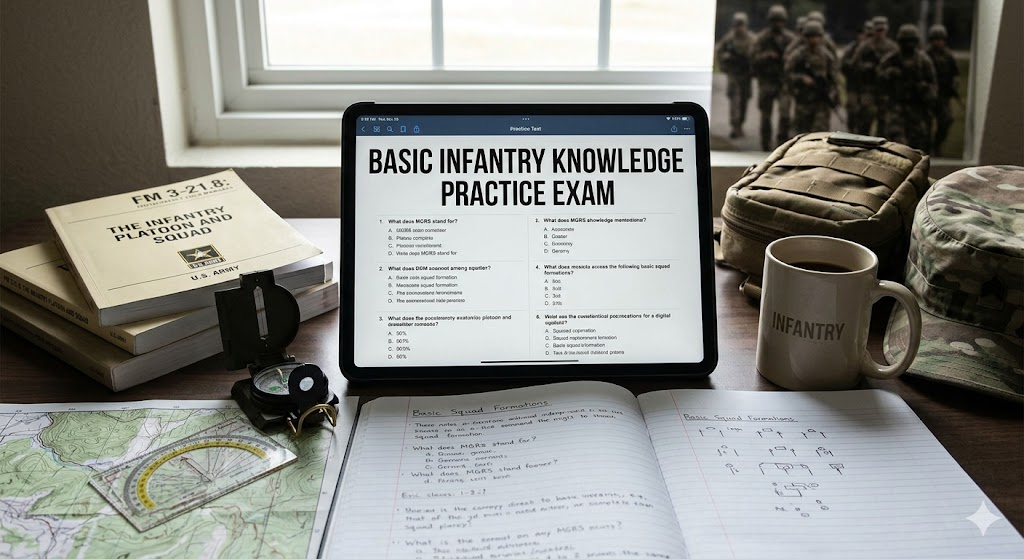
Additional Information
What the Course Entails and Exam Details
The materials associated with this practice exam and the curriculum it assesses cover a comprehensive range of critical infantry skills. The primary goal is to standardize the technical proficiency and tactical intuition required of a ground soldier.
The core syllabus typically focuses on several main domains:
Land Navigation: Mastery of map reading, plotting grids using the Military Grid Reference System (MGRS), identifying terrain features, and using a lensatic compass for dead reckoning and terrain association.
Weapon Systems Proficiency: Basic knowledge of standard infantry small arms, including safe handling, maintenance (clear, disassemble, assemble), and basic operating capabilities of weapons like the M4/M16 series.
Tactical Movements: Understanding and identifying essential individual movement techniques (low crawl, high crawl, rush) and basic fire team and squad formations (wedge, file) used in patrolling.
Communications: Familiarity with standard military communication procedures, including the use of basic radio equipment and signaling methods (hand and arm signals).
Medical Skills (Basic TCCC): Core knowledge of Tactical Combat Casualty Care (TCCC), focusing on immediate care under fire, bleeding control (tourniquet application), and basic casualty evacuation.
What to Expect in the Final Exam
The actual final exam associated with Basic Infantry Knowledge training is often a hybrid assessment, consisting of both a written or computer-based test and practical evaluations.
For the practice exam we are focusing on, the standard is typically a written (or digital) multiple-choice assessment that mirrors the knowledge component of the final test. This component requires high recall accuracy under time constraints. You can expect questions that test your understanding of terminology, procedures, and safety protocols across all core domains mentioned above. A typical written exam might have 50 to 100 questions.
The passing score for these types of assessments is usually quite demanding, often set at 70% or 80%, depending on the specific branch or unit standard. You will likely have a specific time limit (e.g., 60 to 90 minutes) to complete the knowledge portion. This practice test is designed to simulate that environment, helping you build the speed and confidence necessary to pass the written component on your first attempt.
How to Study and Exam Centers
Effective preparation for this practice exam requires a dedicated study plan that combines theoretical knowledge with practical visualization.
Practice Exam Repetition: Take multiple timed practice exams to become familiar with the question types, pacing, and core content areas. Analyze your incorrect answers to identify knowledge gaps.
Study Field Manuals (FMs): For the most reliable information, refer to official doctrine. Key resources include Army Field Manuals and Army Techniques Publications (ATPs), especially those covering Land Navigation (FM 3-25.26), Rifle Marksmanship (FM 3-22.9), and Infantry Squad Tactics (FM 3-21.8).
Review Practical Skills: Although this practice test is focused on knowledge, visualize how the procedures apply in real life. If possible, practice map reading and compass use, or safe weapon handling with inertial trainers, to reinforce the written content.
The practice exam itself is accessible through authorized online learning portals, mobile apps, or within standard military educational platforms (like Joint Knowledge Online, if applicable to entry-level trainees). The official final certification tests, which include the rigorous practical field assessments, are typically administered only at authorized military training centers (such as Fort Moore for the US Army Infantry School) or authorized training detachments after a candidate has formally joined the service and entered a program of instruction.
Job Opportunities from the Course
Successfully demonstrating basic infantry knowledge through assessments like this practice exam is the foundational step toward numerous career paths in tactical ground operations. Completing initial training which includes these competencies unlocks a wide array of specific roles.
These career paths include, but are not limited to:
Army Infantryman (MOS 11B)
Army Indirect Fire Infantryman (MOS 11C - Mortarman)
Marine Corps Rifleman (MOS 0311)
Marine Corps Machine Gunner (MOS 0331)
Marine Corps Mortarman (MOS 0341)
Marine Corps Anti-tank Missileman (MOS 0352)
Unit Armorer
Recruiting and Retention Specialist (often requires infantry background)
Training Instructor (Advanced roles within training commands)
These foundational skills are also highly valued in federal law enforcement and specialized security contracting roles following a successful military career.
Frequently Asked Questions
Reviews
5.0
Based on 0 reviews
Leave a Review
No reviews yet. Be the first to review!