
Basic Life Support (BLS) Practice Exam
$69.00
- Buy to unlock unlimited access to all Quiz questions and Answers in this Quiz.
- After purchase you can print a PDF of the whole quiz at any point. The PDF will contain the questions and the correct answers.
About this Exam
Basic Life Support (BLS) is the foundation of emergency medical care, a critical set of life-saving skills designed to sustain life in the crucial minutes before advanced medical help arrives. This certification is essential for recognizing several life-threatening emergencies, providing high-quality chest compressions, delivering appropriate ventilations, and ensuring early use of an Automated External Defibrillator (AED).
The BLS course is primarily designed for healthcare professionals, including nurses, physicians, paramedics, emergency medical technicians (EMTs), respiratory therapists, and physical therapists. However, it is also highly valuable, and often required, for a wider audience, including public safety personnel (police officers, firefighters), teachers, childcare providers, lifeguards, and anyone whose job requires a duty to respond to cardiac or breathing emergencies. Mastering BLS doesn't just grant a certification; it empowers individuals to act with confidence and precision during a crisis.
Ready to test your knowledge?
Buy Now to Access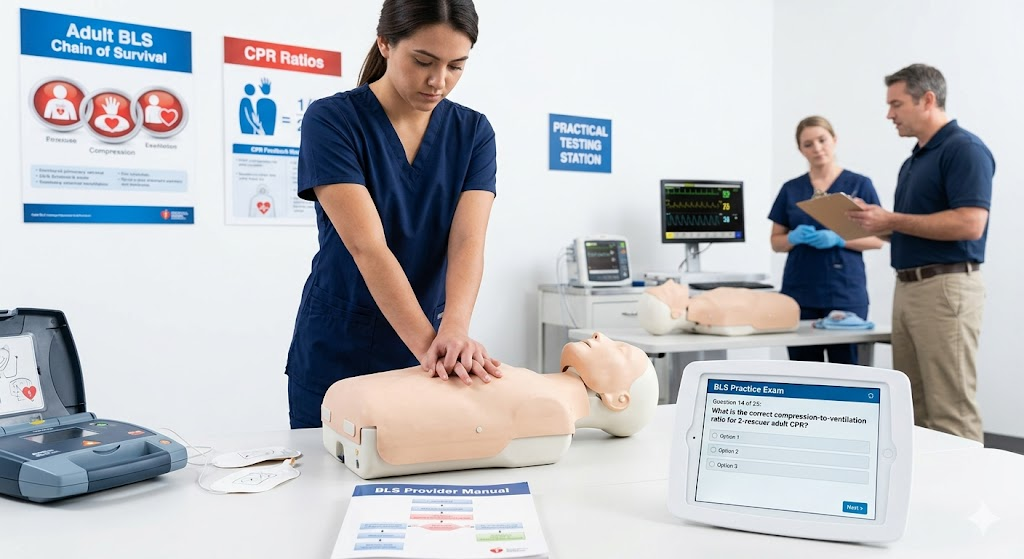
Additional Information
What the Course Entails and Exam Details
A comprehensive BLS course provides rigorous training in the latest science and treatment recommendations from the International Liaison Committee on Resuscitation (ILCOR) and authorized providers like the American Heart Association (AHA) or American Red Cross.
The core syllabus and skills covered include:
1-Rescuer and 2-Rescuer CPR: Techniques for adults, children, and infants, focusing on correct compression depth, rate (100-120 per minute), and full chest recoil.
Use of an AED: Proper integration of an Automated External Defibrillator during resuscitation.
Ventilations and Barrier Devices: Effective rescue breathing using pocket masks and bag-mask devices.
Relief of Choking: Responding to foreign-body airway obstructions in adults, children, and infants.
Team Dynamics: The importance of clear communication and assigned roles in high-performance team resuscitation.
Opioid-Associated Life-Threatening Emergencies: Recognition and response, including the administration of Naloxone.
The certification process generally consists of two distinct parts: a cognitive assessment and a practical skills evaluation. Students must demonstrate competency in both areas to receive their two-year certification card.
What to Expect in the Final Exam
Preparing for the BLS final assessment means preparing for two challenges. You must prove you have the theoretical knowledge and the physical coordination to save a life under pressure.
The Written (Cognitive) Exam:
Format: The cognitive portion is a multiple-choice exam, typically consisting of 25 to 35 questions.
Content: Questions cover algorithms, compression-to-ventilation ratios, AED operation, and critical steps for adult, child, and infant rescues.
Passing Score: A passing score is usually 84% or higher (e.g., answering at least 21 out of 25 questions correctly).
Time Limit: The written exam is generally self-paced but is usually allocated 30 to 45 minutes within the total course time.
Rule: This is often an "open resource" exam, allowing you to reference your provider manual, emphasizing the practical application of knowledge rather than rote memorization.
The Skills (Practical) Evaluation:
Format: You will perform hands-on demonstrations in front of a certified instructor or using a feedback manikin.
Components: You will be assessed on scenario-based skills, such as 1-Rescuer Adult CPR, 2-Rescuer Adult CPR with AED integration, and Infant CPR.
Passing Requirement: You must successfully complete every step on the critical skills checklist. The instructor will provide real-time feedback. You need to demonstrate proper technique to pass; if you make a critical error, you will be allowed to remedial practice and re-test that skill.
How to Study and Exam Centers
Effective preparation requires balancing knowledge retention with muscle memory development. Approach your study with a plan.
How to Study and Practice:
Master the Provider Manual: Your primary resource is the official BLS Provider Manual (e.g., from AHA or Red Cross). Read it thoroughly before your class. Focus on the algorithms and summary tables for compression rates and ratios.
Use Practice Exams: Take multiple BLS practice exams online. These mock tests are invaluable for identifying your knowledge gaps and familiarizing yourself with the wording of test questions. Focus on understanding why an answer is correct, not just which one it is.
Visualize the Steps: Mentally rehearse the sequence of actions for an adult versus an infant rescue. Use the acronyms and pneumonics provided in the manual.
Practice Hands-On (If Possible): While you will have ample practice time during the course, if you have access to a CPR manikin beforehand, practice your compression depth and hand placement. Remember, muscle memory is key.
Where and How to Take the Exam:
Authorized Training Centers: BLS certification must be obtained through an authorized training center, such as those affiliated with the American Heart Association (AHA) or the American Red Cross.
Course Formats:
In-Person Classroom: The traditional format, where you attend a comprehensive 4 to 5-hour session covering all lectures, practice, and testing.
Blended Learning (HeartCode BLS): A popular two-part option. Part 1 is a self-paced online cognitive portion (1–2 hours) where you complete modules, simulations, and the written exam. Part 2 is an in-person, structured hands-on skills session (60–90 minutes) with an instructor or feedback manikin.
You can find authorized providers and schedule your session directly through the official websites of the American Heart Association or American Red Cross, or by searching for local "AHA BLS training near me."
Job Opportunities from the Course
A valid BLS certification is not just a regulatory hurdle; it is a key credential that instantly strengthens your resume and is a non-negotiable requirement for an immense variety of careers in health, public safety, and community service. It demonstrates your readiness to act in an emergency.
Here is a list of job titles and career paths this certification unlocks:
Registered Nurse (RN) and Licensed Practical Nurse (LPN)
Emergency Medical Technician (EMT) and Paramedic
Physician and Physician Assistant (PA)
Respiratory Therapist
Physical Therapist and Physical Therapist Assistant
Dentist and Dental Hygienist
Medical Assistant
Nursing Assistant (CNA) and Home Health Aide
Occupational Therapist
Pharmacist
Police Officer and Firefighter
Lifeguard
Teacher (K-12) and Childcare Provider
Flight Attendant
Fitness Instructor and Personal Trainer
School Bus Driver
Security Guard
Clinical Laboratory Technician
Surgical Technologist
Frequently Asked Questions
Reviews
5.0
Based on 0 reviews
Leave a Review
No reviews yet. Be the first to review!