
Basic Life Support for Children and Infants Practice Test
$69.00
- Buy to unlock unlimited access to all Quiz questions and Answers in this Quiz.
- After purchase you can print a PDF of the whole quiz at any point. The PDF will contain the questions and the correct answers.
About this Exam
The Basic Life Support (BLS) for Children and Infants certification is a specialized training program designed to equip individuals with the critical skills needed to recognize and respond to life-threatening emergencies in pediatric patients. This course goes beyond general CPR to focus specifically on the unique physiological needs of children and infants, who often require different techniques than adults during a crisis. It is intended for a wide range of professionals and caregivers, including healthcare providers such as nurses, medical assistants, and emergency medical technicians, as well as educators, childcare workers, nannies, lifeguards, and even proactive parents. This certification ensures that when seconds count, you are prepared to deliver high-quality, life-saving care.
Ready to test your knowledge?
Buy Now to Access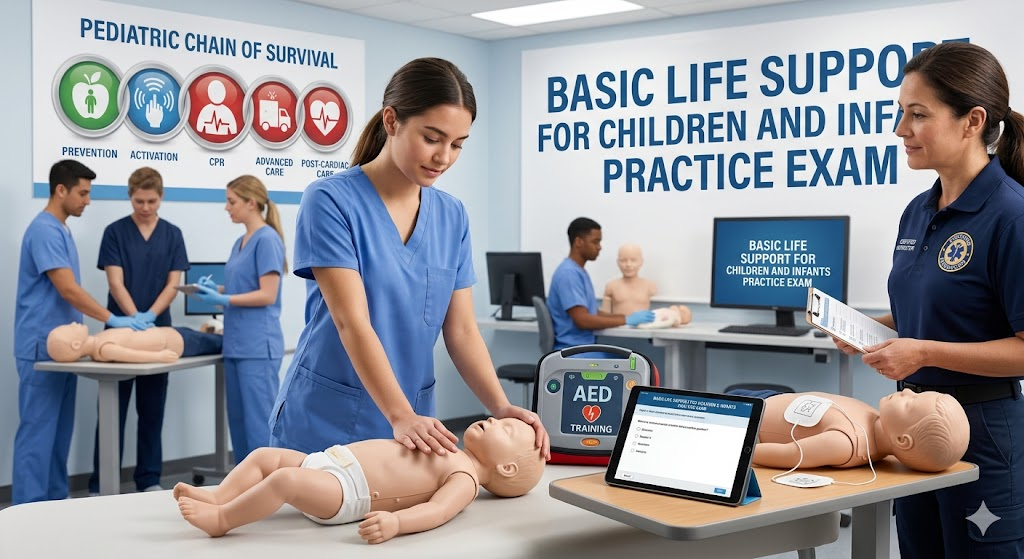
Additional Information
What the Course Entails and Exam Details
This comprehensive course teaches a structured approach to pediatric emergency care. Key topics and practical skills covered include the pediatric-specific Chain of Survival, which emphasizes prevention and rapid intervention. You will learn to identify the early signs of respiratory distress, respiratory failure, and cardiac arrest. Mastery of single-rescuer and multi-rescuer CPR techniques for both children and infants is central to the training, with a strong focus on maintaining proper compression depth and rates. The course also covers effective ventilation techniques using barrier devices and bag-mask systems, the safe and timely application of an Automated External Defibrillator (AED) on pediatric patients, and the specialized maneuvers required to relieve a choking emergency in a child versus an infant (abdominal thrusts vs. back slaps and chest thrusts). Understanding team dynamics and effective communication during a resuscitation attempt are also crucial elements of the curriculum.
What to Expect in the Final Exam
To achieve your BLS for Children and Infants certification, you must successfully complete two primary components in the final assessment. First, you will take a written cognitive exam, which is typically a multiple-choice test consisting of approximately 25 to 30 questions designed to evaluate your theoretical knowledge of the algorithms, ratios, and protocols. The passing score required is often 84% or higher, and the time limit is generally one hour, though many students complete it sooner. The second component is a practical skills testing session, where you must demonstrate your ability to perform high-quality CPR on infant and child manikins, use an AED, and provide effective ventilation under the observation of a certified instructor. Both parts are essential, ensuring you can apply the knowledge you have learned in a hands-on, real-world scenario. While the written exam may sometimes be taken online, the skills assessment must almost always be completed in person.
How to Study and Exam Centers
Effective preparation is the key to passing this test on your first attempt. Utilize the provider’s official handbook and study guide as your primary resource, paying close attention to the algorithms for different rescue scenarios. Engaging with practice exams is one of the most effective strategies; retaking them multiple times will help you become familiar with the question formatting and identify any gaps in your knowledge. Watch the skills videos provided in your course materials repeatedly, as these demonstrate the exact techniques your instructor will be looking for. When it comes to taking the exam, certifications must be completed through Authorized Training Centers. Major providers like the American Heart Association (AHA) and the American Red Cross have networks of authorized centers and licensed schools globally. Many institutions offer a "blended learning" option, which allows you to complete the written, cognitive portion online and then schedule a specific hands-on session for your skills testing.
Job Opportunities from the Course
Earning a Basic Life Support for Children and Infants certification is a highly valuable credential that can significantly enhance your career prospects, particularly in fields that involve working with the pediatric population. This certification is a prerequisite or a major asset for a diverse array of job opportunities, including:
Healthcare Provider:
Registered Nurse (RN) and Licensed Practical Nurse (LPN)
Certified Nursing Assistant (CNA)
Medical Assistant (MA)
Emergency Medical Technician (EMT) and Paramedic
Pediatric Dental Assistant
Physical or Occupational Therapy Assistant
Education and Childcare:
School Teacher (Preschool to K-12)
Daycare Center Provider
Nanny and Private Babysitter
After-School Program Coordinator
Public Safety and Recreation:
Lifeguard
Swim Instructor
Youth Sports Coach
Camp Counselor
Security Personnel working in venues with children
By investing the time to prepare for and pass the Basic Life Support for Children and Infants Practice Exam, you are not just earning a certificate; you are gaining the confidence and ability to make a life-saving difference for the most vulnerable in our communities.
Frequently Asked Questions
Reviews
5.0
Based on 0 reviews
Leave a Review
No reviews yet. Be the first to review!