
Basic Officer Leader Course (BOLC) 3 Practice Exam
$69.00
- Buy to unlock unlimited access to all Quiz questions and Answers in this Quiz.
- After purchase you can print a PDF of the whole quiz at any point. The PDF will contain the questions and the correct answers.
About this Exam
The Basic Officer Leader Course (BOLC) III, often referred to as the Branch-Specific Officer Leadership Course, represents a pivotal phase in a newly commissioned U.S. Army officer’s career. While BOLC I and II establish the baseline requirements and foundational soldier skills, BOLC III transitions Second Lieutenants into specialized experts within their specific branches—such as Infantry, Armor, Signal Corps, or Intelligence. This course is specifically designed for officers following their commissioning via ROTC, OCS, or the U.S. Military Academy, ensuring they possess the tactical and technical skills required to effectively lead a platoon in operations. It is a rigorous immersion into branch-specific methodologies, leadership responsibilities, and technical proficiency.
Ready to test your knowledge?
Buy Now to Access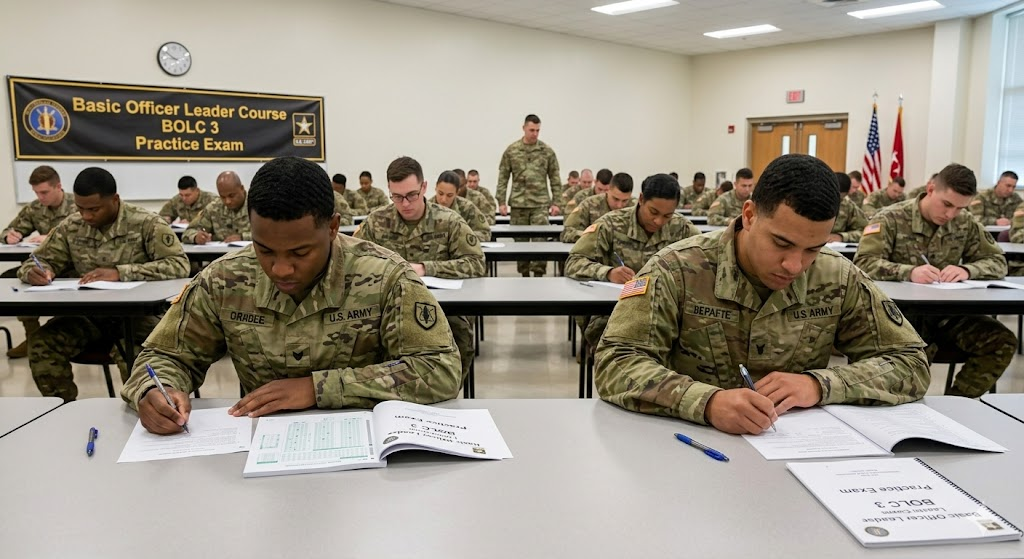
Additional Information
What the Course Entails and Exam Details
BOLC III is an immersive, residential course varying in length from several weeks to months, depending entirely on the specific branch. The core curriculum focuses heavily on tactical operations, technical branch skills, and advanced leadership philosophies relevant to the officer’s designated role.
Candidates can expect intense modules covering:
Branch-Specific Tactics: Mastering the doctrines, procedures, and deployment strategies unique to the assigned branch (e.g., small unit tactics for Infantry, network operations for Signal Corps).
Technical Systems and Equipment: Detailed, hands-on training and conceptual understanding of the weapons, communication systems, and platforms utilized by the branch.
Leadership and Ethics: Advanced application of command leadership, ethical decision-making, and platoon-level management responsibilities.
Physical and Mental Rigor: Continuous physical training, leadership evaluations under stress, and complex problem-solving scenarios in field environments.
The examination component is not a single sitting but rather a cumulative series of assessments, practical exercises, and field evaluations that test a Lieutenant's ability to synthesis these complex topics and apply them in real-world simulations.
What to Expect in the Final Exam
While the structure varies by branch (e.g., Infantry Officers face a different final evaluation than Finance Officers), the "final exam" of BOLC III is essentially the Capstone Exercise or culminating field training event (FTX).
Here is what candidates should prepare for:
Format: A comprehensive mix of written examinations testing doctrinal knowledge, tactical planning exercises (Operations Orders), and high-stakes practical leadership evaluations in a field setting.
Passing Requirements: Candidates must demonstrate competency across all evaluated areas. Performance is typically graded as "Go/No-Go" based on adherence to standards, leadership effectiveness, and technical accuracy. Failure in key areas or leadership evaluation may result in recycling or relief from the course.
Time Limit: Written components have specific time limits, while field exercises can last days or weeks, testing endurance and decision-making under stress.
Specific Rules: Strict adherence to Army standards, safety protocols, and the Uniform Code of Military Justice (UCMJ) is mandatory throughout all testing and evaluations.
How to Study and Exam Centers
Effective preparation for BOLC III begins long before arriving at the training installation. It requires a disciplined approach to both mental and physical fitness.
Actionable Study Strategies:
Master the Fundamentals: Solidify foundation from BOLC II, ROTC, or OCS. Revisit core soldier skills, land navigation, and the Army leadership requirements model.
Pre-Reading Branch Doctrine: Investigate the specific Field Manuals (FMs), Army Techniques Publications (ATPs), and technical guides relevant to your assigned branch (e.g., ATP 3-21.8 for Infantry Platoons).
Engage with Mentors: Seek advice from senior officers and instructors who have recently completed BOLC III to understand the current curriculum and common pitfalls.
Prioritize Physical Readiness: BOLC III demands exceptional physical condition. Arrive at a high level of fitness (APFT/ACFT standards) to handle the stresses of continuous field operations.
Exam Centers: BOLC III does not take place at civilian testing centers. It is exclusively conducted at designated U.S. Army training centers and authorized military schools. Each branch manages its own specific training location (e.g., Fort Moore for Infantry and Armor, Fort Eisenhower for Signal Corps).
Job Opportunities from the Course
Successfully completing BOLC III is not just a training prerequisite; it is the official certification that validates a Second Lieutenant is ready to lead. This course unlocks immediate leadership roles and career progression within the Army.
Career Paths and Roles:
Platoon Leader (Active Duty or Reserve/National Guard)
Company Executive Officer (XO)
Staff Officer roles (S-1 through S-6) within a battalion
Specialized leadership assignments (depending on branch and unit, e.g., Scout Platoon Leader, Ranger-qualified assignments)
Path toward competitive selection for further specialized schools (e.g., Airborne, Air Assault, Ranger School) and subsequent promotion to First Lieutenant and Captain.
Successful completion transitions an officer from a student to a practicing military leader, poised for a challenging and impactful career in service.
Frequently Asked Questions
Reviews
5.0
Based on 0 reviews
Leave a Review
No reviews yet. Be the first to review!