
Basic Officer Leader Course (BOLC) Aviation Tactics Practice Exam
$69.00
- Buy to unlock unlimited access to all Quiz questions and Answers in this Quiz.
- After purchase you can print a PDF of the whole quiz at any point. The PDF will contain the questions and the correct answers.
About this Exam
The BOLC Aviation Tactics Practice Exam is the essential preparation tool for newly commissioned United States Army officers undertaking the Basic Officer Leader Course (BOLC), specifically within the Aviation Branch.
This rigorous assessment simulates the critical thinking, decision-making, and tactical knowledge required of a junior Aviation officer in dynamic operational environments.
It is specifically designed for 2nd Lieutenants (2LTs) who have completed their initial training (ROTC, OCS, or USMA) and are transitioning to the specialized Aviation Phase.
This practice exam validates an officer's readiness to plan, integrate, and execute aviation operations in support of ground forces, ensuring they possess the fundamental skills necessary to lead soldiers and execute complex missions before proceeding to advanced flight training.
Ready to test your knowledge?
Buy Now to Access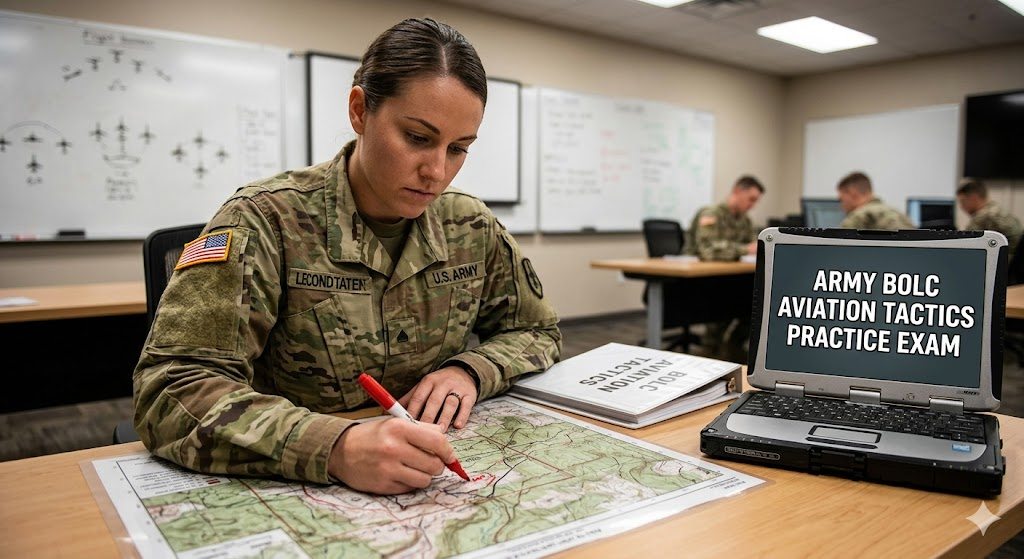
Additional Information
What the Course Entails and Exam Details
The Aviation Tactics phase of BOLC provides a comprehensive immersion into the application of Army Aviation doctrine.
The course content, which this practice exam mirrors, focuses heavily on operations, planning, and tactical integration.
Core topics covered within the comprehensive syllabus include:
Aviation Doctrine and Fundamentals: Mastery of key manuals such as ADP 3-0 (Operations), FM 3-04 (Army Aviation), and ATPs (Army Techniques Publications) relevant to aviation operations.
Tactical Mission Planning: Proficiency in the Military Decision Making Process (MDMP) or Troop Leading Procedures (TLP) to generate sound Operation Orders (OPORDs). This includes developing Courses of Action (COAs) and analyzing enemy and friendly forces (METT-TC).
Core Aviation Missions: Comprehensive understanding of the execution and employment of standard aviation roles, including Attack Reconnaissance (AR), Air Assault (AASLT), Air Movement, and Medical Evacuation (MEDEVAC).
Airspace Control and Integration: Knowledge of airspace coordinating measures, Joint Airspace Control, and methods to integrate aviation assets with ground forces and other joint platforms.
Threat Systems and Analysis: Understanding adversarial capabilities, including air defense assets, electronic warfare threats, and tactical employments.
What to Expect in the Final Exam
While the final assessment format is determined by the specific instructional cadre at the training center (e.g., Fort Novosel, formerly Rucker), candidates should prepare for a combined, comprehensive assessment style.
This structure often includes multiple evaluation components designed to test both theoretical understanding and practical application.
The exam usually consists of the following formats:
Multiple-Choice (Check on Learning): This section evaluates foundational knowledge of regulations, doctrine definitions, and theoretical tactical concepts. This is typically digital, taken within a Learning Management System (LMS).
Scenario-Based Planning Exercise (Practical Application): Candidates are often provided a detailed tactical scenario (e.g., "The enemy has a motorized platoon dug in at Objective Alpha; plan an Attack-Recon mission to neutralize.")
Map Exercises and Overlay Creation: Students must demonstrate the ability to translate planning concepts into visuals, generating clear tactical overlays depicting routes, landing zones, battle positions, and control measures.
Passing Score and Time Limits:
A passing score of 80% is the standard requirement across most Army academic evaluations, though students must confirm the precise benchmark with their instructors.
Time limits are strictly enforced, particularly during planning phases, to simulate the high-pressure environments of real-world operations. Candidates must produce complex plans within compressed timelines.
How to Study and Exam Centers
Preparation for the Aviation Tactics final requires a synthesis of independent study and collaborative planning exercises.
The following actionable strategies are proven paths to success:
Master the Practice Exam: Treat the BOLC Aviation Tactics Practice Exam not just as a diagnostic tool, but as a teaching aid. Analyze every incorrect answer, revisiting the specific doctrine it references. Identify patterns in the types of planning scenarios presented.
Immerse Yourself in Doctrine: Do not skim FM 3-04 (Army Aviation) or ADP 3-0 (Operations). Highlight key principles of attack and air assault operations. Create flashcards for definitions of tactical tasks and mission symbols.
Conduct Group "Sand Table" Exercises (STX): Tactics is rarely an individual sport. Organize study groups to brief OPORDs to each other based on hypothetical scenarios. Practice developing overlays under time constraints and cross-check each other’s plans for doctrinal flaws.
Utilize Physical Models and Overlays: Do not rely solely on digital tools. Practice drawing graphics on actual maps using acetate. This physically reinforces the "where and how" of operational control measures.
Exam Centers:
This certification (the completion of BOLC Aviation Phase) is an internal Army training prerequisite and is not delivered via public testing facilities like Pearson VUE or online open portals.
The final assessments (written and practical) are administered solely at authorized US Army training centers responsible for BOLC, primarily the US Army Aviation Center of Excellence (USAACE) at Fort Novosel, Alabama.
Note: The actual practice exams you find may be accessible via military networks (such as Blackboard or ALMS) or generated locally by the instructional cadres of specific cohorts.
Job Opportunities from the Course
Successfully completing the BOLC Aviation Phase and passing the subsequent evaluations is not just an academic achievement; it is the essential qualification that unlocks a dynamic career in Army Aviation.
Completion of BOLC allows an officer to officially transition to their initial flight training and subsequent job assignments.
This course is the direct gateway to the following specific leadership roles and career paths:
Aviation Platoon Leader (Attack/Recon, Assault, or Cargo): This is the immediate target job. Officers lead a platoon of aircraft and personnel (approx. 20-30 soldiers), executing missions and ensuring unit readiness.
Aviation Company Operations Officer (Assistant S-3): Responsible for short-range planning, tracking unit readiness, and assisting in the management of daily operations within an aviation company or battalion.
Aviation Maintenance Platoon Leader: Ensures the airworthiness and operational status of assigned aircraft, leading teams of maintenance specialists and managing complex logistics.
Future Career Progression: Passing BOLC sets the foundation for progression to critical leadership roles including: Aviation Company Commander, Aviation Battalion/Brigade Staff (e.g., S-3 Operations Officer, S-2 Intelligence Officer, or S-4 Logistics Officer), and ultimately, Command.
Frequently Asked Questions
Reviews
5.0
Based on 0 reviews
Leave a Review
No reviews yet. Be the first to review!